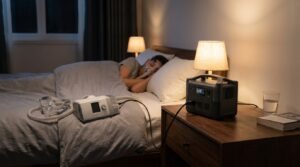
If you rely on a CPAP machine and you’re staring down a hurricane forecast or a winter storm warning, “will my power station last the night” isn’t a hypothetical question — it’s the one that actually decides whether you sleep safely.
Most articles on this topic hand you a vague “it depends” and move on. That’s not good enough when the thing depending on it is your breathing.
So let’s actually do the math, using real manufacturer numbers instead of guesses.
How Much Power Does a CPAP Machine Actually Use?
This is the number most guides skip, and it’s the one that matters most — because CPAP power draw varies a lot more than people expect, mostly because of the heated humidifier.
| CPAP Model | Watts (no humidifier) | Watts (humidifier on) |
|---|---|---|
| ResMed AirSense 10 AutoSet | ~53W average, 90–100W at max pressure | ~90–130W |
| ResMed AirSense 11 | ~56W typical | Up to ~73W typical, higher under load |
| Philips Respironics DreamStation Auto | ~45–91W | ~80–121W |
| Fisher & Paykel Icon Novo | ~40W average | ~75W max |
These figures come from manufacturer power supply ratings and independent CPAP power-draw testing, cross-checked against ResMed’s own AirSense 10 power specifications.
The gap between “humidifier off” and “humidifier on” is the single biggest variable in this whole calculation — it can nearly double your power draw, which means it can cut your runtime almost in half.
If you’re planning for an outage, that’s the first setting worth knowing about your own machine.
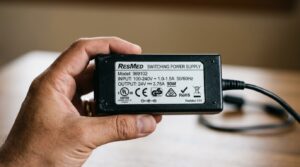
Every CPAP ships with a power supply unit that lists its rated wattage directly on the label — flip yours over before you do any of this math.
The numbers above are useful ballpark figures, but your specific unit’s label is the number that actually matters for your situation.
What “1000Wh” Really Means Once You Account for Inverter Loss
Here’s the part that trips people up: a “1000Wh power station” doesn’t actually give you 1000 usable watt-hours for a device like a CPAP that runs on AC power.
Take the Jackery Explorer 1000 as a concrete example, since it’s one of the most common 1000Wh-class stations on the market.
It has a rated capacity of 1002Wh, but that power has to pass through an inverter to convert the battery’s DC power into the AC power your CPAP actually plugs into. Real-world testing on this exact model has measured inverter efficiency in the 84–90% range, depending on the load.
Do the math conservatively at 85% efficiency, and 1002Wh becomes roughly 850Wh of usable AC power — not 1002Wh. That’s not a manufacturer flaw, it’s just how power conversion works, and it’s true of every power station on the market, not just this one.
Any runtime estimate that skips this step is already off by 10–15% before you’ve even factored in your specific CPAP.
The Real Math: How Many Hours (and Nights) You’ll Actually Get
Using that ~850Wh usable figure, here’s what a realistic 1000Wh-class power station actually gets you, across a range of CPAP settings:
| CPAP Power Draw | Estimated Runtime | Roughly How Many 8-Hour Nights |
|---|---|---|
| 40W (low pressure, no humidifier) | ~21 hours | ~2.6 nights |
| 60W (moderate pressure, humidifier on low) | ~14 hours | ~1.75 nights |
| 90W (higher pressure, humidifier on high) | ~9.4 hours | ~1.2 nights |
| 120W+ (high-output BiPAP with humidifier) | ~7 hours | Under 1 full night |
That range matters. If you assumed your CPAP pulled a flat “50 watts” — a number thrown around a lot online — and your machine is actually running its humidifier at a higher pressure setting closer to 100W, you could be planning for nearly three nights of backup when you actually have just over one.
That gap is exactly why generic runtime charts aren’t good enough for a device you depend on.
Things That Change the Math
A few real-world factors will shift these numbers in either direction, and they’re worth knowing rather than assuming away:
- Cold temperatures reduce usable battery capacity. Lithium battery packs can lose a meaningful chunk of their rated capacity in freezing conditions — a real concern if your power station is sitting in an unheated garage during a winter outage rather than indoors. This matters more for some battery chemistries than others; see our breakdown of LiFePO4 vs lithium-ion power stations if you’re shopping for a unit that holds up better in the cold.
- Battery age matters. A power station that’s a few years old and has been through hundreds of charge cycles won’t deliver its full original rated capacity.
- Heated tubing adds real draw. If your CPAP setup includes heated tubing in addition to a humidifier, that alone can add another 10–15 watts on top of the numbers above.
- Running other devices at the same time cuts into your total. If you’re also charging a phone or running a small fan off the same power station, that comes out of the same shared 850Wh pool.
- Altitude and pressure settings affect draw too — a higher prescribed pressure setting means the motor works harder, which pulls more watts. Never adjust your prescribed pressure to save power; that’s a conversation for your sleep physician, not a power-planning workaround.
Which Power Station Size Do You Actually Need?
If the math above is landing you short of the coverage you actually need — say you want three full nights of guaranteed runtime, not one and a half — the honest answer is that a single 1000Wh unit may not be enough on its own for a longer outage, especially with the humidifier running.
Options worth knowing about: stepping up to a 1500–2000Wh class station, pairing your unit with an expansion battery, or running the humidifier only on the first night and switching it off for subsequent nights to stretch your remaining capacity.
We break down exact sizing by outage length in our companion guide on choosing the right power station size for a multi-day outage, and if you’re weighing specific models against each other, our EcoFlow vs Jackery vs Bluetti recharge time comparison covers how they stack up beyond just the capacity number on the box.
If a CPAP isn’t the only thing you’re planning around, our guide on running a full-size fridge off a power station walks through the same kind of real-world math for that use case.
The Bottom Line
A 1000Wh-class power station will reliably get most CPAP users through one full night, and often close to two, if the humidifier stays off or low.
Once you’re running a heated humidifier at a higher pressure setting, plan for closer to one night per charge, not two or three.
The single most useful thing you can do before an outage isn’t buying a bigger battery — it’s checking the wattage label on your own CPAP’s power supply and doing this exact math with your real number, not an average pulled from a chart.
This article is for general power-planning purposes only. For guidance specific to your prescribed therapy settings, talk to your sleep physician or equipment provider — and always check your device’s power supply label for its exact rated wattage before relying on any backup power source.