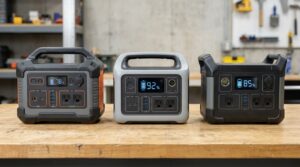
We’ve referenced a “1000Wh-class power station” throughout this series without picking a specific model, because the underlying math — inverter efficiency, runtime per watt, solar recharge — holds roughly true across brands. But when you’re actually buying one, the differences between the three biggest names in this space are real and worth knowing, especially around recharge speed, which matters more during an outage than almost any other spec.
The Three Models at a Glance
Here’s how the current mid-range flagship from each brand stacks up as of 2026:
| Spec | EcoFlow Delta 2 | Bluetti AC180 | Jackery Explorer 1000 v2 |
|---|---|---|---|
| Capacity | 1,024Wh | 1,152Wh | 1,070Wh |
| AC Output | 1,800W | 1,800W | 1,500W |
| Weight | ~27 lbs | ~36 lbs | ~23.8 lbs (lightest) |
| Price (approx.) | $399–499 | $499 | $799 |
| Max Solar Input | 500W | 500W | Not specified here — check current listing |
| Expandable Battery? | Yes, up to 3,072Wh | No — single closed system | Check current lineup |
Prices and exact specs shift often in this category — always confirm current numbers directly on the manufacturer’s site before buying, especially since new model generations tend to replace these roughly annually.
Recharge Speed: Wall Outlet
If you’re topping up before a forecasted storm, wall-outlet recharge speed is arguably the single most useful number on this whole table. Real-world testing puts the Bluetti AC180 at roughly 45 minutes for 0–80% via its fast-charge mode — the quickest of the three in independent tests. The EcoFlow Delta 2 has been measured at 50 minutes for the same 80% in one test, though other testing has put it closer to 80 minutes, suggesting real-world charge speed varies more with conditions and settings than the marketing numbers suggest. The Jackery Explorer 1000 v2 comes in around 58–60 minutes for the same benchmark. In a scenario where storms arrive in waves and you’re grabbing 30–60 minutes between them to top up, that gap between roughly 45 and 80 minutes is a genuinely practical difference, not just a spec-sheet curiosity.
Recharge Speed: Solar
This is where it’s worth connecting back to the real-world solar math we covered earlier in this series. One independent test found the Bluetti AC180 paired with its own 200W panel recharges from 0–100% in roughly 6–7 hours in direct sun — and pairing two of those panels together (400W total) cut that down to about 3.5 hours. That tracks closely with the “you need roughly double the naive panel wattage for a same-day recharge” conclusion from our solar chart. All three brands sell their own panel ecosystems, and mixing brands can introduce cable or connector compatibility issues — generally worth sticking with the same brand’s panels as your power station, or confirming compatibility before buying third-party.
Weight & Portability
If you’re moving the unit around — from a shelter to a car, up and down stairs, between rooms — this matters more than the spec sheet implies. The Jackery Explorer 1000 v2 at roughly 23.8 lbs is meaningfully lighter than the Bluetti AC180’s roughly 36 lbs, a gap one reviewer specifically flagged as relevant for anyone carrying a unit down steep shelter steps. The EcoFlow Delta 2 sits in between at around 27 lbs.
Expandability
If your outage-prep plan might grow over time — say, starting with CPAP and wifi coverage and later wanting enough capacity for a fridge too — expandability changes the long-term math. The EcoFlow Delta 2 supports adding external battery packs to reach up to 3,072Wh total, letting you scale up later rather than buying an entirely separate larger unit. The Bluetti AC180, by contrast, is a single closed system with no expansion path — what you buy is what you have. This is the same trade-off we’ll cover in more depth in our expandable battery power station breakdown.
Which One Fits Which Profile From Our Sizing Chart
Mapping these three back to the profiles from our power station sizing chart:
- Profile A/B (communication + medical devices) — any of the three comfortably cover this; the deciding factor becomes recharge speed and portability rather than raw capacity, since all three sit in the same ~1000–1150Wh range.
- Profile C (adding a laptop and lighting) — still comfortably covered by all three; the Delta 2’s expansion option is worth considering if you expect this profile to grow.
- Profile D (adding a fridge) — none of these mid-range units alone will comfortably cover a full day of fridge use, as we found in that breakdown; this is where the Delta 2’s expandability or pairing any of the three with solar recharging becomes the realistic path forward, not a single bigger single-unit purchase.
The Bottom Line
There’s no single “best” among these three — the honest answer depends on which spec you’re actually optimizing for.
Fastest wall-outlet recharge: Bluetti AC180. Best expansion path if your needs might grow: EcoFlow Delta 2. Lightest to carry: Jackery Explorer 1000 v2, at a real price premium.
If you take away one thing from this comparison, let it be that recharge speed and expandability matter more for real outage scenarios than the capacity number most people fixate on first — three power stations within 130Wh of each other on paper can behave quite differently once a storm actually hits.