Our power station sizing chart landed on an honest conclusion: for anything beyond a single day of light use, you’re not really solving a multi-day outage with a bigger battery alone — you need a way to recharge. For renters, “solar” sounds like it should be the answer.
But there’s a mix-up hiding in that word that could leave you with a $600 setup that does nothing during an actual blackout — so let’s clear that up first.
Two Completely Different Things Are Both Called “Balcony Solar”
This is the single most important thing to understand before you buy anything, and most product listings don’t make it obvious.
Grid-tied plug-in solar — the type that’s become newly legal across more U.S. states thanks to the UL 3700 safety standard finalized in 2025–2026 — plugs directly into a wall outlet and feeds solar power into your apartment’s existing wiring to offset your electric bill.
It’s genuinely useful for saving money. But it has a legally mandated safety feature that makes it useless in an outage: anti-islanding protection automatically shuts the system off the instant the grid goes down, so utility workers repairing lines aren’t at risk of electrocution from your panel feeding power back in.
As EcoFlow puts it plainly, for backup power during outages, you need an entirely different kind of system — grid-tied plug-in solar won’t provide it, by design.
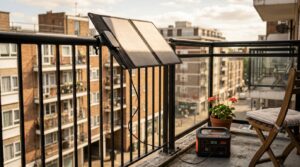
Portable off-grid solar generators, on the other hand — a folding solar panel paired with a portable power station — never connect to your home’s wiring or the grid at all. You run devices directly off the power station, which the panel recharges independently.
Because there’s no connection to the grid to protect, these systems keep working perfectly fine during a blackout, and they require no permits, since they’re legally treated as standalone portable appliances rather than home electrical modifications.
If your goal is outage backup — which, since you’re reading this pillar, it probably is — you want the second kind, not the first. Grid-tied plug-in solar is a genuinely good product for a different problem (lowering your monthly bill), but don’t buy one expecting it to help during the exact scenario this whole series is about.
What Your Lease Actually Allows
The good news: because a portable solar generator setup is entirely freestanding — no drilling, no permanent mounting, no electrical connection to the building — it sits in a much simpler category for renters than rooftop or hardwired systems.
Portable panels that lean against a railing or sit flat generally don’t require landlord sign-off the way drilling mounting brackets into a balcony would.
A few things still worth checking before you set up, since “generally fine” isn’t the same as “guaranteed fine everywhere”:
- Balcony weight and railing rules. Some buildings restrict what can be hung on or leaned against railings for structural or fire-code reasons — worth a quick check of your lease or a message to your landlord, especially for anything larger than a small foldable panel.
- HOA or condo association restrictions, if applicable, sometimes go further than a standard lease and restrict visible equipment on balconies entirely.
- Renters insurance coverage. If you go the grid-tied plug-in route for bill savings, using non-certified equipment could affect insurance coverage if it causes an electrical issue — another reason to stick with UL 3700-certified kits if you go that direction at all.
- Cable management. Keep charging cables away from walkways and away from standing water if your balcony isn’t covered — a basic safety step, not a lease issue, but worth building into your setup either way.
How Fast Will a Portable Panel Actually Recharge Your Power Station?
This is where the math from earlier in this series comes back in. A commonly cited real-world figure: a 220W portable panel can recharge a 1,024Wh battery in under six hours of good direct sunlight — enough over a full sunny day to meaningfully offset a router, some lighting, a laptop, or a fridge’s compressor cycles.
To translate that to your own setup: divide your power station’s rated capacity by your panel’s wattage, then add real-world buffer for clouds, imperfect sun angle, and panel inefficiency — realistically 60–75% of the panel’s rated output on a good day, less on an overcast one.
A 100W panel recharging a 1000Wh station, for example, isn’t a 10-hour job in ideal math — expect closer to 13–16 hours of actual sun-dependent charging, which usually means spreading it across a full day or two rather than one sitting.
Compared against the daily energy profiles from our sizing chart: a single 100–200W balcony panel won’t fully recharge a station running a full household load (Profile D) in one day, but it can meaningfully stretch a lighter setup — wifi, phone charging, some lighting (Profiles A or B) — closer to indefinite runtime as long as the sun keeps showing up, which is exactly the “recharge plan instead of a bigger battery” strategy that sizing chart pointed to.
What to Actually Look For When Buying
- Match panel wattage to your power station’s charging input limit. A bigger panel than your station can accept won’t charge any faster — check your station’s max solar input spec before buying a large panel.
- Foldable/portable panels over rigid mounted ones, unless you’ve specifically confirmed mounting is allowed — foldable panels can be angled toward the sun and moved indoors easily, which also solves storage and weather concerns.
- UL 3700 certification only matters if you’re going the grid-tied plug-in route for bill savings — it’s not relevant to a standalone portable panel-and-battery setup, since those aren’t connecting to your home’s wiring at all.
- Check the actual charging cable/connector compatibility between the panel and your specific power station brand — not all panels and stations are cross-compatible without an adapter.
The Bottom Line
If you’re a renter shopping for “balcony solar” with an outage in mind, skip anything that plugs into a wall outlet — it’s built for bill savings, and it’s designed by law to shut off exactly when you’d need it most.
A portable solar panel paired with your power station is the setup that actually keeps working when the grid doesn’t, needs no landlord approval in most cases, and — paired with the sizing math from earlier in this series — is the realistic path to stretching a single power station from “one day of backup” toward “indefinite, as long as the sun cooperates.”