It’s 4 PM. Your eyes feel like sandpaper. You have a dull throb behind your temples. Welcome to “Computer Vision Syndrome.” The internet says the cure is Blue Light Glasses.
I know the ones—they have yellow-tinted lenses and promise to block the “harmful rays” from your monitor that destroy your sleep and fry your retinas. But are they legitimate medical science, or just a clever way to sell cheap plastic frames for $50?
I am not a scientist, but I am a freelancer who stares at screens for 10 hours a day. I bought five pairs—ranging from $15 gas station glasses to $95 “premium” frames—to see if they actually cure the headache.
The Science (Briefly)
Screens emit blue light. The sun also emits blue light (a lot more of it). The theory is that blue light suppresses melatonin (the sleep hormone).
Staring at it all day tricks your brain into thinking it’s noon, wrecking your sleep cycle. It also scatters more easily in the eye, reducing contrast and forcing your eyes to strain to focus.
The Reality: The American Academy of Ophthalmology says blue light from digital screens doesn’t damage eyes. The strain comes from not blinking enough and focusing at a fixed distance. So… is it a placebo?
The Experiment
I wore different glasses for one week each. The Control Week (No Glasses):
-
End of day status: Dry eyes, mild headache, trouble falling asleep before 12:30 AM. Week 1: The $15 Amazon Pair (Yellow Lens)
-
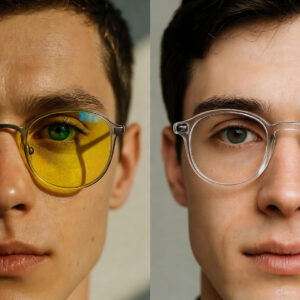
The Look: I looked like a character from Breaking Bad. The yellow tint was intense.
-
The Feeling: The screen instantly felt “softer.” The harsh white background of Google Docs turned into a warm cream color.
-
The Result: My eyes felt less tired. I blinked more because the light wasn’t piercing. However, doing color-sensitive design work was impossible (everything looked yellow). Week 2: The $95 “Premium” Pair (Clear Lens)
-
The Look: Looked like normal hipster glasses. No yellow tint.
-
The Feeling: Subtle. I barely noticed a difference in screen color.
-
The Result: I honestly felt… nothing. They claimed to block “40% of blue light,” but without the tint, the screen still felt bright and harsh. I got a headache on Tuesday.
The “Placebo” Effect?
Here is the truth I discovered: The glasses work, but not because of the blue light blocking. They work because they create a physical barrier.
-
Airflow: They stop the AC/Fan from blowing air directly into your eyes, keeping them moist.
-
Focus: The slight tint increases contrast (like sunglasses), making text pop a bit more.
-
The Ritual: Putting them on signals “Work Mode.” Taking them off signals “Rest Mode.”
Should You Buy Them?
Don’t buy the expensive ones. If you are buying clear-lens blue light glasses for $100 hoping for a miracle, save your money. Just turn on “Night Shift” or “f.lux” on your computer (it’s free software that turns your screen yellow). DO buy the cheap ones IF:
-
You work late at night (past 9 PM). The yellow tint absolutely helps your brain wind down.
-
You have intense light sensitivity.
-
You just want to look smart on Zoom.
My Verdict
If you have headaches, try the 20-20-20 Rule first (Every 20 minutes, look at something 20 feet away for 20 seconds). If that fails, spend $20 on Amazon for a basic pair of yellow-tinted computer glasses. They act as “sunglasses for your monitor.” They aren’t magic, but they take the edge off a 10-hour coding marathon.
Read Also:
The $300 Home Office: How to Fix Your Back Without Going Broke (2026 Guide).