Last October, I invoiced $9,200 in a single month. Two months later, I made $1,100. Same business, same skills, same client roster — just the normal rhythm of freelance work. If you’ve felt that whiplash, you already know why budgeting apps built for a steady paycheck don’t hold up for freelancers – Budget with Irregular Income as a Freelancer.
Traditional budgeting tells you to plan around your “monthly income.” But when your monthly income swings by 5x or more, that advice doesn’t just fall short — it actively sets you up to overspend in good months and panic in bad ones. This is the core problem with budgeting for freelancers with irregular income: the system assumes stability that doesn’t exist.
What actually works is a system that separates what you’re paid from what you spend. That gap is where stability lives. Below is the exact method I use — the Baseline + Buffer system — tested across eighteen months of genuinely unpredictable freelance income, including a three-month dry spell that would have wrecked a normal budget.
By the end of this article, you’ll know how to calculate your true baseline income, set up the accounts that protect you, and apply a simple percentage rule every time a payment lands — so a $9,200 month and a $1,100 month both feel manageable.
Why Traditional Budgets Fail Freelancers
Most budgeting frameworks — the 50/30/20 rule, envelope budgeting, even most banking apps — assume one thing: a predictable monthly deposit. They tell you to divide that number into categories and track spending against it. That works fine if you get a salary. It breaks immediately if your income is irregular.
The first mistake freelancers make is budgeting from an average. If you made $60,000 last year, it’s tempting to budget as if you make $5,000 a month. But averages hide the timing problem. You don’t get $5,000 every month — you might get $11,000 in March and $400 in April. If your fixed costs are built around the average, the low months force you into debt or into raiding savings meant for taxes.
The second issue is emotional. Feast months create a false sense of security that leads to lifestyle creep — a nicer dinner, a spontaneous purchase, a “I earned this” upgrade. Famine months create the opposite: stress-driven cost-cutting, missed payments, or dipping into whatever cash is available, including tax money. Over a year, this cycle is exhausting even when the total income is genuinely fine. The problem was never the income. It was the absence of a system to smooth it out.
The Core System: Baseline + Buffer Method
This system has one job: convert unpredictable client payments into a predictable personal salary, without ever touching money that’s already earmarked for taxes or emergencies. It works in five steps.
Step 1: Calculate Your Baseline (Survival Number)
Your baseline is not your average income. It’s your safe income — the number you can count on even in a bad stretch. Here’s how to find it:
- Pull your last 6–12 months of actual deposits (not invoiced amounts — money that actually landed).
- Rank the months from lowest to highest.
- Take the average of your three lowest months.
That number is your baseline. If your worst three months were $1,100, $1,800, and $2,300, your baseline is $1,733. This is deliberately conservative. You’re not trying to capture your potential — you’re trying to find the floor you can build on.
Step 2: List Only Tier 1 Essential Expenses
Tier 1 expenses are the non-negotiables: rent or mortgage, utilities, groceries, insurance, minimum debt payments, and any recurring business costs required to keep working (software, hosting, a laptop payment). Everything else — subscriptions, dining out, upgrades, travel — is Tier 2 and gets funded separately, only in good months.
Add up your Tier 1 costs. If they’re higher than your baseline number from Step 1, that’s useful information on its own: it tells you exactly how much runway or cost-cutting you need before this system can fully protect you.
Step 3: Set Your Personal “Salary”
Your salary is a fixed number you pay yourself on a set schedule — weekly, biweekly, or monthly — regardless of what clients paid you that week. This number should sit at or slightly below your baseline from Step 1, so it’s sustainable even during a slow stretch. This salary comes from your Buffer account, not directly from client payments.
Step 4: Create a Buffer / Income-Smoothing Account
Open a separate account — ideally a high-yield savings account — that exists purely to absorb the highs and lows. Every client payment goes here first. Your personal salary gets transferred out of this account on your fixed schedule. This one separation is what actually breaks the feast-or-famine cycle, because your spending life is now connected to a steady transfer, not to whichever client happened to pay you that week.
Step 5: Apply Percentage Allocation the Moment Payment Arrives
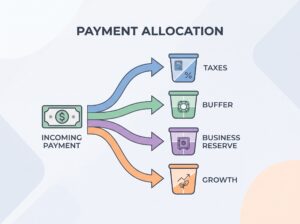
The moment a payment hits your Buffer account, split it immediately using fixed percentages — before you have a chance to “decide” what to do with it. A workable starting split:
| Category | Percentage | Purpose |
|---|---|---|
| Taxes | 25–30% | Moved instantly to a separate tax-only account |
| Buffer / Salary funding | 45–55% | Stays in the Buffer account to fund your fixed salary |
| Business reserve | 10% | Covers software, equipment, slow-season costs |
| Growth / Tier 2 spending | 10–15% | Unlocked only after 3 months of full buffer coverage |
Here’s how that looks on two real payments:
| Payment Amount | Taxes (28%) | Buffer/Salary | Business Reserve (10%) | Growth (12%) |
|---|---|---|---|---|
| $6,000 | $1,680 | $2,880 | $600 | $840 |
| $2,500 | $700 | $1,200 | $250 | $350 |
Notice the percentages stay identical regardless of the payment size. That consistency is what makes the system easy to run — you’re not recalculating anything, you’re just applying the same split every time.
How to Handle Feast Months vs. Famine Months
The system only works if you have exact rules for the extremes, so you’re never negotiating with yourself in the moment.
Feast month rules: Once your Buffer account holds at least 3 months of your fixed salary, anything above that threshold gets split between your business reserve and your Growth/Tier 2 category. Do not raise your salary just because one month was strong — wait until three consecutive months confirm a genuinely higher baseline before adjusting Step 1’s number.
Famine month rules: If a payment doesn’t arrive and your Buffer account would drop below one month of salary coverage, pause all Tier 2 spending immediately and pull only from the Buffer — never from the tax account. If the Buffer itself is insufficient, that’s a signal to temporarily lower Tier 2 spending in the following month, not to skip taxes or rent.
The decision framework is simple: check the Buffer balance before you check your feelings. If it’s above three months of salary, you have flexibility. If it’s below one month, you’re in protection mode. Everything else is business as usual.
Tools That Make This Easy
You don’t need expensive software to run this. A few practical, low-cost options:
- A high-yield savings account for the Buffer, ideally with sub-accounts or “buckets” so taxes, reserve, and salary funding can sit visibly separate.
- A basic spreadsheet (or a free template) to log each payment, the percentage split, and running balances — this alone gives you the visibility most freelancers are missing.
- A bank that supports multiple free checking/savings accounts, so you can physically separate salary, taxes, and business reserve rather than tracking it mentally in one account.
The tool matters far less than the consistency of applying the percentage split the moment money arrives. A $0 spreadsheet used every time beats a $20/month app used occasionally.
Common Mistakes That Break the System
- Skipping the split on “small” payments. A $300 payment feels too small to bother splitting — but skipped splits compound into a missing tax cushion by year-end.
- Raising your salary after one good month. One strong month is not a new baseline. Wait for three in a row before adjusting Step 3.
- Treating the tax account as accessible. The moment you borrow from taxes “just this once,” the system stops protecting you from the exact problem it was built to solve.
- Funding Tier 2 spending before the Buffer threshold is met. Growth spending should be a reward for a stocked buffer, not a hope that the next payment arrives on time.
- Recalculating the baseline too often. Constantly moving the baseline up during good stretches erases the safety margin the whole system depends on.
Real Example Walk-Through
Here’s how three real consecutive months might flow through the system, using a $2,000 baseline salary.
Month 1 (high — $8,000 collected): Split immediately: $2,240 to taxes, $4,000 to Buffer, $800 to reserve, $960 to growth. Salary of $2,000 is transferred out on schedule; Buffer now holds $2,000 surplus above the immediate salary need.
Month 2 (average — $3,200 collected): Split: $896 to taxes, $1,760 to Buffer, $320 to reserve, $224 to growth. Combined with Month 1’s surplus, the Buffer comfortably covers this month’s $2,000 salary with room left over.
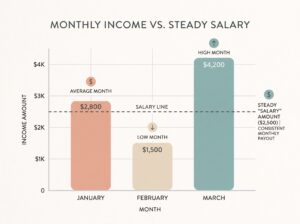
Month 3 (low — $900 collected): Split: $252 to taxes, $495 to Buffer, $90 to reserve, $63 to growth. This alone doesn’t cover the $2,000 salary — but because Month 1 and 2 built a surplus in the Buffer, the salary still transfers on schedule. No panic, no missed rent, no dipping into taxes.
That’s the entire point of the system: the reader never has to feel Month 3 the way they would have without a buffer already in place.
Conclusion + Next Steps On how to Budget with Irregular Income as a Freelancer.
To recap the system in five steps:
- Calculate your baseline using your three lowest months of real income, not your average.
- List only true Tier 1 essential expenses and set a salary at or below your baseline.
- Route every payment into a dedicated Buffer account before it touches your spending life.
- Split every payment the moment it arrives, using fixed percentages for taxes, buffer, reserve, and growth.
- Follow clear feast and famine rules so you never have to guess what to do with a big or small payment.
The system doesn’t require a bigger income to work — it requires separating what you earn from what you spend, and doing it consistently. Set up your accounts this week: one for taxes, one as your Buffer, and a fixed salary transfer date. That’s the whole foundation.
If you haven’t already, it’s worth pairing this with a clear line between business and personal money — see our guide on Separating Business & Personal Finances — and building the habit of not spending everything the moment a good month hits, covered in Stop Spending Everything in Good Months.
Irregular income doesn’t have to mean irregular stress. Build the system once, and the math does the steadying for you.
Read Also:
I Tried ‘Cash Stuffing’ for 30 Days: Did I Save Money or Just Look Weird?.