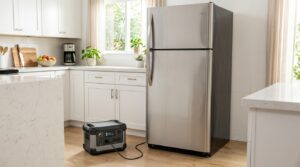
Of everything we’ve run the numbers on for this series — CPAP machines, wifi routers — the fridge is where the marketing gets the most misleading. Product listings love to show a power station “running a refrigerator,” and it’s technically true, but the number that actually determines whether your food survives a multi-day outage isn’t “can it run” — it’s “for how long, and can it even start it in the first place.”
Let’s separate those two questions properly.
How Many Watts Does a Full-Size Fridge Actually Use?
There are two completely different numbers here, and mixing them up is the single biggest mistake in fridge backup planning.
Running watts (also called continuous or rated watts) is what the fridge draws once the compressor is already going. For a modern full-size refrigerator, that’s typically 100–250 watts, though older or larger units can run 400–800 watts.
Starting watts (or surge watts) is the brief spike when the compressor motor first kicks on — and it’s dramatically higher. That surge is commonly 2 to 5 times the running wattage, lasting a fraction of a second, but if your power source can’t supply it, the fridge simply won’t start — it’ll click and stop, over and over.
| Fridge Type | Running Watts | Starting/Surge Watts |
|---|---|---|
| Modern, efficient full-size fridge | 100–250W | 600–1,200W |
| Standard/older full-size fridge | 400–800W | 1,200–1,600W |
| Compact/mini fridge | 70–100W | 280–360W |
Why the Surge Number Matters More Than the Running Number
This is the part most marketing conveniently skips. A power station’s continuous output rating tells you what it can sustain — but its surge rating is what determines whether the fridge starts at all. Take a 1000W-class station like the Jackery Explorer 1000: it’s rated for 1,000W continuous with a 2,000W surge capacity.
That surge headroom comfortably covers most modern fridges’ starting watts (600–1,600W), but it’s worth double-checking against your specific fridge — an older or larger unit pushing toward the top of that surge range doesn’t leave much margin.
If you’re shopping for a station specifically to run a fridge, surge capacity — not just the Wh number on the box — is the spec to check first. We compare how different models handle this in our EcoFlow vs Jackery vs Bluetti breakdown.
The Real Math: How Long Will It Actually Run?
Here’s where fridges behave differently from something like a CPAP or router — they don’t draw power continuously. The compressor cycles on and off to maintain temperature, so the running-watts number only applies part of the time.
The more useful figure is daily energy consumption, usually somewhere in the 1–2 kWh (1,000–2,000Wh) range per day for a typical modern full-size fridge, though larger, older, or frequently-opened units run higher.
Using the same ~850Wh of usable AC power we calculated for a 1000Wh-class station in our CPAP runtime breakdown:
| Fridge Daily Consumption | Runtime on an 850Wh Usable 1000Wh Station |
|---|---|
| ~1 kWh/day (efficient, modern) | ~20 hours (just under 1 full day) |
| ~1.5 kWh/day (average) | ~13.6 hours (~half a day) |
| ~2 kWh/day (older or larger unit) | ~10 hours or less |
That lines up with real-world independent testing, too — one hands-on test measured a Jackery Explorer 1000 running a full-size LG 26 cu. ft. French door refrigerator continuously for 10.27 hours before depleting, which sits right in the range this math predicts for a larger unit.
The honest takeaway: a single 1000Wh-class power station will typically get a full-size fridge through less than a day of continuous backup, not several days. If you’re planning for a multi-day outage and the fridge is a priority, you’re looking at either a much larger station, an expansion battery pack, or a strategy for reducing how much the fridge actually needs to run — which brings us to the next section.
Should You Run It Continuously, or Ration It?

Because refrigerators are insulated boxes, not devices needing constant power, you don’t actually need to run the power station nonstop to keep food safe. A few practical approaches that stretch your runtime meaningfully:
- Keep the door closed as much as possible. Every time it opens, warm air gets in and the compressor has to work harder to recover — directly increasing the energy draw for that cycle.
- Run the power station only during the day, and let the fridge coast overnight on its own insulation (a well-sealed, mostly full fridge can safely hold temperature for several hours unpowered).
- Consider an expansion battery if you already own a station that supports one — that’s usually a cheaper way to add runtime than buying an entirely second unit. We cover whether that’s worth it in our expandable battery power station breakdown.
- A full fridge holds cold longer than an empty one. Thermal mass from the food itself acts as backup insulation if the power does need to cut out for a stretch.
The Bottom Line
A 1000Wh-class power station can absolutely start and run a full-size fridge — the surge capacity on most modern units handles that fine — but “can run it” and “can run it for a three-day outage” are two very different promises, and only one of them is usually printed on the box.
Plan on roughly half a day to just under a full day of continuous runtime from a single 1000Wh unit, and build your outage strategy — door discipline, overnight coasting, or a bigger battery — around that real number rather than the marketing photo of a fridge plugged into a power station.