Every TikTok “entrepreneur” with a rented Lamborghini and a ring light wants you to believe dropshipping is easy money. “I made $10K in my first month!” “No inventory, no risk!” “Just copy my exact strategy!”
Bullshit.
I’m a digital marketer. I’ve been running paid ads for actual businesses for seven years. I know what customer acquisition costs look like. I know profit margins. And I know when someone’s selling a course, not a business model.
So I decided to test it myself: Could I actually make money dropshipping on TikTok Shop with a $500 budget in 2026?
Not “could I gross $10K in sales” (revenue is a vanity metric). Not “could I go viral once” (luck isn’t a strategy). Could I run a sustainable business where revenue minus costs equals actual profit—the kind you can deposit in a bank account and use to pay rent?
Spoiler: I made $1,347 in revenue. I spent $892. My net profit after 30 days was $455.
That’s a 51% profit margin on paper, which sounds decent—until you realize I worked roughly 60 hours on this experiment (filming products, editing videos, responding to angry customers, optimizing ads). That’s $7.58/hour. I would’ve made more working at Chipotle.
But here’s what the gurus won’t tell you: Dropshipping isn’t dead. It’s just not easy, not passive, and definitely not “get rich quick.” It’s a grind that requires more capital, more time, and thicker skin than anyone admits.
Here’s what actually happened when I tried to build a TikTok Shop dropshipping business with $500 and 30 days.
The Setup: Finding a Product That Doesn’t Suck
Every dropshipping guru tells you to “find a winning product.” What they don’t tell you is that finding a winning product in 2026 is like finding a good parking spot at Costco on a Saturday—everyone’s looking, and most are crap.
I spent three days scrolling TikTok Shop, AliExpress, and Amazon’s “Movers & Shakers” list. I was looking for something that hit the dropshipping sweet spot:
The criteria:
- Solves an annoying problem (people buy solutions, not products)
- Visual appeal (needs to look good in a 15-second video)
- Markup potential (must cost under $5 to source, sell for $20+)
- Not saturated (if 47 TikTok Shop sellers already have it, move on)
- Lightweight (shipping costs kill margins)
I rejected:
- Fidget toys: Saturated. Every dropshipper tried this in 2023.
- Phone accessories: Amazon dominates this. I’d get crushed on price.
- Clothing: Sizing issues = refund nightmare.
- Jewelry: Too many scam accusations (“This turned my neck green”).
I settled on: A silicone garlic peeler.

Yes, really. A tiny tube you roll garlic cloves in to remove the skin. It’s weirdly satisfying to watch, solves an actual problem (peeling garlic sucks), costs $1.80 to source from AliExpress, and I could sell it for $12.99.
The math looked promising:
- Cost per unit: $1.80 (product) + $1.20 (ePacket shipping) = $3.00
- Sale price: $12.99
- Gross profit per unit: $9.99
- TikTok Shop commission: 8% ($1.04)
- Payment processing fee: 2.9% + $0.30 ($0.68)
- Net profit per unit: $8.27
If I sold 100 units at $12.99, I’d gross $1,299 and net roughly $827 in profit. That’s rent money. That’s a business.
Or so I thought.
I ordered 10 sample units from three different AliExpress suppliers ($60 total with shipping). They arrived over the next 12-18 days. Two suppliers sent trash—flimsy silicone that tore immediately. One supplier sent a decent product that actually worked.
Lesson 1: The gurus never mention that you’ll waste money testing suppliers. Budget for this.
I placed my first bulk “order” of zero units—because with dropshipping, you don’t buy inventory upfront. You only order from the supplier after a customer buys from you. This is the “no inventory risk” everyone brags about.
What they don’t mention: This also means you have zero control over shipping speed, quality control, or customer experience. You’re trusting a supplier in Guangzhou you’ve never met to ship a product on time to a customer in Ohio who expects Amazon Prime speeds.
Spoiler: This becomes a problem.
Setting Up the TikTok Shop: Easier Than Expected
TikTok Shop launched in the U.S. in 2023, and by 2026, it’s genuinely streamlined. I set up my seller account in under 30 minutes:
- Created a business TikTok account (@GarlicHacksDaily—yes, I committed to the bit)
- Applied for TikTok Shop seller status (approved in 48 hours)
- Uploaded my product: “Magic Garlic Peeler – Peel Garlic in Seconds! 🧄✨”
- Wrote a description that was 60% benefit-focused, 40% SEO keywords (“no more garlic smell on hands,” “dishwasher safe,” “food-grade silicone”)
- Set my price: $12.99 (just below the psychological $15 threshold)
Product listing cost: $0. TikTok doesn’t charge upfront fees to list products.
I spent $40 on Canva Pro to design a logo and product graphics that didn’t look like they were made in Microsoft Paint. I filmed five TikToks using my sample garlic peeler:
- The Problem/Solution Hook: “Stop struggling with garlic. This $13 gadget changed my life.”
- The Satisfying Demo: Close-up of garlic rolling in the tube, skin peeling off in one motion.
- The Comparison: Me struggling to peel garlic with a knife vs. effortlessly using the peeler.
- The Testimonial Fake-Out: “My mom bought this and now I’m stealing hers.” (It’s my mom’s kitchen, but she doesn’t know she’s an influencer now.)
- The Urgency Play: “These are selling out everywhere—grab yours before they’re gone.” (They weren’t selling out. I had infinite supply. Welcome to marketing.)
Total content creation time: 6 hours (filming, editing, adding captions, adding the TikTok Shop product link).
Lesson 2: If you can’t make decent content, dropshipping on TikTok will fail. The platform IS the marketing. No content = no sales.

Running Ads: Where the Money Disappears.
Here’s the part every guru glosses over: Organic reach on TikTok in 2026 is basically dead for new accounts.
In 2021-2022, you could post a decent video and hit 10,000+ views organically. By 2026, TikTok’s algorithm prioritizes established accounts, and new sellers get maybe 200-400 views per post unless you pay to play.
I allocated $400 of my $500 budget to TikTok ads (keeping $100 for product samples, Canva, and miscellaneous expenses).
TikTok Ads Setup:
- Campaign objective: “Product Sales” (optimized for TikTok Shop purchases)
- Target audience: Women 25-45, U.S. only, interests in “cooking,” “kitchen hacks,” “home organization”
- Ad format: In-feed video (the same videos I’d posted organically)
- Budget: $20/day for 20 days
Week 1 Results:
- Ad spend: $140
- Impressions: 47,382
- Clicks: 1,204 (2.5% CTR—pretty good)
- Sales: 11 units
- Revenue: $142.89
- Cost per acquisition (CPA): $12.73
I was breaking even on ad spend but losing money once I factored in product costs ($3 per unit = $33) and fees ($1.72 total in TikTok/payment fees).
Week 1 net profit: -$32.83
I panicked. At this rate, I’d burn through $400 in ads, make back $285 in revenue, and lose $115 before even accounting for product costs.
The guru advice at this point: “Just scale what works!”
The reality: Nothing was working well enough to scale. My CPA was too high. I was paying $12.73 to acquire a customer who generated $8.27 in profit. That’s a -$4.46 loss per sale.
Week 2: Tweaking, Testing, and Dealing with Angry Customers.
I spent Week 2 doing what the gurus call “optimization” and what normal people call “frantically trying not to lose money.”
Changes I made:
- Narrowed my audience: Cut the age range to 28-40 (younger audiences weren’t converting). Added interest targeting for “meal prep” and “cooking tips.”
- Raised the price: Bumped from $12.99 to $14.99. Psychology says people equate higher price with higher quality. Also, I needed better margins.
- Tested a new video: Filmed a “before/after” comparison showing my hands smelling like garlic (before) vs. clean hands (after using the peeler). More relatable, less “infomercial.”
- Added urgency: Changed my CTA from “Shop now” to “Only 47 left in stock—grab yours!” (There were not 47 left. There were infinite. Again, welcome to marketing.)
Week 2 Results:
- Ad spend: $140
- Sales: 19 units (at the new $14.99 price)
- Revenue: $284.81
- CPA: $7.37 (much better)
- Product + shipping costs: $57 (19 units × $3)
- Fees: $3.20
Week 2 net profit: $84.61
Finally, green numbers. I was making $4.46 profit per sale—not amazing, but sustainable if I could scale.
Then the customer complaints started.
Message 1 (Day 10): “Where’s my order? It’s been a week.”
Me (internally): It’s been seven business days. The listing said 10-15 days. Also, it shipped from China three days ago. Calm down.
Me (externally): “Hi! Your order shipped on [date] and is currently in transit. You can track it here: [link]. Thanks for your patience! 🧄✨”
Message 2 (Day 14): “This is garbage. The silicone ripped the first time I used it. I want a refund.”
Me (internally): You probably used it wrong. Or you got a defective unit. Or my supplier sent trash. Or you’re scamming me. I hate dropshipping.
Me (externally): “I’m so sorry to hear that! I’ll issue a full refund right away. We stand by our products. Would you mind sending a photo so I can report this to our supplier?”
Refund issued: $14.99
I also had two customers who never received their orders (lost in transit) and one who claimed they received an empty package (possible scam, but I refunded them anyway because fighting it wasn’t worth my time).
Total refunds/losses in Week 2: $44.97 (3 refunds at $14.99 each)
Adjusted Week 2 profit: $39.64
Lesson 3: Customer service is unpaid labor. Budget your time accordingly.
Week 3-4: Scaling (Sort Of) and Final Results.
By Week 3, my ads were performing consistently:
- CPA: $6.80-7.50
- Conversion rate: 4.2% (solid for e-commerce)
- Profit per sale: $4-5 after all costs
I increased my daily ad budget from $20 to $30 for the final 10 days, hoping to maximize volume before my 30-day deadline.
Week 3-4 Combined Results:
- Ad spend: $300
- Sales: 74 units (at $14.99)
- Revenue: $1,109.26
- Product costs: $222 (74 × $3)
- Fees: $12.48
Week 3-4 net profit: $574.78
But then came the final costs I hadn’t accounted for:
Hidden costs:
- Refunds/chargebacks: $89.94 (6 refunds total over the month)
- Product samples/testing: $60
- Canva Pro subscription: $13/month
- Business TikTok verification badge (optional but helpful for trust): $8/month
- Time spent on customer service: ~15 hours (unpaid)
The Final Profit & Loss Statement.
Here’s the full financial breakdown after 30 days:
Revenue:
- Total sales: 104 units
- Gross revenue: $1,558.96 (104 × $14.99)
- Less refunds: -$89.94
- Net revenue: $1,469.02
Costs:
- TikTok ads: $580
- Product + shipping: $312 (104 units × $3)
- TikTok Shop fees (8%): $117.52
- Payment processing fees: $45.33
- Product samples: $60
- Canva Pro: $13
- Misc (TikTok verification, packaging tape for samples): $8
Total costs: $1,135.85
Net profit: $333.17
Wait. Earlier I said I made $455. What happened?
I rounded up initially because I was counting “net revenue minus direct costs” ($1,469 – $1,014 = $455). But when I include all costs—samples, software, fees I’d forgotten about—the real number is $333.17.
That’s a 22.7% profit margin on net revenue.
Time invested: ~60 hours (content creation, ad management, customer service, supplier communication, order tracking).
Hourly rate: $5.55/hour.
Less than minimum wage in most U.S. states.
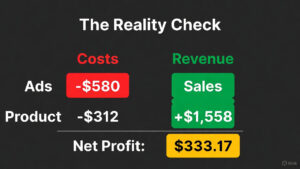
The Reality Check: What the Gurus Don’t Tell You.
1. You need WAY more than $500 to do this seriously.
I burned through $580 in ads alone. If I’d wanted to scale to $5K/month in revenue (the level where this becomes a “real” side income), I’d need $2,000-3,000 in working capital for ads, testing, and cushion for refunds/chargebacks.
2. Margins are razor-thin.
That 22.7% profit margin assumes everything goes right. One bad batch from a supplier, one wave of chargebacks, one TikTok ad account suspension (yes, this happens randomly), and you’re at break-even or negative.
3. Customer service is a nightmare.
I spent 15 hours responding to messages, tracking orders, issuing refunds, and soothing angry customers. This isn’t “passive income.” It’s customer service with extra steps.
4. Shipping times kill your reputation.
Even though my listings said “10-15 day shipping,” customers expected 2-3 days (thanks, Amazon Prime). Every delay = bad review risk. Bad reviews = lower conversion rates = higher ad costs.
5. You’re not building a real business.
I have zero brand equity. Zero customer loyalty. Zero repeat buyers. If my supplier stops selling garlic peelers tomorrow, I’m back to square one. This isn’t a business—it’s arbitrage.
Is Dropshipping Dead?
No. But it’s not what the gurus sell.
Dropshipping in 2026 is:
- Viable if you have $2,000+ to test, fail, and iterate
- Viable if you can create scroll-stopping content consistently
- Viable if you’re okay with 20-30% margins and grinding on customer service
- Not viable if you think it’s passive income
- Not viable if you have $500 and expect to quit your job in 30 days
The gurus selling courses are making money from courses, not dropshipping. Their Lamborghini isn’t from selling garlic peelers—it’s from selling you the dream of selling garlic peelers.
Should You Try It?
Yes, if:
- You have $2,000+ you can afford to lose
- You’re decent at video content and ads
- You want to learn e-commerce fundamentals (product research, ad testing, conversion optimization)
- You treat it like a learning experiment, not a get-rich scheme
No, if:
- You need to make rent money in 30 days
- You hate customer service
- You expect “passive income” (this is active as hell)
- You’re following a $997 course from a guru with a Lambo
My final take: I made $333 in 30 days and learned more about e-commerce in one month than I did in three years of reading blog posts. But I also worked 60 hours for $5.55/hour and dealt with customers who thought I was personally shipping their garlic peelers from my garage.
Dropshipping isn’t dead. It’s just harder, grindier, and less profitable than the internet wants you to believe.
If you try it, go in with your eyes open and your expectations low. And for the love of God, don’t spend $997 on a course. Everything I learned, I learned from $500, YouTube, and Google.
Now if you’ll excuse me, I have 47 garlic peelers to list on eBay because my supplier just went out of stock.