If you’re a freelancer who deposits every client payment into the same checking account you use for rent, groceries, and everything else, you already know the tax-season panic that comes with it. Scrolling back through six months of transactions trying to remember which $47 charge was a business expense and which was just lunch is not a system—it’s a monthly source of stress hiding as a habit.
Learning how to separate business and personal finances is one of the highest-leverage financial moves you can make. It’s not complicated, and it doesn’t require an accountant to get started. It requires a handful of accounts, a few clear rules, and the discipline to follow them the moment money arrives.
This guide walks through a complete, realistic system to build a financial boundary, including a cleanup path for those who’ve been mixing money for months or years. Whether you are scaling an agency or just securing your first clients on Upwork, the account structure you’re about to build is what makes your financial growth sustainable.
Why You Must Separate Business and Personal Finances
There are five concrete reasons to maintain a strict financial boundary, and none of them require you to be running a massive operation.
-
Liability and asset protection: If you operate as an LLC or corporation, mixing funds can undermine the legal separation between you and your business—a problem known as “piercing the corporate veil.” The U.S. Small Business Administration (SBA) explicitly advises that a dedicated business bank account helps shield your personal funds by keeping them functionally and legally separate in the event of an audit or dispute.
-
Cleaner taxes and deductions: When every transaction lives in one account, you either miss deductions you’re entitled to or you claim things you shouldn’t. According to the IRS self-employment tax guidelines, calculating your Social Security and Medicare contributions accurately depends on knowing your true net income. That is incredibly difficult to isolate from a mixed account.
-
True profit visibility: You can’t know if your business is actually profitable if you can’t see what came in and what went out at a glance. A dedicated business account turns “I think I made money this year” into an actual, verifiable number.
-
Business credit building: A business account with a clean transaction history is a prerequisite for most freelance-friendly credit products and eventually for financing.
-
Mental clarity: This is the most underrated benefit. Separating the accounts gives you a clearer read on your company’s actual cash flow. Much like doing a 30-day social media detox to reclaim your focus, clearing out financial clutter makes your business decisions significantly easier and less stressful.
The True Cost of Co-Mingling Your Funds
Skipping this step doesn’t just create inconvenience—it creates specific, avoidable problems:
-
Messy taxes: Reconstructing a year of business expenses from a personal account at tax time is slow, error-prone, and often results in missed deductions.
-
Lifestyle inflation: Without a clear line between “business revenue” and “my money,” a good month quietly funds personal spending that a leaner month can’t sustain.
-
Difficulty getting financing: Lenders and landlords sometimes want to see business income history. A mixed account makes that history illegible.
-
Legal exposure: For LLCs especially, mixing funds is one of the clearest ways to weaken the liability protection the business structure was supposed to provide.
The Minimum Viable System to Separate Business and Personal Finances
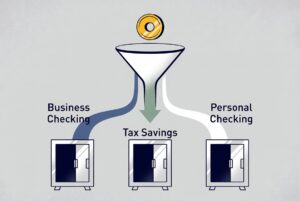
You don’t need six accounts and a bookkeeper to do this well. Three accounts—four if you want extra cash-flow protection—are enough to fully isolate your finances.
-
Business Checking: Every client payment lands here first. All business expenses (software, equipment, contractor payments) are paid from this account.
-
Tax Savings: A separate account, ideally high-yield, that holds money set aside for quarterly estimated taxes. Nothing else touches this account.
-
Personal Checking: Your everyday spending account (perfect for your daily expenses or payouts from lazy receipt scanning apps). This is where your “salary” transfers to on a fixed schedule.
-
(Optional) Buffer Account: For those with irregular income, this smooths out high and low months so your personal salary transfer stays consistent even when client payments don’t.
Every time a payment arrives in your Business Checking, split it immediately using fixed percentages.
| Category | Percentage | Destination Account |
| Taxes | 25–30% | Tax Savings account |
| Business Expenses | 10–15% | Stays in Business Checking |
| Your Salary | 40–50% | Transfers to Personal Checking on schedule |
| Buffer/Reserve | 10–15% | Buffer account (if using irregular-income smoothing) |
Example: A $4,000 payment split at 28% tax / 12% expenses / 45% salary / 15% buffer looks like this: $1,120 to taxes, $480 held for expenses, $1,800 toward salary, and $600 to the buffer.
The percentages don’t change based on the size of the payment—that consistency is what makes the system sustainable.
Step-by-Step: Setting Up Your Accounts This Week
-
Get an EIN, even as a sole proprietor: It’s free and takes minutes through the IRS’s online EIN application portal. Most banks will ask for one when you open a business account.
-
Open a dedicated business checking account: Use your EIN and pick a bank with no or low monthly fees for freelancer-level transaction volume.
-
Open a separate tax savings account: A high-yield savings account works well since the money sits for weeks or months before quarterly tax payments are due.
-
Set your transfer rules: Decide your percentage split and write it down somewhere visible. The rule only works if you apply it every time, without renegotiating in the moment.
-
Set a fixed pay schedule for yourself: weekly, biweekly, or monthly—pick one and stick to it, transferring from business checking to personal checking.
A Cleanup Path for Tangled Accounts

If you’re starting this cleanup after months or years of mixed transactions, don’t try to fix the past perfectly. Focus on drawing a clean line going forward.
-
Open the new accounts first. Every payment from today forward goes through the new system, even before the old account is sorted out.
-
Pull the last 12 months of transactions from your mixed account and categorize them as business or personal.
-
Record cross-contamination properly. If you paid for business software from your personal account, that’s an “owner contribution.” If you paid rent from your business account, that’s an “owner draw.” Keeping these labeled matters for accurate books.
-
Set a cutoff date and treat it as the day the new system starts. A clean line going forward is worth more than an unattainable retroactive fix.
Scaling Up: Multiple Entities and Equity Partners
As you transition from a solo freelancer to a business proprietor directing multiple registered corporate entities, this foundational system must scale with you.
If you operate multiple businesses under different registered names, each entity requires its own isolated ecosystem. Never cross-contaminate funds between your different ventures.
Furthermore, if you share corporate directorship with partners under a structured equity share allocation, your dedicated Business Checking account must act as the absolute clearinghouse for all partner distributions. Never pay a partner out of a personal account or a mixed fund. The percentage split system ensures that taxes and operational overhead are covered before any equity payouts are distributed according to your shareholder agreements.
Tools That Make the Process Effortless
If you want to seamlessly separate business and personal finances, rely on tools that remove the friction of manual tracking:
-
Online-only business banks built for independent workers often waive monthly fees and offer built-in expense tagging.
-
Zero-based budgeting tools are excellent for irregular income. (See our guide on the 5 Best Free Alternatives to YNAB to track your business budget without adding subscription overhead).
-
Light accounting software (even a free tier) offers automatic categorization of business expenses without manual entry.
How to Pay Yourself Correctly
Once the accounts exist, the next question is how much to pay yourself. The simplest approach: base your salary on your lowest realistic income months, not your average. This keeps the transfer sustainable even during a slow stretch.
Sole proprietors and single-member LLCs typically do this as an “owner’s draw”—a straightforward transfer from Business Checking to Personal Checking. No payroll tax is withheld at the time of the draw, but self-employment tax still applies when you file.
The mistake most people make here is treating a great month as a reason to raise their salary immediately. Wait for three consecutive strong months before treating a higher number as your new normal.
Maintaining the Boundary Long-Term
This isn’t a one-time setup; it’s a habit with recurring checkpoints:
-
Monthly: Confirm the percentage split was applied to every payment and that your salary transfer happened on schedule.
-
Quarterly: Review the Tax Savings account against your estimated tax payments so there are no surprises.
-
Annually: Reassess your baseline salary and percentage splits based on the last 12 months of real numbers, not assumptions.
None of this requires perfect bookkeeping instincts—it requires a structure that does the separating for you. Open the accounts this week, apply the rules without exception, and you will have the foundation to permanently separate business and personal finances regardless of how large your ventures grow.