If you’ve read our balcony solar guide, you know a portable solar panel is the real way to recharge a power station during a multi-day outage. But there’s a number almost every product listing gets you to calculate wrong, and it’s worth fixing before you buy — because “1000Wh ÷ 200W = 5 hours” is not how solar charging actually works in the real world.
The Naive Math (and Why It’s Wrong)
The tempting shortcut is to just divide your power station’s capacity by your solar panel’s wattage rating and call that your recharge time.
A 1000Wh station with a 200W panel looks like a clean 5-hour recharge. In practice, it usually isn’t — often closer to a day and a half of real sun.
The reason: a panel’s wattage rating is measured under laboratory conditions — direct perpendicular sunlight, a cool 77°F, zero shading — that essentially never occur outdoors for an extended stretch.
Real-world panel output is commonly 60–85% of the rated wattage in good conditions, and it drops to roughly 20–40% on cloudy or hazy days. On top of that, you’re not getting a full day of that output — only the hours when the sun is strong and direct enough to count, known as “peak sun hours.”
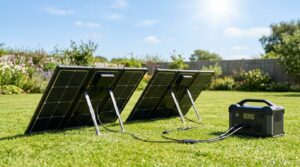
What Actually Cuts Into Real-World Output
- Peak sun hours, not daylight hours. Most U.S. regions average 4–6 peak sun hours per day — sunny areas like Arizona can see 6+, while the Pacific Northwest often sees closer to 3.5–4. A 14-hour summer day might only contain 5 of those “peak” hours.
- Panel angle. Panels produce the most power when aimed directly at the sun. Even a simple tilt adjustment from flat to 30–45 degrees can improve output by 15–25%.
- Heat. Counterintuitively, panels get less efficient as they get hotter — output drops roughly 0.5% for every degree Fahrenheit above 77°F, which adds up to an 11–12% loss on a 100°F day.
- Shading. Because panel cells are typically wired in series, shading even a small portion of one panel can drag down output for the whole thing.
- Charge controller conversion loss. A further 10–15% is typically lost converting the panel’s output into what actually reaches the battery.
The Real Math: Recharge Time by Sun Conditions
Here’s what a single 200W portable panel realistically delivers toward recharging a 1000Wh-class power station, factoring in the losses above:
| Sun Conditions | Real Panel Output | Peak Sun Hours | Energy Delivered per Day | Days to Fully Recharge |
|---|---|---|---|---|
| Strong, clear sun, well-angled | ~75% (150W) | 5 hrs | ~750Wh | ~1.3 days |
| Average / hazy or imperfect angle | ~55% (110W) | 4.5 hrs | ~495Wh | ~2 days |
| Overcast / winter / poor angle | ~35% (70W) | 3.5 hrs | ~245Wh | ~4+ days |
This lines up with what more detailed solar recharge calculators show as well: a single 200W panel recharging a 1000Wh-class station on realistic sun typically takes more than one calendar day, not the 5 hours the naive math suggests.
One clarification worth making explicit, since it trips people up: this recharge math is separate from the ~85% inverter efficiency loss we’ve used throughout this series for running AC devices off a power station.
Solar charging goes into the battery more directly, so the loss here comes from the panel and charge controller side, not the same inverter that converts stored power back into AC for your devices.
How Much Panel Wattage Do You Actually Need for a Same-Day Recharge?
If waiting a day and a half per recharge isn’t good enough for your situation, the fix is more panel wattage, not a bigger battery.
A commonly cited rule of thumb: multiply your battery capacity by roughly 1.2–1.5 and divide by your peak sun hours to find the panel wattage needed for a same-day full recharge — which for a 1,056Wh station and 6 peak sun hours works out to roughly 211W, and meaningfully more in regions with fewer peak sun hours.
| Power Station Size | Panel Wattage for Same-Day Recharge (avg. 4–5 peak sun hours) |
|---|---|
| 500Wh | ~150–200W |
| 1000Wh | ~300–400W |
| 2000Wh | ~600–800W |
In practical terms: if you’re buying a single 200W panel expecting to fully recharge a 1000Wh station in one day, you’ll likely be disappointed — pairing two 200W panels together gets you much closer to that goal on an average day.
The Bottom Line
Treat the wattage number on a solar panel’s box the way you’d treat a power station’s rated capacity — a lab number, not a real-world promise.
Plan around 55–75% of rated output on a decent day, 4–5 peak sun hours rather than the full daylight window, and expect a single panel roughly sized to your battery’s capacity to take a day or more to fully recharge it, not a handful of hours.
If fast, reliable recharging matters for your outage plan, size your panel wattage well above the naive “capacity ÷ panel watts” math suggests — closer to double, not equal.