We’ve referenced expandable batteries a few times throughout this series as the answer to “what if one power station isn’t enough capacity.”
It’s worth actually running the numbers on whether that’s true, because the marketing pitch — “just add a battery instead of buying a bigger unit” — isn’t always the cheaper path it sounds like.
What “Expandable” Actually Means
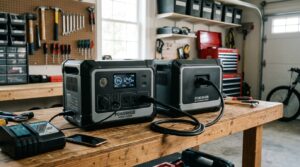
An expandable power station is a base unit with a port for connecting one or more additional battery packs, letting you grow total capacity over time instead of committing to one fixed size upfront.
It sounds like pure upside, but there are two catches worth knowing before you buy into it:
- Expandable base units typically cost 20–30% more than an equivalent fixed-capacity model, because you’re paying for the expansion ports and supporting electronics whether or not you ever actually expand.
- You’re locked into one manufacturer’s ecosystem. Jackery expansion batteries only work with Jackery base units, EcoFlow only with EcoFlow, and so on — there’s no mixing brands.
The Real Cost Math
Here’s the number the marketing conveniently leaves out: the total cost of a base unit plus one or more expansion batteries often exceeds what you’d pay for a single larger all-in-one system with the same final capacity.
Expandability isn’t a discount — it’s a way to spread the cost out over time, and sometimes a way to pay more for the same total capacity in exchange for that flexibility.
That said, some brands price their expansion batteries genuinely well. One real-world example: a FOSSiBOT F3600 Pro base unit (3,840Wh) paired with one expansion battery brought the total to roughly 7.68kWh for about $1,878 combined — under $0.25 per Wh, which is a genuinely strong rate.
The Jackery Explorer 2000 Plus ecosystem has also been singled out for expansion batteries priced around $0.49/Wh, scaling up to a 12,000Wh ceiling.
The lesson: expansion economics vary a lot by brand, so check the actual per-Wh cost of the expansion pack against a comparable fixed-capacity unit before assuming either one is the better deal.
The “Efficiency Tax” Nobody Mentions
There’s a small but real cost to linking batteries together beyond the purchase price: when a base unit and an expansion battery are connected, the battery management system has to balance voltage between them, which introduces a modest 2–5% energy loss.
It’s not a dealbreaker, but it means your combined capacity delivers slightly less usable energy than the sum of the two ratings would suggest — worth factoring in if you’re doing precise runtime math like we have throughout this series.
When Expandable Actually Makes Sense
- Your needs are genuinely uncertain or likely to grow. If you’re starting with CPAP-and-wifi coverage today but might want fridge coverage in a year or two, paying to grow into that gradually can beat committing to a large unit you don’t need yet.
- Your budget works better spread over time. Buying a base unit now and an expansion battery next year is a real, legitimate way to stage a larger purchase, even if the total ends up costing a bit more than buying everything at once.
- You already trust a specific ecosystem and plan to stay within it long-term, making the lock-in a non-issue.
When Fixed Capacity Is the Smarter Buy
If you can confidently predict your capacity needs for the next several years and your budget covers that size today, a fixed-capacity unit is usually the cheaper, simpler choice — no expansion premium, no ecosystem lock-in, no efficiency tax from linking batteries.
This is probably the right call for most people following our sizing chart: if you’ve landed on Profile A, B, or C from that guide, your needs are relatively well-defined, and a fixed 500–2000Wh unit likely covers it without needing room to grow.
Where This Actually Matters Most: Profile D
The clearest case for expandability shows up with Profile D from our sizing chart — full household coverage including a fridge.
We found in our fridge runtime breakdown that even a large single unit struggles to cover a full day of fridge use, and our comparison of EcoFlow, Bluetti, and Jackery noted that the EcoFlow Delta 2’s expansion path is specifically relevant here — it’s a realistic way to grow into fridge-level capacity over time rather than buying an oversized unit upfront that sits underused most of the year.
The Bottom Line
Expandable power stations aren’t automatically the smarter buy — they’re the right tool specifically when your capacity needs are uncertain or you want to spread cost over time, not a universal upgrade over fixed-capacity units.
Run the actual per-Wh math on the specific expansion battery against a comparably-sized fixed unit before assuming the flexible option is cheaper, because often it isn’t.
If your outage-prep needs are already well-defined — which, for most single-person or small-household setups following Profile A through C, they probably are — a fixed-capacity station is usually the simpler and cheaper path.