Hurricane outages aren’t like a typical evening blackout — they can stretch for days or, in the worst cases, weeks. Hurricane Helene left parts of North Carolina without power for more than 14 days in 2024, and Hurricane Milton knocked out power to 3.4 million customers in Florida at landfall. That’s the scale worth planning around, not the best-case scenario.
The Hurricane Timeline, and What Each Stage Means for Power Prep
Atlantic hurricane season runs June 1 through November 30, with activity typically peaking from mid-August through October. A Hurricane Watch means hurricane conditions are possible in your area — this is your window to finish preparations calmly. A Hurricane Warning means hurricane conditions are expected within 36 hours — at this point, preparation should already be complete, not starting.
Before Hurricane Season Even Starts
- Confirm your power station is sized correctly for what you actually need — don’t discover a capacity gap during a storm watch.
- Test your setup once, before the season starts, not for the first time during an actual outage.
- If you’re relying on solar recharging as part of your multi-day plan, confirm your panels and cables still work and that connectors haven’t degraded from a season in storage.
When a Storm Enters the Forecast (Watch Stage)
- Fully charge your power station now, while you still have grid power — don’t wait for the warning stage.
- Turn your refrigerator and freezer to their coldest setting. Pre-cooling gives you extra buffer once the USDA’s 4-hour safe window for a closed fridge starts counting down.
- Charge phones, laptops, and any medical device batteries to 100%.
- If refrigerated medication is part of your household, prep your cooler and ice packs now, before ice becomes hard to find.
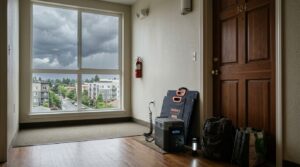
Once a Hurricane Warning Is Issued (About 36 Hours Out)
- Preparation should be finished, not started, at this point.
- Position your power station and any solar panels somewhere accessible but protected from wind and flooding — not on a balcony exposed to the storm itself.
- Keep your phone charged and know your building’s evacuation routes, especially if you’re above the ground floor and elevators may fail.
- If evacuation is ordered for your zone, or you have a medical need requiring reliable power, leaving is the safer call — a power station is for riding out an outage safely at home, not a reason to stay through a mandatory evacuation.
During and After
- Keep refrigerator and freezer doors closed as much as possible — every opening shortens your safe window.
- Ration power station use around priority devices first — medical devices and communication, following the profile-based approach we’ve used throughout this series — rather than running everything continuously from the start.
- Once skies clear, use solar recharging during daylight hours to extend your runway if the outage continues, rather than waiting until the battery is fully drained.
- Discard any food or medication that exceeded its safe temperature window, even if it looks fine — when in doubt, throw it out applies here too.
How Long to Actually Plan For
Generic guidance says plan for 72 hours minimum, and that’s a reasonable floor for a typical storm. But real hurricane outages regularly exceed that—multi-day restoration timelines are common, and severe events have stretched into weeks in the hardest-hit areas.
This is exactly why a solar recharge plan matters more for hurricane prep specifically than for a routine evening outage: a single power station charge is not designed to carry a household through two weeks without power, but a station paired with realistic solar recharging can meaningfully extend how long you can hold out before you need an alternative like relocating to a place with power.
The Bottom Line
Hurricane prep isn’t fundamentally different from the rest of the outage planning in this series — it’s the same power station, the same sizing math, the same solar recharge strategy — but the stakes and the timeline are bigger.
Have everything charged and staged before the watch becomes a warning, not after, and plan around the real range of hurricane outage lengths rather than the best-case scenario.