If you or someone in your household takes insulin, biologic injections, or any other medication that needs refrigeration, the moment the power goes out, a countdown starts — and it’s a much shorter one than most people assume.
Here’s what actually protects your medication, based on real cold-chain guidance rather than guesswork, plus where a small power station genuinely helps.
Why This Matters More Than People Think
Most refrigerated medications need to stay within a fairly narrow window — typically 36 to 46 degrees Fahrenheit (2 to 8 degrees Celsius), the same range your fridge normally holds. Insulin, biologic injectables, and reconstituted liquid antibiotics are especially sensitive because they rely on stable protein structures that break down once they leave that range.
A closed fridge generally holds a safe temperature for a few hours after the power goes out — cited ranges vary from roughly 2 to 3 hours up to about 12 to 24 hours depending on the unit and how often the door opens — which is exactly why it’s worth acting early rather than waiting to see how long the outage lasts.
This article is general information, not medical advice specific to your prescription. Storage windows vary by drug, brand, and whether the medication has already been opened — check your medication’s label or package insert, or call your pharmacist, for the exact number that applies to you.
In an emergency involving a medication you depend on, contact your pharmacist or prescriber, or call 911 for a life-threatening situation.
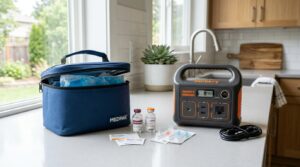
Method 1: A Cooler With Ice or Gel Packs
This is the most reliable no-electricity option, and it’s simple to set up correctly:
- Use a standard cooler with ice packs or frozen water bottles (the water bottles do double duty as drinking water as they melt).
- Never let the medication touch the ice directly. Frozen insulin and many biologics are permanently damaged by freezing. Put a towel, cardboard, or the medication’s original packaging between the ice and the vials.
- Done this way, a cooler with ice can hold refrigerator temperature for roughly 24 to 48 hours before the ice needs replacing.
- Keep the cooler in the coolest room in your home, away from windows and direct sunlight.
Method 2: A Small Powered Cooler on a Portable Power Station
If the outage is stretching past what ice alone can cover, a compact 12V thermoelectric cooler or mini medical fridge — not a full-size kitchen fridge — is a genuinely practical option, and this is where the wattage math from the rest of this series comes back in.
These small units typically draw around 40–50W, dramatically less than a full-size fridge’s 100–800W. Using the same ~850Wh usable capacity we’ve calculated for a 1000Wh-class station throughout this series:
| Cooling Method | Typical Draw | Runtime on an 850Wh Usable 1000Wh Station |
|---|---|---|
| Full-size kitchen fridge | 100–800W | Under 1 day |
| Small 12V thermoelectric medical cooler | 40–50W | ~17–21 hours |
That’s a meaningfully better runtime-per-watt-hour trade than trying to power your whole kitchen fridge just to protect one box of medication.
If you’re building out a sizing plan for an outage and medication is a priority, a dedicated small cooler is usually a smarter use of your power station’s capacity than running the whole fridge.
Method 3: Evaporative Cooling Pouches
Specialized cooling wallets (often marketed for insulin travel) use evaporative cooling — you soak them in water and they stay cool for extended periods without ice or electricity at all.
They’re not a substitute for genuine refrigerator-range cold storage for medications that require it, but they’re a useful backup layer, especially for shorter outages or as a bridge while you set up a cooler or powered option.
Method 4: The Unplugged-Freezer Trick
This one is worth knowing, but it has to be done carefully. A well-insulated, unopened freezer section can maintain safe temperatures for up to 48 hours during an outage. Wrapping the medication in a towel and placing it in the freezer (not touching frozen surfaces directly) can extend protection during a longer outage.
The critical step: unplug the freezer before power is restored. If the power comes back while the medication is still inside and the compressor kicks on, it can freeze the medication and ruin it.
What to Do If You’re Not Sure Whether Medication Is Still Good
- If it’s been frozen at any point, treat it as damaged and do not use it—thawed-and-refrozen medication should be discarded, even if it looks normal.
- If you can’t verify the temperature was maintained and you have a replacement available, err on the side of replacing it.
- If the medication is one you depend on to survive and no replacement is available, some guidance frames this as a judgment call — using it while you arrange a fresh supply may carry less risk than skipping a dose entirely for certain drugs like insulin, but this is exactly the kind of decision to make with your prescriber or pharmacist, not from an article, if you’re able to reach one.
The Bottom Line
Don’t wait to see how long the outage lasts before acting — move refrigerated medication into a cooler with ice (never touching it directly) within the first hour or two if you can.
For longer outages, a small powered cooler on a compact power station protects your medication far more efficiently than trying to run a full kitchen fridge, and it’s worth having as a backup layer alongside ice.
Whatever method you use, when in doubt about whether a specific medication is still safe, your pharmacist is a faster and more reliable answer than any general guide, including this one.