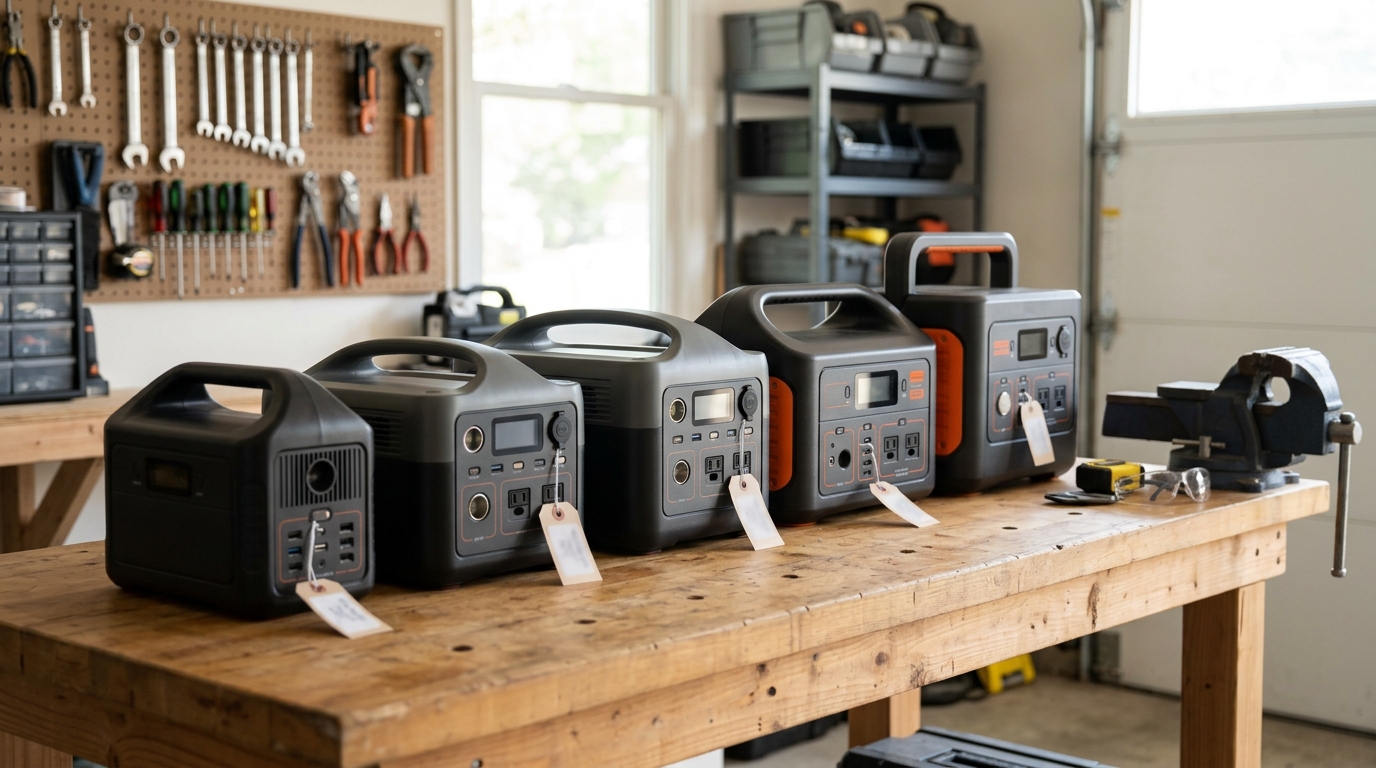
We covered cold-garage storage risk in our LiFePO4 vs lithium-ion breakdown — but heat is actually the bigger long-term threat to a power station’s lifespan, and it’s the one more likely to apply to most garages for most of the year.
Here’s what the real research shows, and how to store your unit correctly without needing climate control.
The Short Answer
Yes, you can store a lithium power station in a hot garage — but “can” and “should, without consequences” are different questions. Sustained heat meaningfully shortens the battery’s usable lifespan, and the damage accumulates quietly over months, not something you’ll notice on any single hot day.
The Real Numbers on Heat Damage
LiFePO4 batteries perform best stored between roughly 41–77°F (5–25°C). Here’s what happens as that climbs:
| Storage Temperature | Approx. Capacity Loss/Year (50% charge) | Approx. Capacity Loss/Year (100% charge) |
|---|---|---|
| 32°F (0°C) | ~1% | ~3% |
| 77°F (25°C) | ~2% | ~10% |
| 104°F (40°C) | ~5% | ~20% |
A general rule of thumb worth remembering: for every 18°F (10°C) above the battery’s ideal range, cycle life can be cut roughly in half.
One real-world estimate puts it starkly — a battery stored at 104°F (40°C) for six months can age as much as a battery stored at a stable 77°F (25°C) for two full years.
A garage that regularly hits 100°F+ in summer is squarely in that damaging range, not a hypothetical extreme.
The State-of-Charge Detail That Matters More Than People Realize
Notice the gap in the table above between 50% and 100% charge at the same temperature — at 104°F, a fully charged battery degrades roughly four times faster than one stored at half charge. This is genuinely the single most actionable thing in this article:
if you’re storing a power station in a hot garage for an extended period without regular use, don’t leave it at 100%. Charging it to roughly 40–60% before a season of storage, rather than topping it off and forgetting about it, meaningfully slows the degradation heat causes.
The obvious tension: an emergency power station you’re keeping for outage-prep needs to actually be charged when you need it, not sitting at 50%.
The practical compromise most manufacturers and battery guides recommend: keep it at a higher charge (80–100%) during active outage seasons (hurricane season, winter storm season, covered in our seasonal prep guides), and let it drop to 40–60% during the off-season months when you’re less likely to need it on short notice.
Is There a Safety Risk, Not Just a Lifespan One?
LiFePO4 is meaningfully more heat-stable than other lithium chemistries — we covered this in detail in our chemistry comparison — with a thermal runaway threshold around 270°C (518°F), far above what any garage will realistically reach.
A quality unit’s battery management system will also typically include a high-temperature cutoff that stops charging or discharging before things reach a dangerous range. Practically speaking: the realistic risk from a hot garage is accelerated aging, not a safety incident — you’re far more likely to end up with a battery that holds less capacity in three years than one that fails catastrophically.
Practical Storage Tips for a Hot Garage
- Keep it off the floor and away from direct sun through a window — a shelf or cabinet away from a west-facing window that gets full afternoon sun makes a real difference.
- Don’t store it at 100% charge for months at a time — target 40–60% for long idle stretches, closer to full only when you’re actively expecting to need it.
- Check on it every few months, not just when an outage hits — a quick voltage check confirms the battery management system is doing its job and the unit hasn’t drifted to an extreme state of charge.
- If your garage regularly exceeds 100°F, consider an interior closet instead for at least the hottest months — the capacity-loss numbers above make a real case for this if you have the space, even though it’s less convenient than grab-and-go garage storage.
- Avoid sealed, unventilated storage bins or cabinets that can trap heat well above ambient garage temperature — some airflow around the unit helps more than people expect.
The Bottom Line
A hot garage won’t make your power station catch fire or fail outright — LiFePO4’s thermal stability handles that concern well. What it will do, quietly and cumulatively, is shorten the battery’s useful life faster than storage in a temperature-controlled space would.
If you’re going to store one in a garage anyway, the single highest-leverage fix is managing state of charge — don’t leave it sitting at 100% through a hot summer if you’re not actively expecting to need it that week.