A “200W solar panel” almost never gives you 200 watts. It gives you 200 watts under laboratory test conditions, and something noticeably lower on your patio, and a small fraction of that when the sky turns gray, which is exactly when you’re most likely to be running on backup power.
This guide ranks portable panels by what independent testing actually measured, and covers the thing that causes more failed setups than anything else: whether the panel will even plug into your power station.
If you’re still deciding on the power station itself, start with our under-$500 roundup or the sizing chart.
For the recharge-time math that goes with any panel below, see our solar panel wattage and recharge time guide.
What Independent Testing Found
Outdoor Life’s tested roundup of portable solar panels measured each panel’s real output in full sun and under cloud cover, which is the data most listicles skip. Here is what they recorded:
| Panel | Rated | Measured in Full Sun | Measured Under Clouds | Connector | Price at Time of Review |
|---|---|---|---|---|---|
| Bluetti PV120 | 120W | 110W (92%) | 25W (21%) | DC, 20V | $300 |
| Jackery SolarSaga 200W | 200W | 184W (92%) | 49W (25%) | DC8020 / DC7909 (8mm), 20V | $700 |
| Bluetti PV200 | 200W | 178W (89%) | 44W (22%) | MC4, 21V | $500 |
| Anker SOLIX 400W | 400W | 330W (83%) | 77W (19%) | XT-60, 48V | $900 |
| Zendure 400W | 400W | 359W (90%) | Not tested | XT-90, 40V | $1,000 |
Two patterns matter more than the brand names:
- Full-sun output ran 83-92% of the rated number. That is good, and it is the best case. It assumes the panel is aimed correctly at midday.
- Under cloud cover, every panel dropped to roughly 19-25% of rated output. A “200W” panel delivered 44-49W. If your outage is a storm, plan around the cloudy number, not the sunny one.
Prices above are what the reviewer recorded and have likely moved; check current pricing before buying.
Best Picks by Situation
Best 200W panel overall: Jackery SolarSaga 200W. It measured the highest output of the 200W panels in both sun (184W) and clouds (49W) and weighs 14 lb, light for a 200W panel.
The catch is price: the reviewer listed it at $700, noticeably more than the Bluetti PV200 for a small performance edge.
Best value 200W: Bluetti PV200. It measured 178W in sun, within about 3% of the Jackery, for roughly a third less money according to the reviewer, and it uses standard MC4 connectors, which makes it the easiest panel here to mix and match with other equipment.
It is also heavier, around 16-19 lb depending on which figure in the review you trust.
Best 100W-class panel: Bluetti PV120. At 13 lb and 110W measured, it suits a small power station where you only need to top up a phone-and-router setup, like the units in our Wifi router outage guide. It is expensive per watt, but a small panel is the one that fits in a closet.
Best 400W options: Anker SOLIX 400W and Zendure 400W. The Zendure measured the highest real output of any panel tested (359W) but is the most expensive and the least compatible; the reviewer notes it did not work with the standard stations in the test, only with Zendure’s own SuperBase.
The Anker measured 330W (83%) and delivered 77W under clouds (the Zendure wasn’t tested in cloudy conditions).
Both weigh 30-35 lb, which makes them campsite or backyard equipment, not something you carry onto an apartment balcony.
The Compatibility Check That Prevents Wasted Money
Before you buy any panel, check four things on your specific power station’s spec sheet:
- Connector type. The panels above use at least five different plug standards (DC8020, MC4, XT-60, XT-90, and others). Adapters exist, but the reviewer flags that mismatched connectors may require them. Don’t assume.
- Maximum solar input wattage. A panel larger than your station can accept simply wastes the excess. For example, the Bluetti AC70 accepts up to 500W of solar input, and the Anker SOLIX C1000X accepts up to 600W. A small station like the ones in our budget roundup may cap out around 100-200W.
- Input voltage window. The panels above range from 20V to 48V. A panel whose voltage falls outside your station’s accepted window won’t charge it, or can damage it. The station’s spec page will list an input voltage range.
- Parallel and series rules. If you plan to connect two panels, the station’s manual says whether to connect them in series or parallel. Getting this wrong is the most common cause of “my solar input shows zero.”
Placement Matters More Than the Panel
A few practical points that change real-world output more than the choice between any two panels on this list:
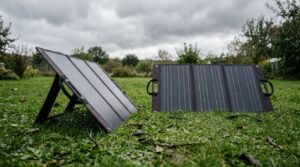
- Aim and re-aim. A flat-lying panel captures far less than one tilted toward the sun. Adjust it every couple of hours.
- Shade kills output disproportionately. A shadow across even part of a panel can cut output far more than the shaded fraction suggests, because of how cells are wired.
- Keep the power station itself in the shade and cool. Heat shortens battery life; see our hot garage storage guide.
- Apartment dwellers: if you have a balcony but no yard, see our guide to balcony-friendly solar generator setups and the balcony solar kits for renters breakdown for what works without permanent installation.
What Solar Can and Can’t Do During an Outage
Be realistic about the ceiling. A single 200W panel measured at around 180W in full sun can support a CPAP, a router, and phone charging through the day (see our CPAP runtime math).
It cannot keep up with a full-size fridge’s daily draw by itself, and it does not come close to running a window air conditioner (we run the numbers in our window AC blackout guide).
Solar extends a power station’s runtime on the margin; it does not turn a small station into a whole-home system.
The Bottom Line
Buy for measured output and compatibility, not the number printed on the box. For most people with a mid-size power station, a 200W panel is the sweet spot: the Bluetti PV200 for value, the Jackery SolarSaga for the best measured performance.
Confirm your station’s connector, voltage window, and maximum solar input first, and plan around cloudy-day output of roughly a fifth of the rated wattage, since that is the weather you will probably be using it in.
Panel prices and test results are from the cited review at the time of its publication and change often. Always confirm current pricing and your power station’s solar input specifications on the manufacturer’s site before buying.