Last updated: November 2026. Method note: we have not lab-tested these units. Specifications are the manufacturers' published figures as we last confirmed them; runtimes are our own arithmetic with an 85% usable-capacity assumption. Prices change constantly with sales, so the dollar amounts below are approximate and dated, and you should check the current listing before buying.
Affiliate disclosure: some links on this page may earn Trendifacts a commission at no extra cost to you. It does not change what we recommend or the order of the list.
Under $500, the best value for outage backup is usually a mid-size unit in the 700 to 800Wh range such as the Bluetti AC70 (768Wh, 1,000W continuous), because it can carry a router, CPAP and lights through a night.
If you only need phones, a router and a few lights for a few hours, a 250 to 300Wh unit such as the Jackery Explorer 300 Plus, EcoFlow River 3 or Anker SOLIX C300 costs far less. None of these will run a full-size fridge for a day, a space heater or an air conditioner.
This guide explains what each budget tier buys, compares five specific picks, shows a worked runtime example, lists what to check before you pay, and says plainly what these units cannot do.
The Short Answer
| If you need... | Look at | Approx. capacity |
|---|---|---|
| Phones, router, lights for a few hours | Jackery Explorer 300 Plus, EcoFlow River 3, Anker SOLIX C300, Bluetti Elite 30 V2 | 245 to 288Wh |
| Router, CPAP (no humidifier), lights overnight | Bluetti AC70 | 768Wh |
| A bit of everything, with room to grow | Bluetti AC70 plus expansion battery | up to 1,574Wh |
| A fridge, heater, AC or whole-home backup | Not at this budget | See our sizing chart |
What a Budget Buys: Three Tiers
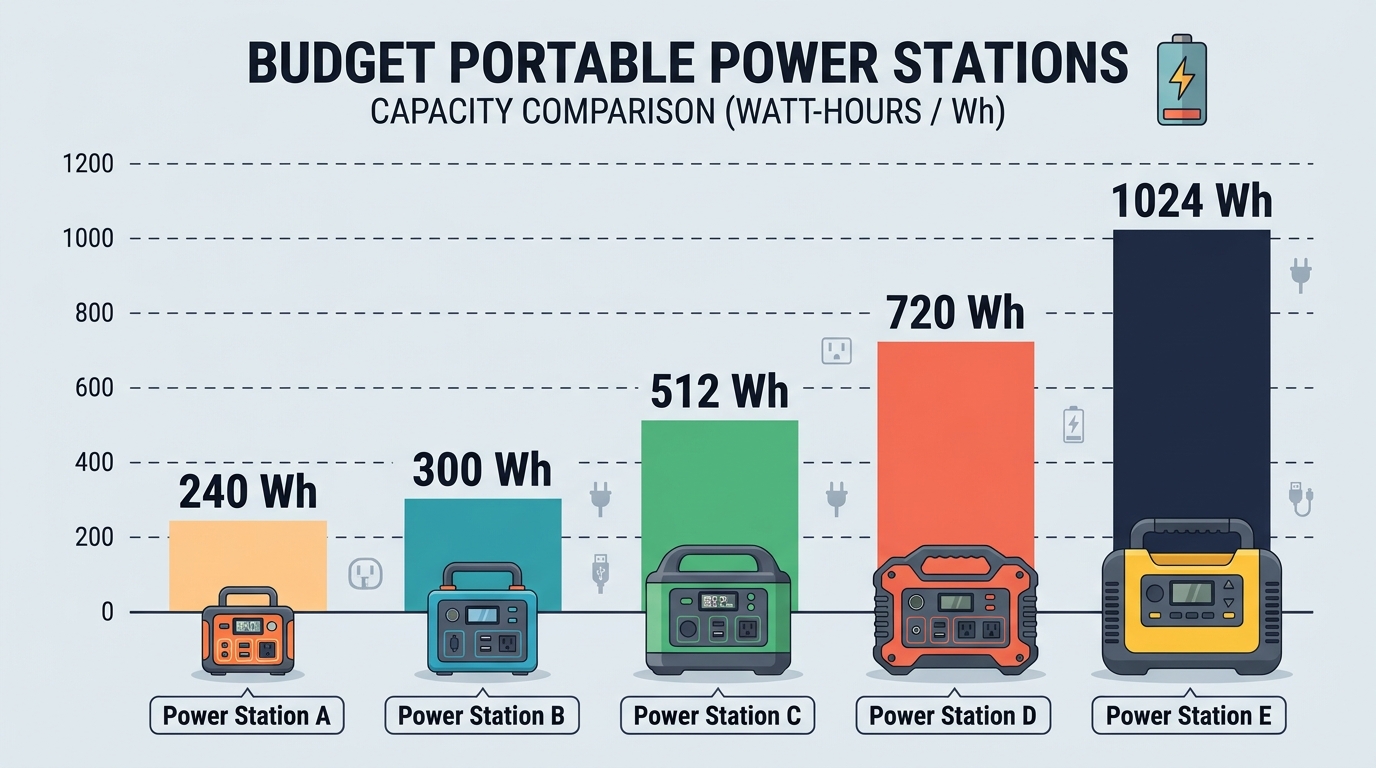
Under about $250: 250 to 300Wh. These are small enough to carry in one hand. They charge phones, run LED lights, a router and modem (about 18W together) and a laptop. Usable energy is roughly 210 to 245Wh, so a router alone could run about 12 hours. A CPAP is possible only for a night or less, and only without a heated humidifier.
About $250 to $400: 500 to 800Wh. Capacity is where it gets useful. At around 768Wh the Bluetti AC70 offers about 650Wh usable, enough for a CPAP and a router for a night with room to spare.
About $400 to $500: 1,000Wh class on sale. Larger units sometimes drop under $500 during sales, but this is volatile. If you can find one, check that it is a current model, since discontinued units get cleared at low prices with limited support.
Five Picks Under $500
Prices and specs change. These figures were checked against manufacturer and retailer information when we last updated; confirm on the product page.
| Pick | Capacity | AC output | Approx. price | Best for |
|---|---|---|---|---|
| Jackery Explorer 300 Plus | 288Wh | 300W (600W surge) | about $199 | Simple, light, well-known brand |
| EcoFlow River 3 | 245Wh | 300W (600W surge) | check current | Very fast wall recharge (about 60 min) |
| Anker SOLIX C300 | 288Wh | see manufacturer | check current | Compact desk and travel use |
| Bluetti Elite 30 V2 | 288Wh | 600W (surge up to 1,500W, resistive loads only) | check current | Small tools and heating-element devices within limits |
| Bluetti AC70 | 768Wh | 1,000W (1,500W surge) | about $359 list | Best all-round under $500 |
1. Bluetti AC70: the pick for most people
At 768Wh with 1,000W continuous output, the AC70 is the only unit on this list with enough energy for a real overnight plan. At about $359 list price it is also well under the cap, and it can be expanded to roughly 1,574Wh with a compatible battery, which keeps an upgrade path open.
Our expansion battery guide explains when that is worth it. Its limits: it is heavier than the small units, 1,000W will not run a hair dryer plus anything else, and it will not run a full-size fridge for long (see our fridge runtime guide).
2. Jackery Explorer 300 Plus: the simple, safe default
288Wh, 300W continuous and 600W surge at about $199 on sale. It is small, widely reviewed and easy to find. It suits phones, tablets, router and lights. It will not run most kettles, hair dryers or space heaters, which draw well over 300W.
3. EcoFlow River 3: fastest to recharge
245Wh, 300W (600W surge) and a recharge from the wall in about an hour per the manufacturer. That matters if you get short windows of power between outages or want to top up quickly before a storm. The trade-off is slightly less capacity than the 288Wh competitors.
4. Anker SOLIX C300: compact and flexible
288Wh in a compact body, aimed at desks and travel. Check Anker's current specifications for output ports and what the unit can do while charging, because details differ between variants in the C300 family.
5. Bluetti Elite 30 V2: watch the surge claim
288Wh and a 600W continuous rating. Bluetti advertises a surge of up to 1,500W, but this is for resistive loads only, such as a heating element, and does not help with motor loads like a fridge compressor. Read that footnote before counting on it.
Models that have gone away
The Bluetti EB3A and AC2A are discontinued. Cheap leftover stock of discontinued models can still be fine, but check warranty terms and the return policy first.
Worked Example: One Night Without Power
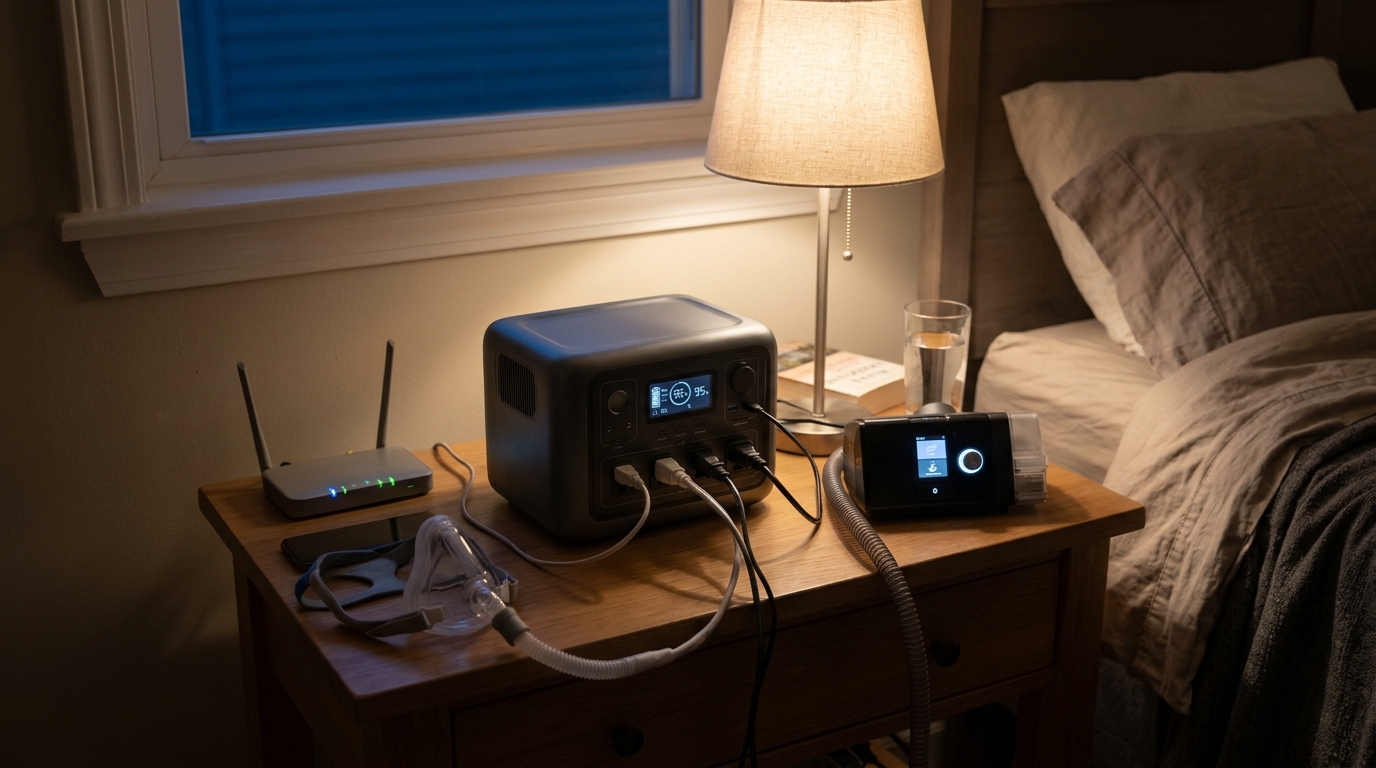
Suppose a renter wants to run a router and modem (about 18W), a CPAP without humidifier (about 45W) and an LED light (about 10W) overnight for 8 hours. That is 73W combined.
- Energy needed: 73W x 8 hours = 584Wh.
- 288Wh unit with about 245Wh usable: runs about 3.4 hours, so it does not cover the night.
- Bluetti AC70 with 768Wh, about 650Wh usable: 650 / 73 = about 8.9 hours. That covers the night with about an hour in reserve.
- If the CPAP has a heated humidifier and draws 100W instead, the combined load is about 128W, and 650 / 128 = about 5 hours. That would not cover the night.
The takeaway: for a CPAP, the cheap 288Wh units are not enough for a full night, and the mid-size unit is. See our CPAP runtime guide and CPAP picks before relying on any of these for a medical device. Check your CPAP's input requirements too: many ResMed models need a DC cable or an AC supply, and the power station must be compatible.
Runtime Quick Reference
Using 85% of rated capacity as usable:
| Load | Typical draw | 288Wh unit (245Wh usable) | 768Wh unit (650Wh usable) |
|---|---|---|---|
| Phone charging | 10 to 15W | about 16 to 24 hours | about 43 to 65 hours |
| Router and modem | about 18W | about 13 hours | about 36 hours |
| LED light | 10W | about 24 hours | about 65 hours |
| Laptop | 45 to 65W | about 4 to 5 hours | about 10 to 14 hours |
| CPAP, no humidifier | 40 to 55W | about 4.5 to 6 hours | about 12 to 16 hours |
| Small TV | 50 to 100W | about 2.5 to 5 hours | about 6.5 to 13 hours |
Our wifi router guide explains why the router and modem number is lower than many people expect.
What You Cannot Do Under $500
- Run a full-size fridge for a day. A fridge uses 1 to 2kWh a day, more than most of these units hold.
- Run a space heater. Most draw 1,500W, and even short use drains small batteries in minutes. See our space heater guide.
- Run a window or central air conditioner. See our window AC guide.
- Back up a whole home. That is a different budget. See our large-station guides.
What to Check Before You Buy
- Rated Wh and usable Wh. Plan on about 85% of the label.
- Continuous watts versus surge watts. Continuous decides what runs.
- Battery chemistry. LiFePO4 generally lasts more cycles than other lithium types; see our chemistry guide.
- Charging options. Wall speed, car input and solar input. Solar input watts limit how fast panels can refill the unit; see our solar recharge chart.
- Warranty and support. Check length and who services it.
- Weight and portability. Small units are easy to move in a storm; larger ones are not.
- Return window and price history. If a "sale" price is the same all year, it is the real price.
- Cold limits. Most lithium units cannot charge below freezing; see our cold weather guide.
Pairing a Budget Unit With Solar
A small battery is only as useful as your ability to refill it. Using our formula, daily Wh equals panel watts x peak sun hours x 0.75, a 100W panel with 4 peak sun hours yields about 300Wh a day (100 x 4 x 0.75), roughly one full recharge of a 288Wh unit but only about 40% of a 768Wh unit. Check each model's maximum solar input in watts before buying a panel, because a unit that accepts only 100W will not use a larger one.
Renters who cannot put panels outside can still keep a unit charged from the wall in advance, which is the simplest plan for short outages. Our balcony solar guide covers renter-friendly setups.
Should You Spend More?
If your plan includes a CPAP, a fridge or more than one night of use, a larger unit is worth the extra money. Our Jackery 1000 vs 1500 comparison and the 1000Wh runtime guide show what the next tier delivers. If budget is tight, the AC70 plus a small solar panel is a stronger system than a larger battery with no way to recharge.
FAQ
What is the best power station under $500?
For most households, the Bluetti AC70 at 768Wh, because it has enough energy for an overnight router and CPAP plan.
Can I run a CPAP on a 288Wh unit?
For a few hours without a humidifier, yes. A full night usually needs more capacity.
Can a cheap power station run a fridge?
Not for long. A fridge needs 1 to 2kWh a day.
Are these safe to use indoors?
Power stations produce no exhaust, but keep them dry and ventilated, and follow the manual.
Do prices change a lot?
Yes. Sales are frequent, so check current listings.
Should I buy a discontinued model?
Only if the warranty and return policy are clear.
The Bottom Line
Under $500, buy for the job: 250 to 300Wh for phones, a router and lights, or the 768Wh AC70 if you need a CPAP overnight. Do the arithmetic for your own loads first, and skip units whose capacity is too small for your longest outage.
Specifications and prices change; confirm with the manufacturer before purchase.