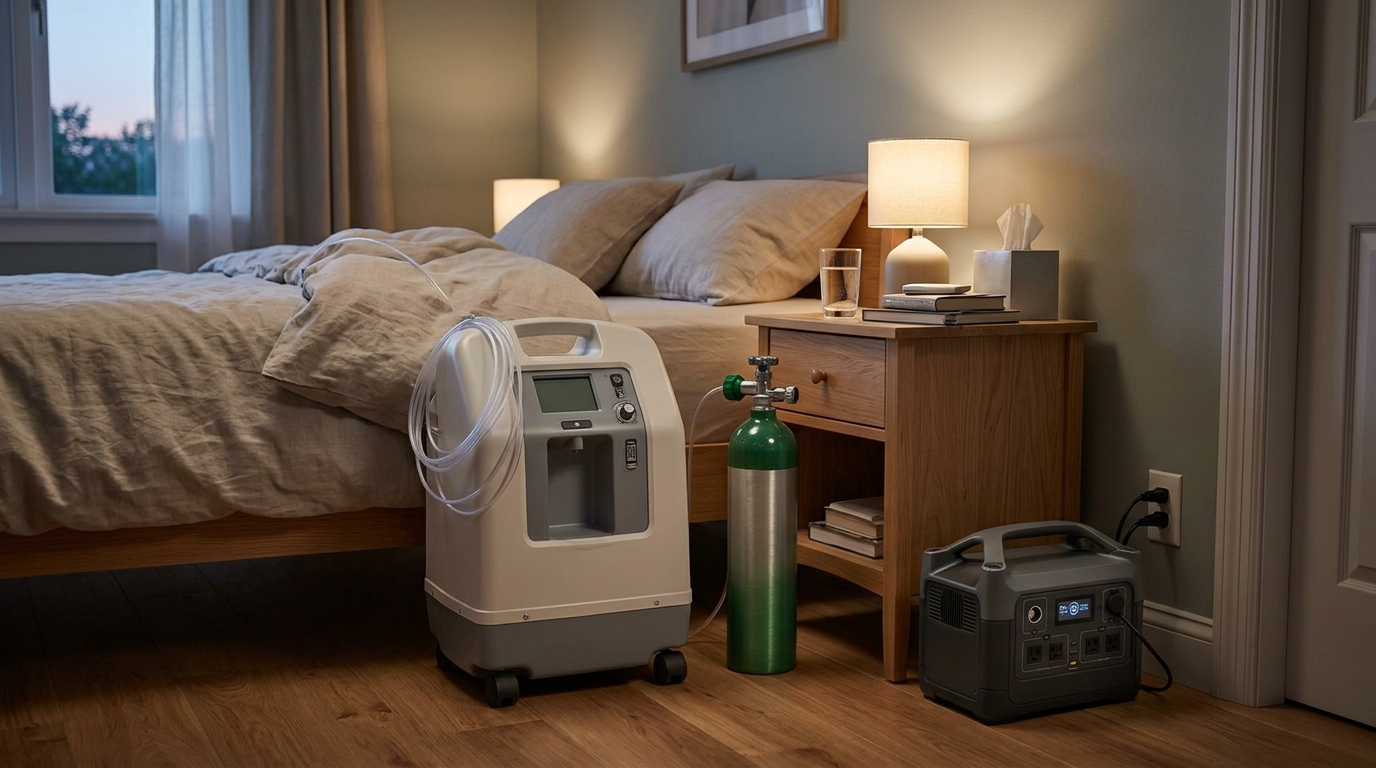
Short answer: a 300Wh power station will get most CPAP users through roughly 5 to 6 hours with the humidifier off — not the full night, and nowhere near the 2-3 nights you’ll see claimed elsewhere.
With the humidifier running, expect closer to 2-4 hours. If a full night of coverage matters to you, a 300Wh unit is the wrong size — this article shows the real math so you know exactly where you stand before an outage, not during one.
The Power Draw Breakdown: Heater vs. No Heater
A power station’s capacity is measured in Watt-hours (Wh) — a 300Wh station can output 1 watt for 300 hours, or 100 watts for 3 hours, before accounting for conversion losses.
The blower motor that pushes air is relatively efficient. The heating element in a humidifier is the real energy drain.
Using the same sourced wattage ranges from our 1000Wh CPAP runtime breakdown — drawn from manufacturer power specs and independent CPAP power-draw testing — here’s what that looks like on a 300Wh-class station:
| CPAP Setting | Average Power Draw | Usable Capacity Needed | Estimated Runtime on a 300Wh Station |
|---|---|---|---|
| No Humidifier, No Heated Tube | 40–55W | 255Wh usable | ~4.6–6.4 hours |
| Humidifier On (Low–Moderate) | 55–90W | 255Wh usable | ~2.8–4.6 hours |
| Humidifier & Heated Tube (High) | 90–130W | 255Wh usable | ~2–2.8 hours |
Note: inverters inside portable power stations typically lose 10–15% of their energy converting DC battery power to AC wall power — a 300Wh battery realistically gives you about 255Wh of usable capacity, the same ~85% efficiency figure we’ve used throughout this series.
A meaningful correction worth being direct about: some CPAP guides cite “10–15W” for a humidifier-off setting, which would suggest 20+ hours of runtime on a 300Wh unit.
That figure doesn’t match the sourced data across major CPAP models — real averages for machines like the ResMed AirSense 10/11 and Philips DreamStation Auto run closer to 40–55W even without the humidifier.
If you’ve seen a much lower number elsewhere, it’s likely measuring only the blower motor at its absolute minimum pressure setting, not a realistic average.
Always check the wattage printed directly on your own machine’s power supply label — that number is more reliable than any average in this article.
The DC Power Cable: A Real Efficiency Gain, With One Critical Catch
If you’re using the standard AC wall adapter that came with your CPAP, you are losing some battery life to double conversion: the power station converts its stored DC power to AC, then your CPAP’s power brick immediately converts that AC back to DC. Bypassing the power station’s AC inverter with a direct DC-to-DC connection genuinely reduces that conversion loss, and can meaningfully extend your runtime.
Here’s the catch the “just buy a 12V car charger” advice gets wrong: many CPAP machines, including the ResMed AirSense 10 and AirSense 11, actually run on 24V DC, not 12V. A plain 12V cigarette-lighter-style adapter is the wrong product for these machines and may not power them at all. ResMed sells an official DC/DC Converter that accepts either 12V or 24V input and steps it up to the regulated 24V the AirSense 10 needs — the AirSense 11 version works the same way.
If you’re buying a third-party cable instead, confirm it’s rated to output the correct voltage for your specific model, not just “12V DC” generically — a detailed voltage compatibility breakdown is worth reading before you buy.
Before purchasing any DC adapter: check the label on your CPAP’s existing power supply for its actual voltage requirement, and confirm your power station’s DC output port matches — or provides the wattage/voltage headroom to convert to — what your specific machine needs.
Getting this wrong doesn’t just waste money; it can mean discovering the mismatch during the exact outage you were preparing for.
How to Calculate Your Exact Sleep Time
Use this before a blackout hits, with your own machine’s real numbers:
- Find your CPAP’s wattage. Check the power brick or the bottom of your machine for its Volts (V) and Amps (A) rating, and multiply them together for maximum wattage. Don’t assume — confirm with your specific label.
- Calculate usable battery. Multiply your power station’s rated capacity by 0.85 to account for inverter loss. For a 300Wh unit, that’s 255Wh usable.
- Divide. 255Wh ÷ your CPAP’s average wattage = estimated hours of runtime.
Worked example: if your CPAP draws 45W with the humidifier off (a realistic average, not the low-end outlier some guides cite), 255 ÷ 45 = 5.67 hours — enough to cover the first several hours of an outage, but not a full 8-hour night.
If you need genuine full-night, multi-night coverage, a 300Wh-class unit isn’t sized for that; see our power station sizing chart for how to match capacity to your actual needs, and our LiFePO4 vs lithium-ion breakdown if you’re comparing specific units for a CPAP-focused purchase.

The Bottom Line
A 300Wh power station is a genuinely useful first line of defense for a CPAP during a short outage — but “one to three nights” is not a realistic expectation even with the humidifier off, based on real sourced wattage data.
Plan on roughly 5-6 hours without the humidifier, meaningfully less with it running, and confirm your exact numbers using your own machine’s label rather than an average.
If a DC bypass cable is part of your plan, double-check your machine’s actual voltage requirement first — for models like the ResMed AirSense 10 and 11, that means 24V, not the 12V most generic adapters provide.