The first question after the lights go out is rarely “how many watt-hours do I have?” It is “how long before my food spoils?” The answer sets how much a power station actually needs to do, and it is more forgiving than most people expect.
This guide starts with the official food-safety timelines, then works out how to cover them with a power station without wasting your battery.
The Official Timelines
According to FoodSafety.gov and the CDC’s guidance on discarding food after an outage:
| Appliance | How Long Food Stays Safe (Doors Closed) |
|---|---|
| Refrigerator | About 4 hours |
| Full freezer | About 48 hours |
| Half-full freezer | About 24 hours |
Two rules from those sources matter for planning:
- After 4 hours without power, discard refrigerated meat, poultry, fish, eggs, milk, and leftovers. Never taste food to decide whether it’s safe, and when in doubt, throw it out.
- Thawed freezer food can be refrozen if it still has ice crystals or is at 40°F (4°C) or below. Food that feels warm or smells, looks, or feels off goes in the trash.
Keeping doors shut is the biggest factor in extending these windows. That single habit is worth more than any piece of equipment.
What This Means for a Power Station
The four-hour fridge window is the one to plan around. A fridge needs power sooner than a freezer, but not continuously.
Our full-size fridge breakdown covers the math: a typical modern fridge uses roughly 1-2 kWh per day, which a 1,000Wh-class station covers for about half a day to under a full day.
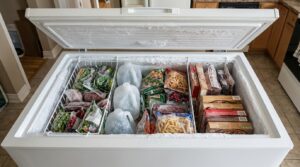
A freezer is a different story. A full, closed freezer holds safe temperatures for about two days with no power at all, so for most outages you may not need a power station for the freezer in the first place.
How Much Power Does a Freezer Use?
BLUETTI’s freezer wattage guide lists these general ranges:
| Freezer Type | Running Watts | Starting/Surge Watts |
|---|---|---|
| Small chest (5-9 cu. ft.) | 70-150W | 300-900W |
| Medium to large chest (10-20+ cu. ft.) | 100-250W | 500-1,200W+ |
| Medium manual-defrost upright (10-16 cu. ft.) | 80-200W | 400-1,200W |
| Large frost-free upright (17+ cu. ft.) | 100-300W | 600-1,500W+ |
The same source puts ENERGY STAR chest freezers at about 215 kWh per year (about 0.59 kWh a day) and upright freezers at about 395 kWh per year (about 1.08 kWh a day). Your own model’s EnergyGuide label gives a more accurate figure. As with every motor-driven appliance, the starting surge, not the running wattage, decides whether a station can start it; we explain why in our sump pump surge guide.
Runtime Math
Using our standard ~85% usable-capacity assumption and the daily figures above:
| Station Size | Usable Energy | Chest Freezer (~0.59 kWh/day) | Upright Freezer (~1.08 kWh/day) |
|---|---|---|---|
| 1,000Wh | ~850Wh | ~1.4 days | ~0.8 days |
| 2,000Wh | ~1,700Wh | ~2.9 days | ~1.6 days |
| 3,000Wh | ~2,550Wh | ~4.3 days | ~2.4 days |
These are estimates from average daily consumption; warm rooms, frequent door openings, and a freezer full of unfrozen new food all push real numbers higher. Running both a fridge and a freezer from one station adds the two together, which is why our sizing chart treats the full-household profile as the hardest one to cover.
A Smarter Plan: Don’t Run Everything All the Time
Because the food-safety windows are generous, you can stretch a single charge considerably:
- Keep every door closed. Resist checking. Every opening lets cold air out.
- Let the freezer coast for the first day or so. A full freezer is fine for about 48 hours; a station isn’t needed for it at the start.
- Prioritize the fridge after hour 3-4. Plug it in to bring it back down to temperature, rather than waiting until food is already warm. This is the same rationing approach from our fridge guide.
- Run in blocks. A fridge or freezer that has been chilled can coast for a while. Alternating periods of running and unplugging stretches runtime. Use an appliance thermometer if you have one so you aren’t guessing.
- Fill empty space. A fuller freezer holds cold longer than an empty one. Jugs of water frozen in advance act as thermal mass.
- Add solar if the outage is long. See our solar panel guide and recharge time chart for realistic numbers.
- Use cold storage for essentials. If medication needs refrigeration, see our guide to keeping medication cold without a generator.
When to Throw Food Out
The rules above are not suggestions. If your fridge has been without power for more than four hours and you didn’t restore it to temperature in time, discard the perishable items. If frozen food has thawed completely and warmed up, don’t refreeze it.
A power station is meant to keep food within the window, not to rescue food that has already left it.
Bottom Line
You often need less backup power for food than you think. A closed fridge buys about four hours, a full freezer about two days, and a 1,000Wh station can extend a chest freezer for well over a day. Plan around the fridge, let the freezer coast, keep doors shut, and ration your battery.
For more outage planning, see our hurricane season checklist and winter storm prep guide.
Food safety guidance comes from FoodSafety.gov and the CDC. Appliance wattage figures are general ranges and vary by model; check your appliance’s label for its exact numbers.