Last updated: November 27, 2026
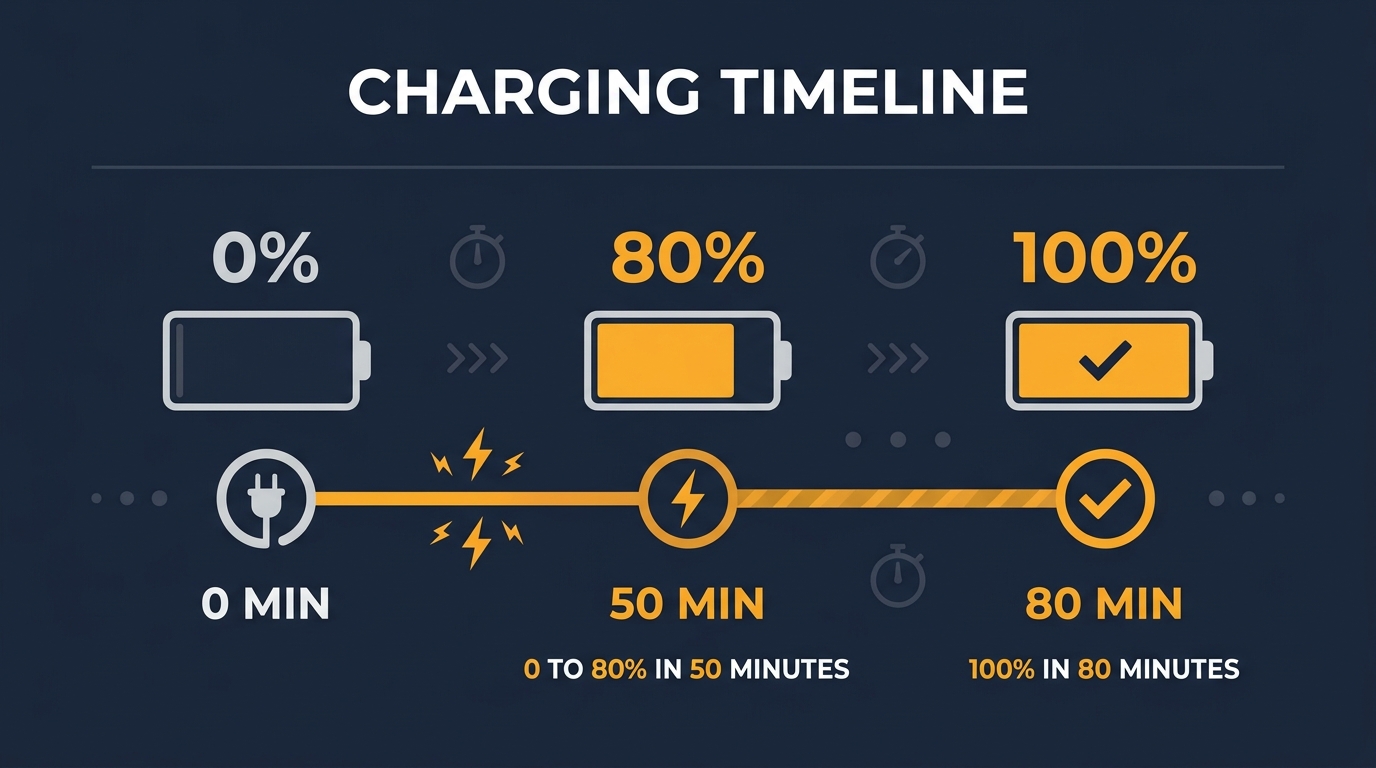
The EcoFlow DELTA 2 is a 1,024Wh LiFePO4 portable power station built around speed and outlet count: it packs 1,800W of continuous pure sine wave AC output across six AC outlets (2,700W surge, plus an X-Boost mode up to 2,200W for resistive heating loads), 500W of solar input, modular battery expansion, a 5-year warranty, and 1,200W AC wall recharging that fills the pack from 0% to 80% in roughly 50 minutes and to 100% in about 80 minutes.
At 27 lb (12 kg), it remains one of the fastest-charging 1,000Wh-class units for rolling blackouts and multi-device desks.
Its main limitations in 2026 are its modest ~850Wh usable AC capacity (~83% of rated capacity after inverter overhead), its age relative to EcoFlow's newer DELTA 3 lineup, and wide street-price swings.
If you catch the DELTA 2 on sale near $0.34 to $0.45 per Wh, it is still a sharp value for fast-turnaround home office and storm prep. Near its older $699–$899 pricing, newer rivals offer better efficiency and quieter fans for the same money.
How we built this review: Rather than in-house bench testing, Trendifacts evaluates the EcoFlow DELTA 2 using published manufacturer specifications, historical price-per-watt-hour benchmarks, and worked appliance runtime math based on a conservative 850Wh usable capacity (~83% efficiency after AC inverter losses—slightly stricter than our standard 85% / 870Wh baseline). Because EcoFlow has introduced newer models since the DELTA 2's launch and clearance pricing shifts quickly, always confirm current checkout prices and warranty terms on the retailer's page before buying.
EcoFlow DELTA 2
Best value fast-charging 1,000Wh station when bought on sale: 0–80% wall recharge in ~50 minutes, 1,800W across 6 AC outlets, 500W solar input, and modular expansion up to 3,040Wh.
The Short Answer
| Feature | EcoFlow DELTA 2 |
|---|---|
| Rated Capacity | 1,024Wh (LiFePO4, 51.2V) |
| Realistic Usable AC Capacity | ~850Wh (~83% efficiency after inverter overhead) |
| AC Output | 1,800W continuous across 6 outlets / 2,700W surge / 2,200W X-Boost |
| Battery Longevity | 3,000+ cycles to ≥80% original capacity |
| Weight | 27 lb (12 kg) |
| Wall Recharge Speed | ~50 min (0–80%) / ~80 min (0–100%) at 1,200W max AC input |
| Max Solar Input | 500W (11–60V, 15A max; ~3 hours in ideal sun) |
| Expansion | Up to 2,048Wh (with DELTA 2 Extra Battery) or 3,040Wh (with DELTA Max Extra Battery) |
| EPS Switchover | <30 ms (fine for routers and lamps; not a true server UPS) |
| Warranty | 5 years |
| Best For | Fast recharging during rolling blackouts, multi-device home offices, expandable setups |
| Watch Out For | ~850Wh real usable ceiling, older generation design, occasional app/firmware setup quirks |
Full Specifications
| Specification | Published Value | Practical Note |
|---|---|---|
| Battery Capacity | 1,024Wh (51.2V LiFePO4) | Expect ~850Wh delivered through AC outlets (~1,220Wh drawn from wall to refill) |
| Cycle Life | 3,000 cycles to ≥80% capacity | Roughly 8–10 years of regular daily cycling |
| AC Output | 6× 120V outlets, 1,800W total | Pure sine wave; handles most household appliances without a power strip |
| Surge / X-Boost | 2,700W surge / 2,200W X-Boost | X-Boost lowers voltage for resistive loads (heaters/kettles); do not rely on it for sensitive electronics |
| USB-C Ports | 2× USB-C (100W PD each) | Charges two modern laptops directly on DC with minimal conversion loss |
| USB-A Ports | 2× standard (12W) + 2× fast-charge (18W) | Plenty of ports for phones, headlamps, and radios |
| 12V DC Outputs | 1× car port (12.6V/10A, 126W max) + 2× DC5521 (12.6V/3A, 38W max each) | Supports 12V coolers and DC CPAP adapters |
| AC Wall Charging | 1,200W max (100–120V) | Adjustable in the EcoFlow app if you want quieter, slower charging |
| Solar Input | 11–60V, 15A, 500W max | Higher ceiling than 400W-capped rivals; accepts third-party MC4-to-XT60i panels |
| Car Charging | 12V / 24V, 8A default | Useful for slow top-ups during road trips |
| Expansion Port | 1× extra battery port | Reaches 2,048Wh (+DELTA 2 Extra Battery) or 3,040Wh (+DELTA Max Extra Battery) |
| Weight | 27 lb (12 kg) | Dual side carry handles; heavier than ultralight 24 lb rivals |
| Certifications & Warranty | UL, FCC, CE / 5-year warranty | Buy from EcoFlow or an authorized seller so the 5-year coverage applies |
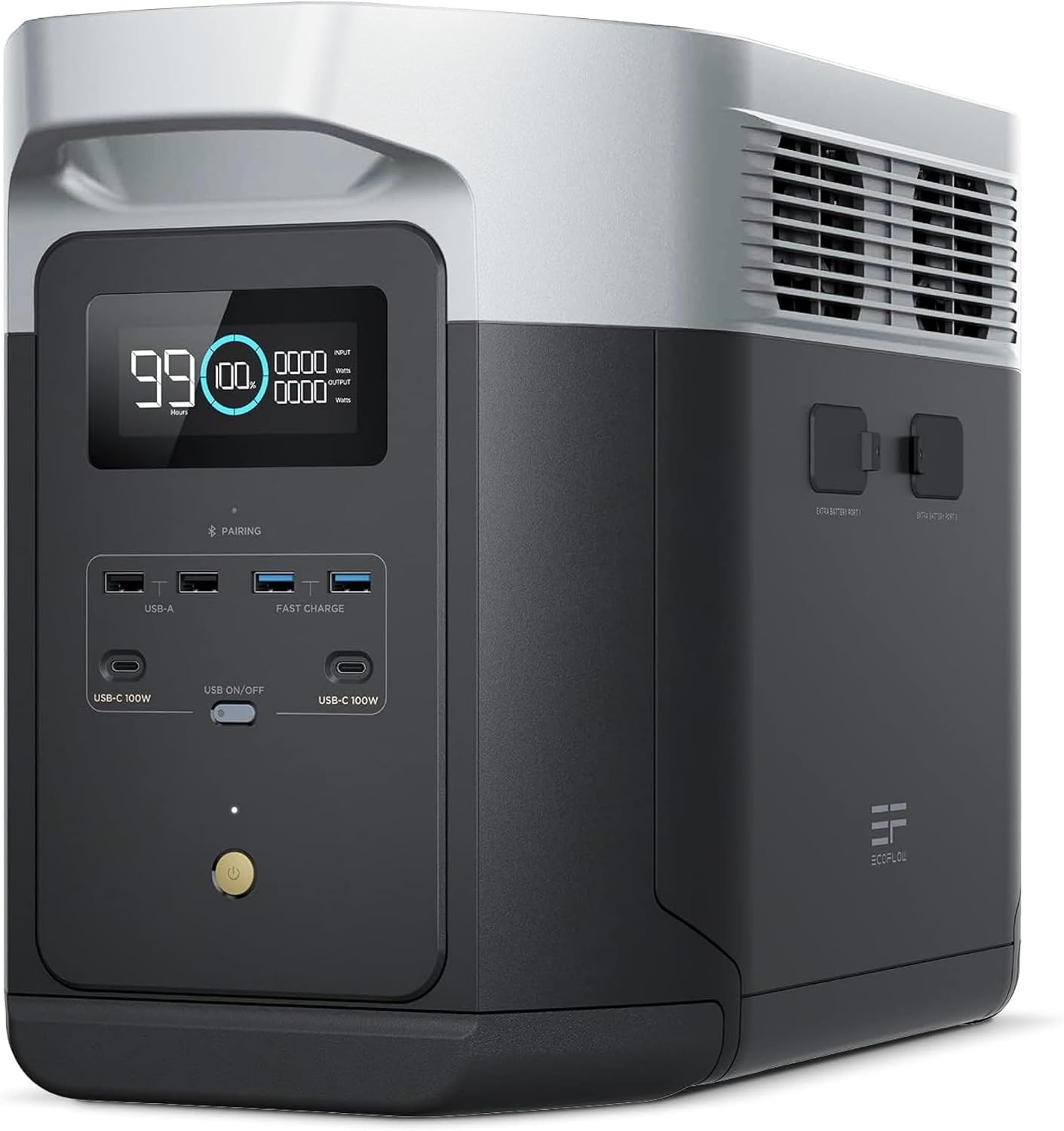
EcoFlow DELTA 2 (1,024Wh)
Check Price on Amazon ↗Efficiency & Pricing Reality Check
Two real-world numbers define the EcoFlow DELTA 2's value: conversion overhead and price per watt-hour.
- Real usable energy vs. wall recharge draw: Delivering roughly 850Wh from a 1,024Wh pack puts AC discharge efficiency at ~83%—normal for a high-output 1,800W inverter and close to Trendifacts' 85% planning rule. Refilling the battery from completely empty draws roughly 1,220Wh from the wall due to AC-to-DC charging losses (an overall round-trip efficiency near 70%), which matters mainly if you are calculating solar panel recharge time or off-grid fuel costs.
- Massive price drop since launch: The DELTA 2 launched around $899 ($0.88/Wh), later settled around a $699 reference price ($0.68/Wh), and dipped as low as $349 ($0.34/Wh) during recent major holiday sales.
| Pricing Tier | Example Price | Price per Wh (1,024Wh) | Value Verdict |
|---|---|---|---|
| Launch-Era MSRP | ~$899 | $0.88/Wh | Never pay this—outclassed by newer units |
| Standard List Price | ~$699 | $0.68/Wh | Overpriced vs. newer 1,000Wh rivals |
| Fair Street Sale | ~$449–$499 | $0.44–$0.49/Wh | Competitive if you need 6 outlets and fast charging |
| Strong Holiday / Clearance Deal | ~$349–$399 | $0.34–$0.39/Wh | Standout value in the 1,000Wh LiFePO4 class |
Because competing 1,000Wh-class units routinely sell between $0.39 and $0.54 per Wh during seasonal promotions, treat $0.45/Wh (~$460) as your upper ceiling on the DELTA 2. Compare live pricing using our power station price-per-watt-hour guide and Black Friday power station deals 2026 guide.
What It Runs: Worked Runtime Math
Using a conservative 850Wh of usable AC energy, here is what the EcoFlow DELTA 2 realistically powers on a single charge:
| Appliance / Load | Typical Power Draw | Estimated Runtime on 850Wh |
|---|---|---|
| Wi-Fi Router & Modem | ~18W | ~47 hours |
| CPAP (no heated humidifier) | 40 to 55W | ~15.5 to 21.3 hours |
| CPAP (with heated humidifier) | 55 to 130W | ~6.5 to 15.5 hours |
| Laptop (active work/charging) | ~60W | ~14 hours |
| Full-Size Refrigerator | ~1,000 to 2,000Wh/day | ~10 to 20 hours |
| Window Air Conditioner | 500 to 900W (cycling) | ~1 to 2.5 hours (see our window AC runtime guide) |
| Space Heater (1,500W high) | 1,500W | ~34 minutes |
Household Outage Profiles (No Recharging)
Mapping 850Wh against the four daily outage profiles in our power station outage sizing chart:
- Profile A (Wi-Fi router and phones — ~447Wh/day): ~1.9 days (~46 hours)
- Profile B (Adds a CPAP without humidifier — ~927Wh/day): ~0.92 days (~22 hours)
- Profile C (Adds a work laptop and LED lights — ~1,287Wh/day): ~0.66 days (~16 hours)
- Profile D (Adds a full-size refrigerator — ~2,787Wh/day): ~0.31 days (~7.3 hours)
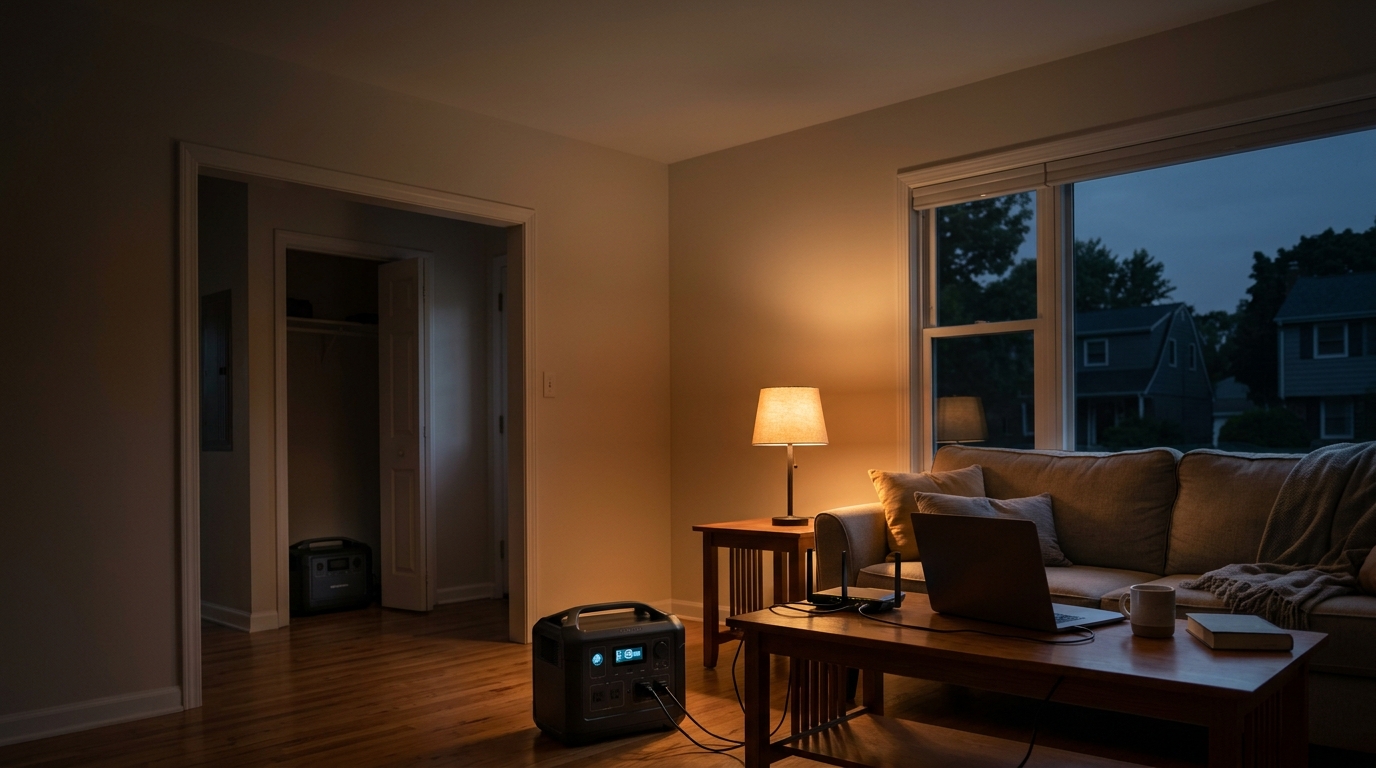
In short: the standalone DELTA 2 easily covers a full overnight CPAP outage plus morning phones, but falls just short of a complete 24-hour Profile B household day without recharging or adding an expansion battery. Want to test your own mix of appliances? Plug their wattages into our calculator below:
⚡ Power Station Size Calculator
Enter your appliance's wattage to see exactly which portable power station you need.
Solar & Fast-Charge Scenarios
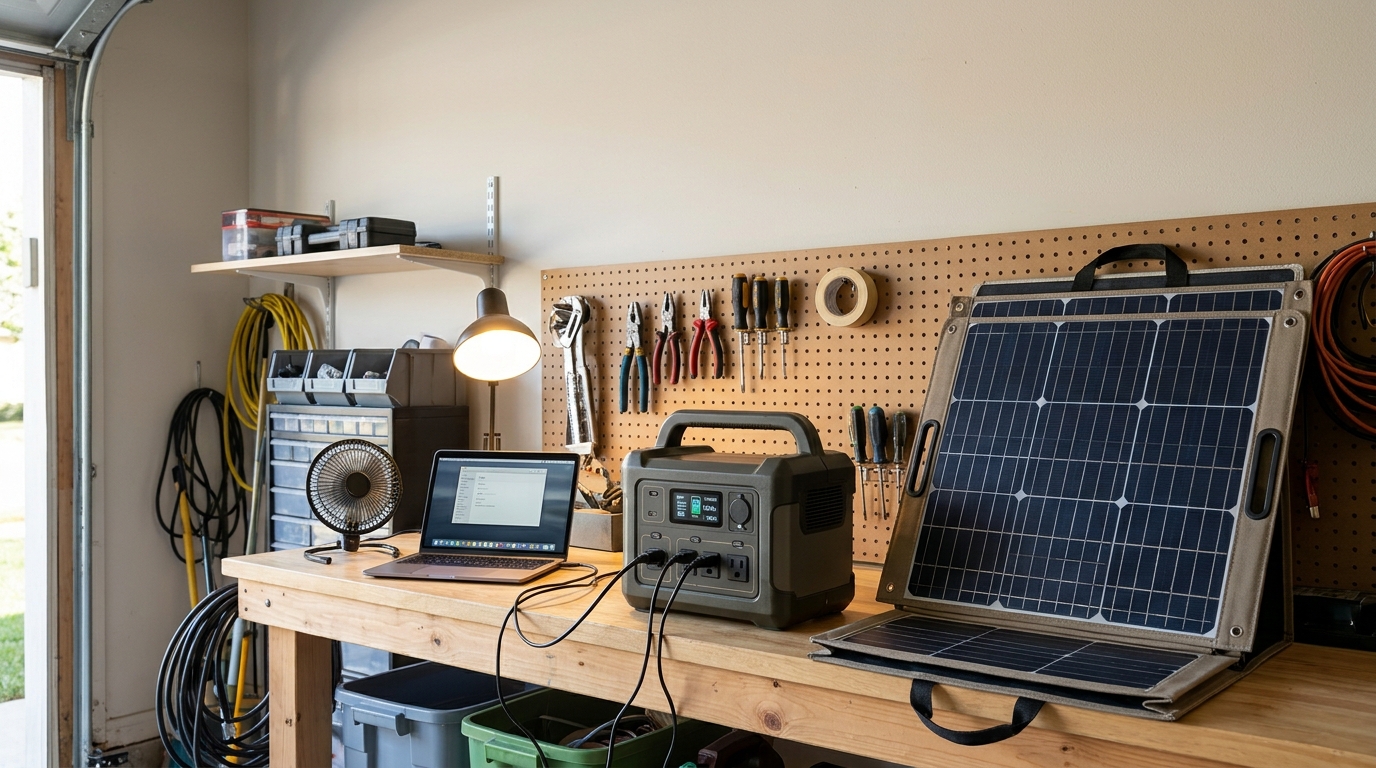
- Solar recharge math: Accounting for ~90% solar charging efficiency (1,024Wh ÷ 0.90 = 1,138Wh of solar input needed from empty) and conservative panel output (Panel Watts × Peak Sun Hours × 0.75):
- 500W max solar array (5 peak sun hours): Produces 1,875Wh/day—refilling the DELTA 2 from empty in roughly 0.6 days (~3 peak sun hours) in clear sunshine.
- Single 200W panel (5 peak sun hours): Produces 750Wh/day—requiring roughly 1.5 sunny days from empty.
- Single 200W panel in winter/cloudy weather (2 peak sun hours): Produces 300Wh/day—stretching a full recharge to ~3.8 days.
- Compare panel pairings in our solar panel wattage vs. recharge time chart and portable solar panels guide.
- Rolling-outage wall charging advantage: At 1,200W AC input, reaching 80% in ~50 minutes and 100% in ~80 minutes means even a brief 1-hour grid restoration window gives you nearly a full battery for the next blackout cycle. See how that stacks up across brands in our EcoFlow vs. Jackery vs. Bluetti recharge times comparison.
Strengths
- Fast wall recharging: 0–80% in ~50 minutes and 0–100% in ~80 minutes makes it ideal for rolling blackouts or quick pre-storm top-ups.
- High AC output and six outlets: 1,800W continuous (2,700W surge) across six AC plugs—plus dual 100W USB-C ports and four USB-A ports—lets you run an entire desk or storm kit without daisy-chaining extra power strips.
- Long-life LiFePO4 battery: Rated for 3,000+ cycles to 80% capacity—read why LFP chemistry matters for longevity in our LiFePO4 vs. lithium-ion power station guide.
- Strong 500W solar ceiling: Accepts more solar wattage than 400W-capped competitors, cutting afternoon recharge times during multi-day outages.
- Modular battery expansion: Supports a single extra battery to double capacity to 2,048Wh (DELTA 2 Extra Battery) or triple it to 3,040Wh (DELTA Max Extra Battery)—see whether add-on packs make financial sense in our expandable battery power stations guide.
- 5-year warranty: Matches the multi-year coverage offered by top competitors when bought through authorized channels.
Weaknesses
- ~850Wh usable AC ceiling: Leaves less overnight headroom than slightly larger 1,152Wh–1,536Wh models for full-day CPAP households.
- Older generation design: EcoFlow's newer DELTA 3 series improves quiet operation and UPS switchover speed, so the DELTA 2 only makes sense at a discount.
- 27 lb carry weight: Manageable with dual handles, though noticeably heavier than ~24 lb ultralight rivals.
- App and firmware reliance: Adjusting charging wattage, X-Boost, and charge limits relies on the EcoFlow app, and older stock occasionally requires a firmware update right out of the box.
- Not a true zero-ms server UPS: Its <30 ms EPS switchover keeps routers, modems, and lamps running, but sensitive desktop workstations or NAS servers can still reboot during a grid cut.
- High-wattage heating limits: Even with 1,800W output and X-Boost, running a 1,500W space heater empties the battery in roughly half an hour—see our space heater runtime guide for why batteries are poor primary heat sources.
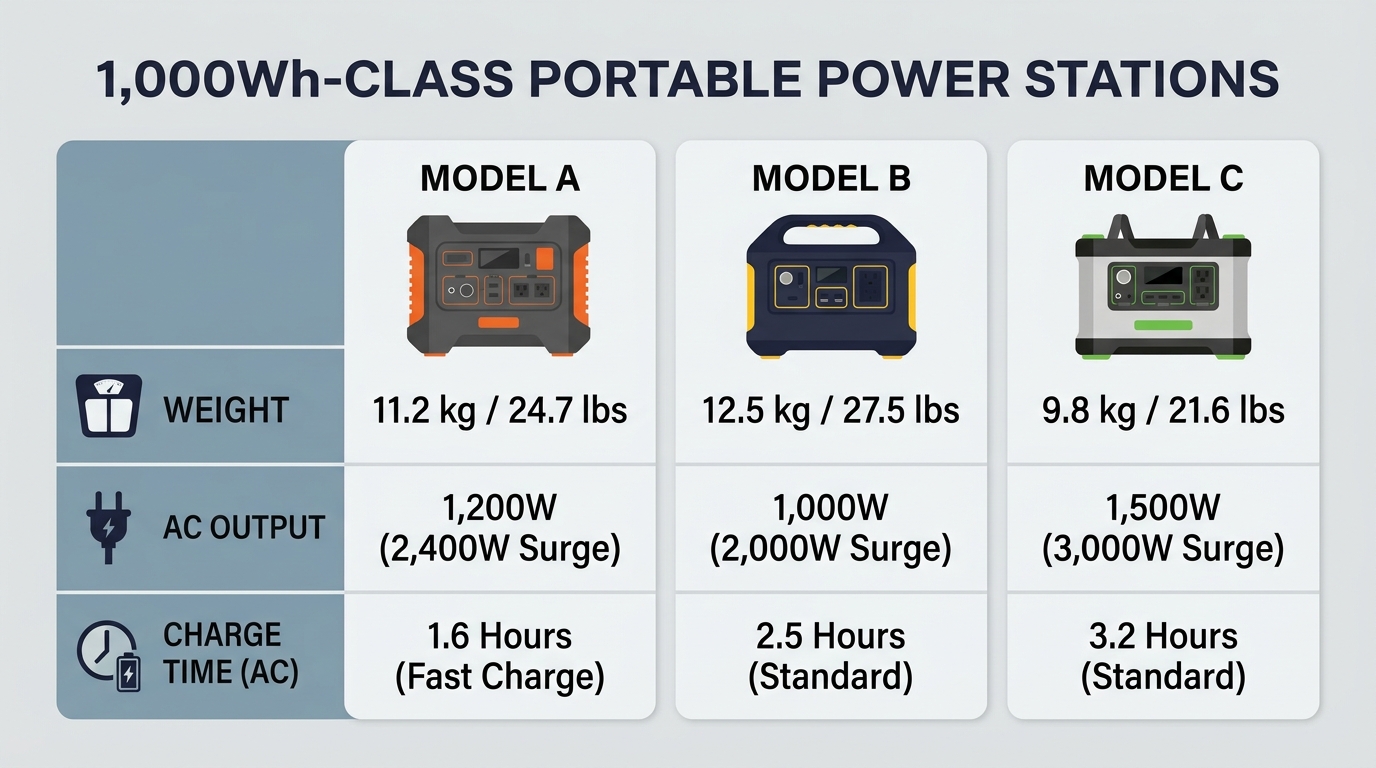
EcoFlow DELTA 2 vs. Jackery Explorer 1000 v2 vs. Bluetti AC180
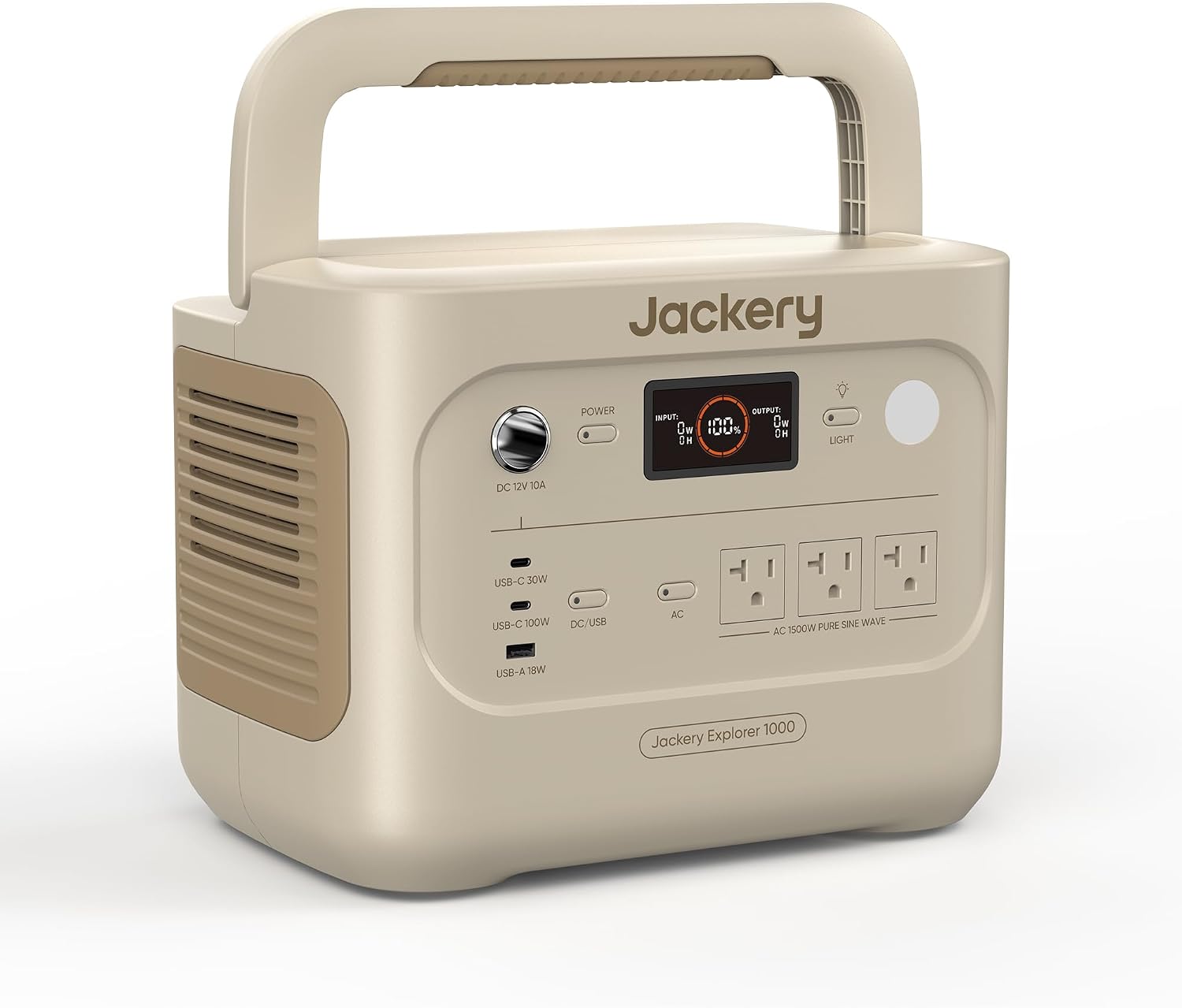
| Specification | EcoFlow DELTA 2 | Jackery Explorer 1000 v2 | Bluetti AC180 |
|---|---|---|---|
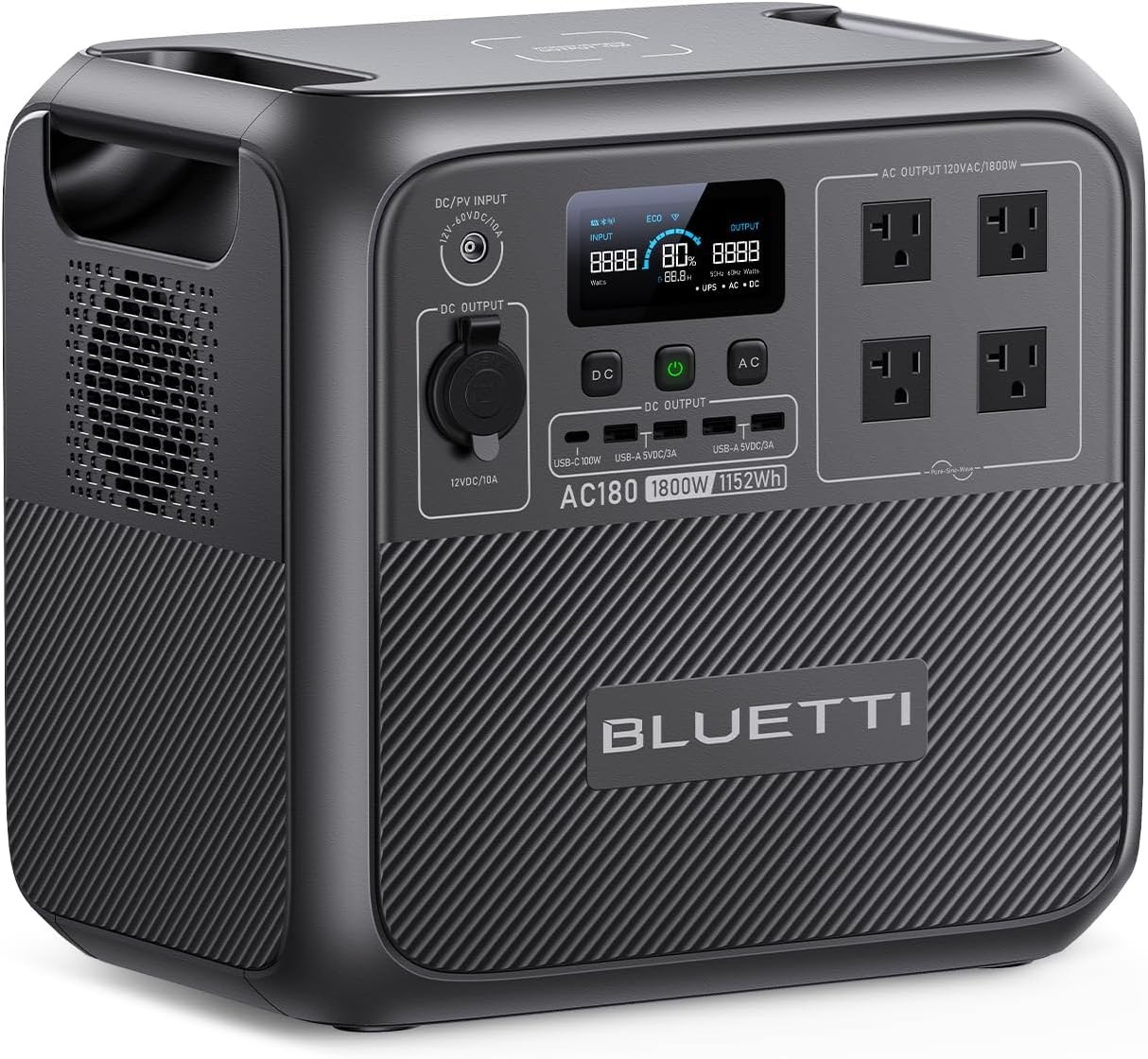
| Rated Capacity | 1,024Wh (~850Wh usable) | 1,070Wh* (~910Wh usable) | 1,152Wh (~979Wh usable) |
| AC Output (Surge) | 1,800W (2,700W surge) | 1,500W (3,000W surge) | 1,800W (2,700W Power Lifting) |
| AC Outlets (US) | 6 | 3 | 4 |
| Weight | 27 lb | 23.8 lb | 35.3 lb |
| Wall Charge (0–100%) | ~80 min (1,200W) | ~1.7 hrs (~1 hr Emergency Mode) | ~1.3–1.8 hrs (1,440W Turbo) |
| Max Solar Input | 500W | 400W | 500W |
| Expandable? | Yes (up to 3,040Wh) | No | No |
| Warranty | 5 years | 5 years (3+2) | 5 years |
*Updated Jackery Explorer 1000 v2 US listings may show 1,024Wh.
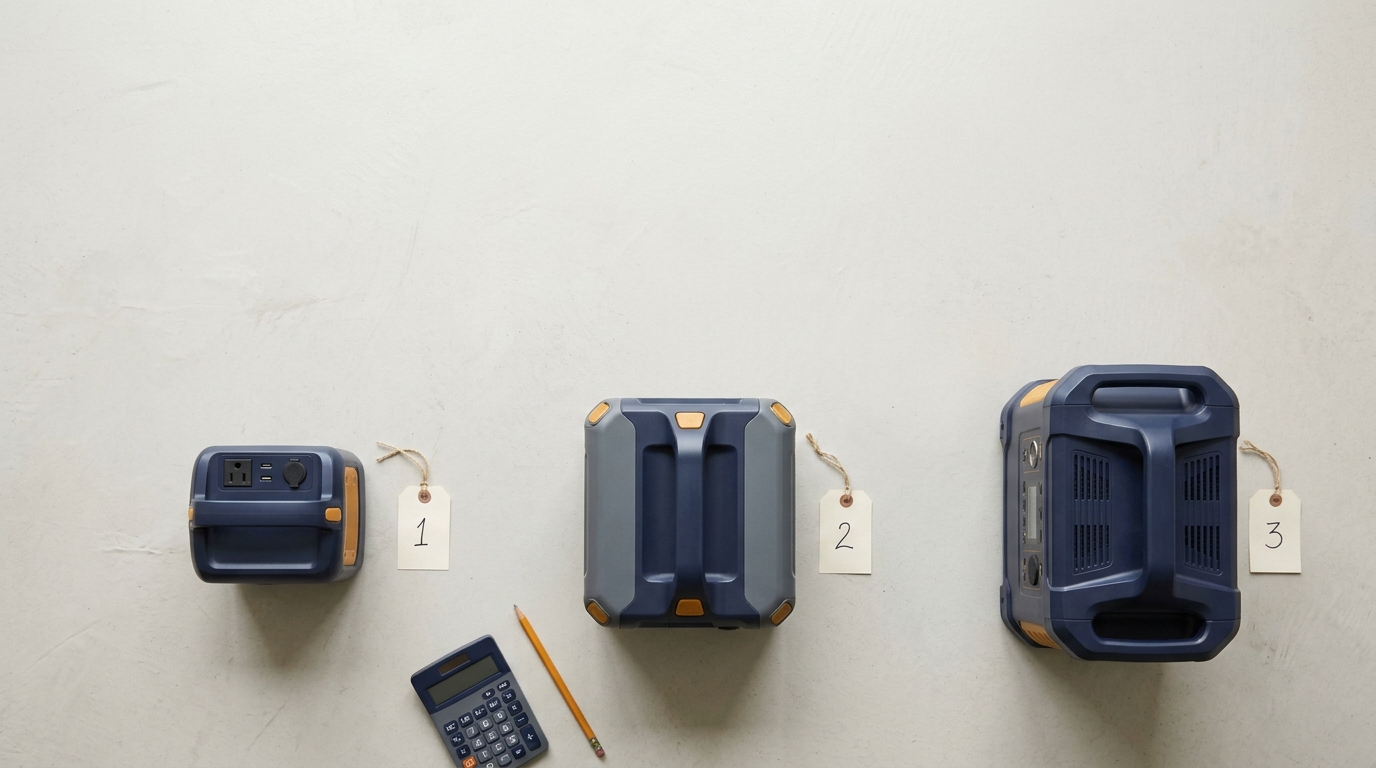
The trade-off is clean: the DELTA 2 wins on fast wall charging, six AC outlets, and modular expansion; the Jackery Explorer 1000 v2 wins on lowest carry weight and quiet bedroom fans (read our Jackery Explorer 1000 v2 review); and the Bluetti AC180 wins on out-of-the-box capacity for full-day CPAP households.
You can also see how the DELTA 2 compares against a heavier 2,000Wh unit in our EcoFlow Delta 2 vs. Bluetti AC200P breakdown, or browse all household tiers in our best portable power stations for home backup.
Bluetti AC180 (1,152Wh)
Check Price on Amazon ↗Who Should Buy the EcoFlow DELTA 2
- Households facing short, rolling outages where recharging from 0% to 80% in 50 minutes is a major practical advantage.
- Remote workers and multi-device desks who want six AC outlets and dual 100W USB-C ports—pair it with our home office blackout setup guide.
- Campers and van travelers who want 500W solar recharging and strong AC output for coffee makers or cooking gear.
- Buyers who want a budget entry point today with expansion later via a DELTA 2 or DELTA Max extra battery.
Who Should Look Elsewhere
- Full-day CPAP households who do not want to buy an extra battery: The 1,152Wh Bluetti AC180 or 1,536Wh Jackery Explorer 1500 v2 gives more breathing room without recharging.
- Noise-sensitive bedroom sleepers or ultralight campers: Compare fan ratings in our power station noise levels comparison or look at the lighter Jackery Explorer 1000 v2.
- Buyers wanting the latest hardware generation: Compare live pricing against EcoFlow's newer DELTA 3 lineup and our Anker SOLIX C1000X review before paying more than ~$450.
- Server and sensitive workstation owners: Use a dedicated computer UPS rather than relying on a <30 ms EPS switchover.
Before You Buy: 6-Point Verification Checklist
- Calculate live price per watt-hour: Aim for $0.35 to $0.45/Wh (~$350–$460); skip listings near $699+.
- Verify seller authorization & warranty: Confirm the "Sold by" line is EcoFlow or an authorized retailer so the 5-year warranty stays valid.
- Price the extra battery upfront: If you plan to expand later, check current availability and pricing for the compatible DELTA 2 or DELTA Max Extra Battery first.
- Update firmware right after unboxing: Connect the unit to the EcoFlow app on Wi-Fi and install any pending firmware updates before relying on it in a storm.
- Store safely indoors: Keep it dry, ventilated, and out of freezing garages—review our cold-weather charging limits guide before winter storage.
- Confirm medical device cables: If backing up a CPAP, check DC cable compatibility in our best portable power stations for CPAP machines and 1,000Wh CPAP runtime guide.
Frequently Asked Questions
Is the EcoFlow DELTA 2 still worth buying in 2026?
Yes—strictly at sale pricing. Near $349 to $450 ($0.34–$0.44/Wh), its 80-minute wall recharge, six AC outlets, 500W solar input, and expansion port still deliver strong value. At $600+, newer-generation 1,000Wh units are better buys.
How long will the EcoFlow DELTA 2 run a full-size refrigerator?
Using ~850Wh of usable AC energy, it runs a typical full-size refrigerator (1,000 to 2,000Wh per day) for roughly 10 to 20 hours, depending on ambient kitchen temperature and how often the doors are opened.
How fast does the EcoFlow DELTA 2 charge from a wall outlet?
At its maximum 1,200W AC input, it recharges from 0% to 80% in roughly 50 minutes and reaches 100% in about 80 minutes. You can dial the charge speed down in the EcoFlow app to reduce fan noise.
Does the EcoFlow DELTA 2 use a LiFePO4 battery?
Yes. It uses LiFePO4 (LFP) cells rated for 3,000+ charge cycles while retaining at least 80% of original capacity.
Can you expand the EcoFlow DELTA 2's battery capacity?
Yes. Its single expansion port connects to a DELTA 2 Extra Battery (bringing total capacity to 2,048Wh) or a DELTA Max Extra Battery (bringing total capacity to 3,040Wh).
Is the EcoFlow DELTA 2 the best 1,000Wh power station?
It remains one of the fastest-charging and most outlet-rich 1,000Wh stations when heavily discounted, though the Jackery Explorer 1000 v2 is lighter and quieter, and the Bluetti AC180 offers more out-of-the-box capacity.
Final Verdict
The EcoFlow DELTA 2 delivers roughly 850Wh of usable AC energy, 1,800W across six outlets, 500W solar input, 80-minute wall charging, and a 5-year warranty backed by LiFePO4 longevity. Because it is now a previous-generation design with a modest usable capacity ceiling, price per watt-hour is the whole decision: buy it confidently when sales drop it into the $349–$450 window for rolling-outage speed and home office versatility, or step across to newer rivals like the Bluetti AC180, Anker SOLIX C1000X, or Jackery Explorer 1000 v2 when prices sit closer together.