Affiliate disclosure: some links on this page may earn Trendifacts a commission at no extra cost to you. It does not change what we recommend.
For camping, a 50 to 100W portable solar panel is enough for phones, a camera and a headlamp, while a camp fridge, laptop and lights call for at least 200W of panels paired with a mid-size power station, according to Goal Zero's guidance and our own math. Use this formula to plan: daily energy in watt-hours equals panel watts x peak sun hours x 0.75. Point the panel at the sun, keep it out of shade, keep it cool, and match its voltage and connector to your power station.
This guide explains how to choose a panel type, how to size it for a weekend or a week with a worked example, how to set it up for the best output, what to do in clouds and cold, and which mistakes waste the most sun.
The Short Answer
| What you run while camping | Daily energy (approx.) | Panel to plan on |
|---|---|---|
| Phones, headlamp, small camera | 50 to 150Wh | 50 to 100W |
| Add laptop and lights | 150 to 300Wh | 100W |
| Add a 12V compressor fridge | 700 to 1,000Wh | 200 to 300W |
| Add heavy gear (e-bikes, CPAP, small appliances) | 1,000Wh or more | 300 to 400W |
Peak Sun Hours: The Number Behind Every Plan
Panel watt ratings assume full, direct sun. Goal Zero defines peak sun hours as the hours when sunlight averages 1,000 watts per square meter, and notes that on a summer solstice day with about 15 hours of light, panels might see only 5 to 6 peak sun hours, because early and late light is too low to matter.
Dense forest, deep valleys, fall and winter, and clouds all reduce it. For a trip plan, use 4 to 5 peak sun hours in a sunny summer, 2 to 3 in shoulder seasons and 1 to 2 in poor weather, and check NREL's PVWatts or a similar tool for your region.
Then apply a real-world factor of 0.75 for heat, wiring, imperfect angle and controller losses. That gives the formula we use throughout this site:
Daily Wh = panel watts x peak sun hours x 0.75
Types of Portable Panels
| Type | Strengths | Weaknesses |
|---|---|---|
| Foldable panel with kickstand | Packs flat, tough fabric or ETFE surface, easy to aim | More expensive per watt than rigid |
| Briefcase-style rigid panel | Durable, easy to carry | Heavier |
| Roll-up or flexible panel | Very light | Often less efficient and less durable |
| Small USB panels | Direct phone charging | Slow and sun-sensitive; weak in clouds |
| Roof or fixed panels | Cheap per watt | Not portable, mostly for RVs |
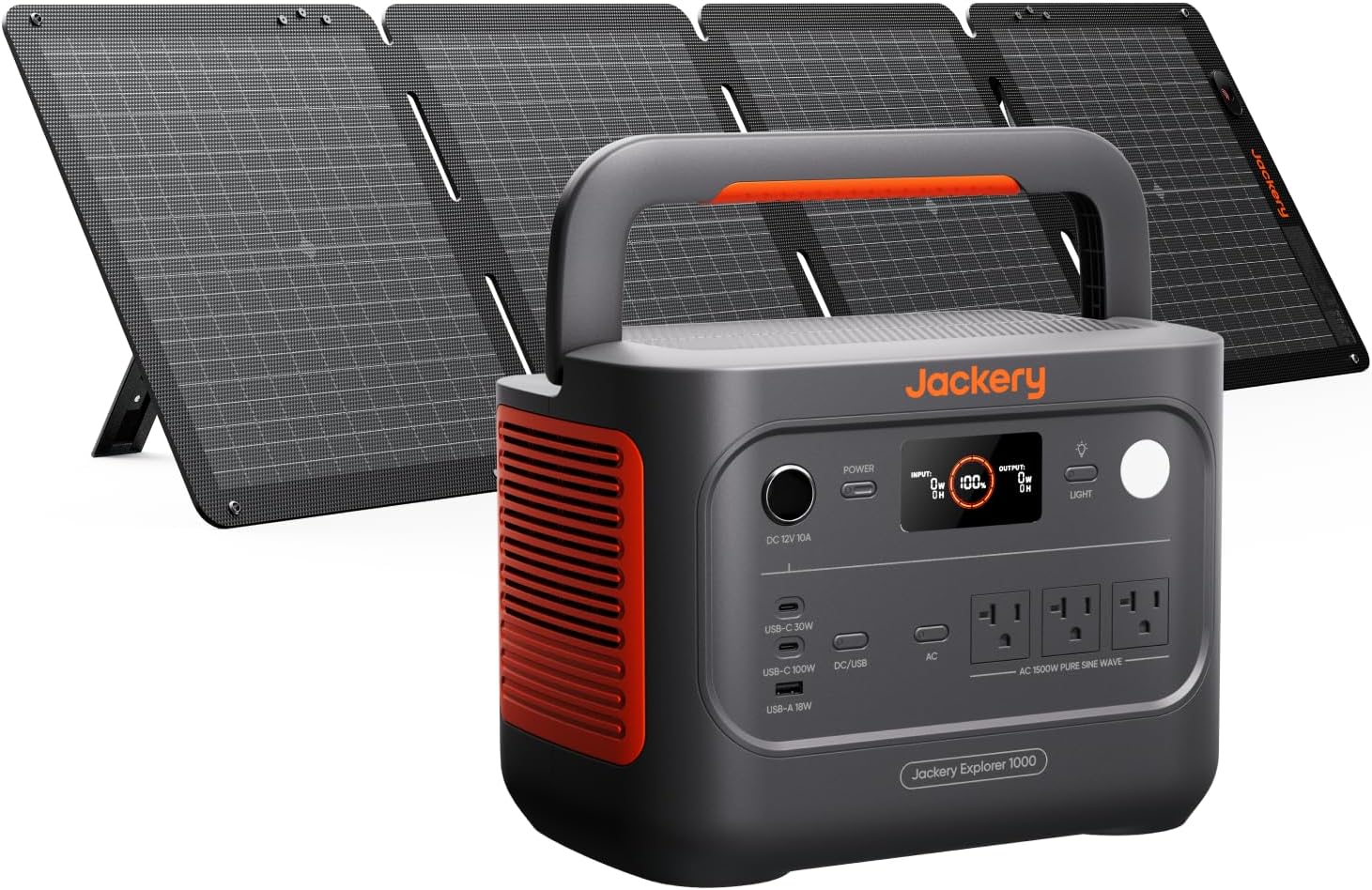
A single 50 to 100W panel is typically enough for phones, cameras and headlamps, per Goal Zero. For anything bigger, panels connect to a power station, which includes the charge controller. Our best solar panels guide compares models, and our solar recharge chart shows output by wattage.
Match the Panel to the Power Station
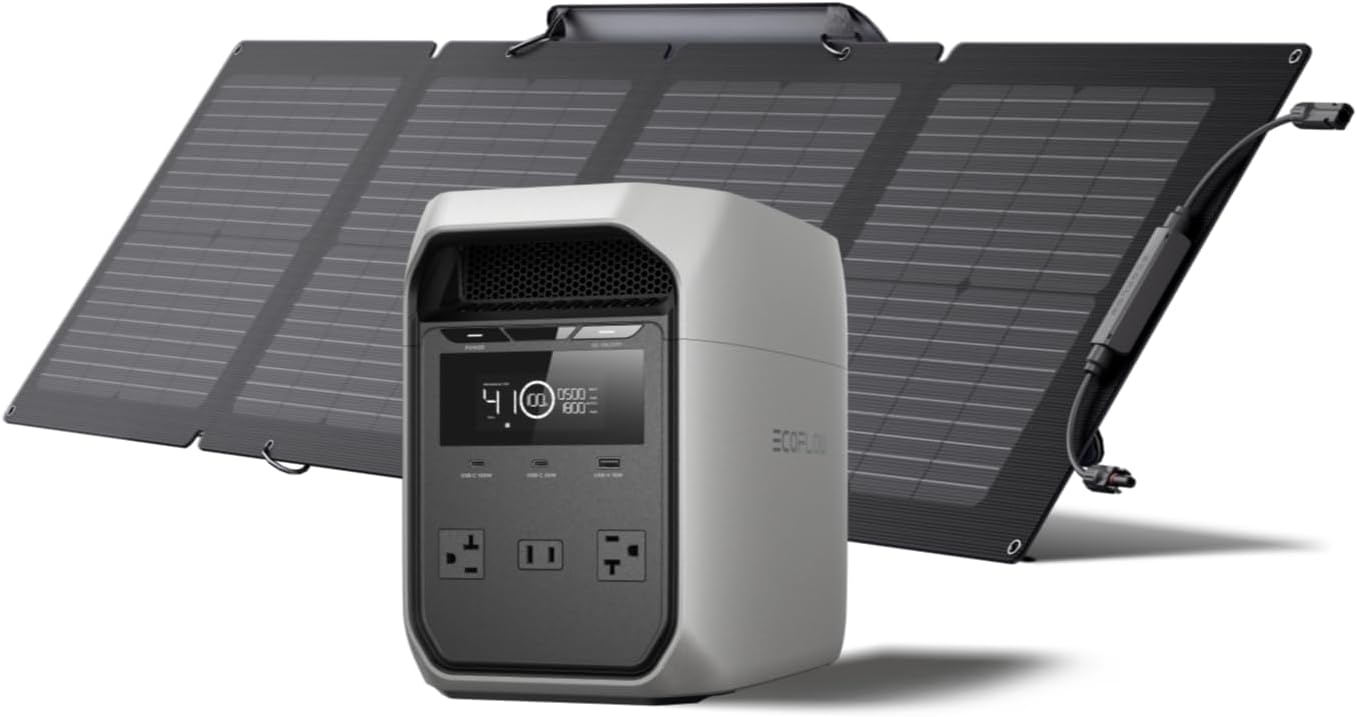
A panel that does not fit the station wastes money. Check three things in the manual:
- Maximum solar input watts. A 200W-limited input will not use 400W of panels.
- Input voltage range. Panels in series add voltage, and exceeding the maximum can cause shutdown or damage. Panels in parallel add current.
- Connector type. Common types include MC4, DC barrel and Anderson-style connectors, and adapters are often needed.
If you are shopping for the station too, see our portable solar power stations guide, under-$500 picks and Jackery 1000 vs 1500 comparison.
Sizing for a Weekend: A Worked Example
A couple camps for three days. We assume these loads, which you should replace with your own:
| Load | Assumption | Daily energy |
|---|---|---|
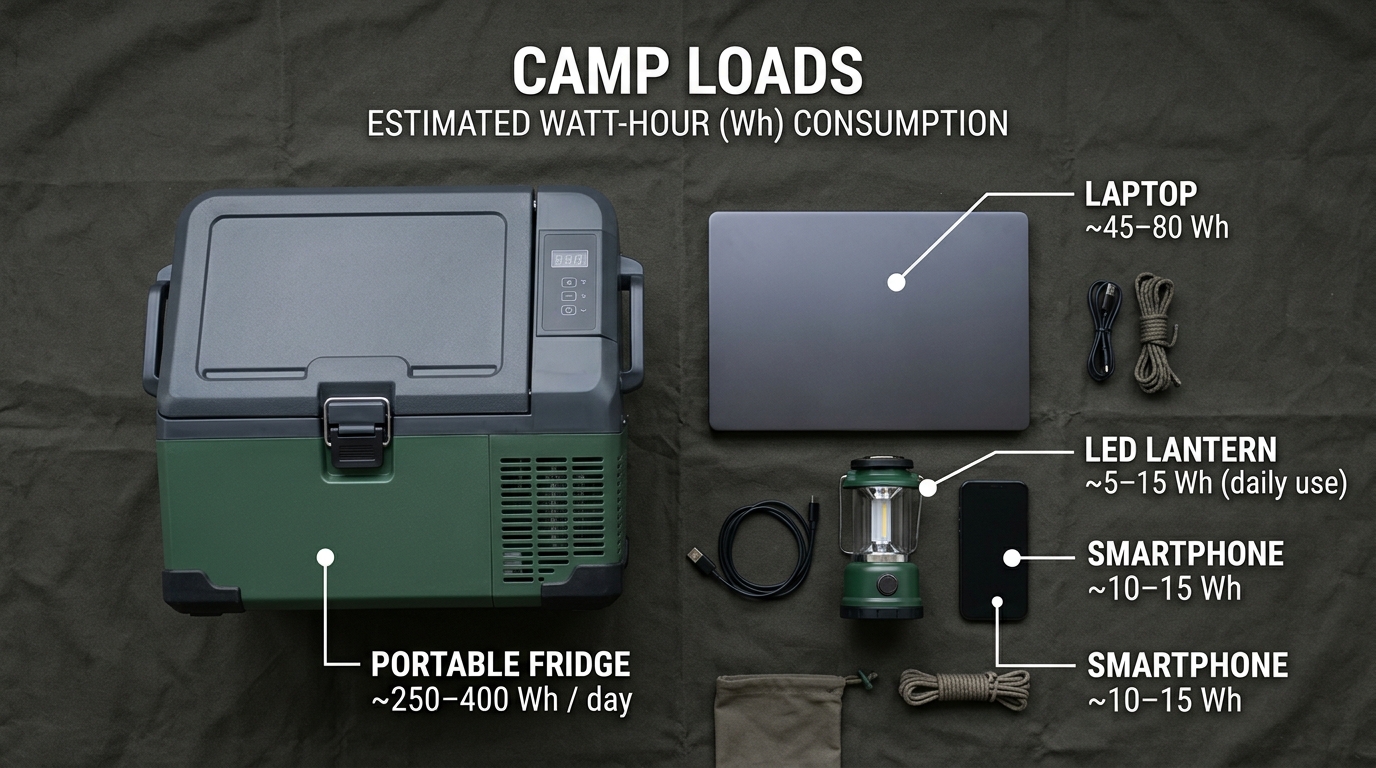
| Two phones | about 15Wh each charge | 30Wh |
| LED lantern | 5W for 5 hours | 25Wh |
| Laptop | 50W for 2 hours | 100Wh |
| Camera and drone batteries | one charge | 50Wh |
| 12V compressor fridge | averaging about 30W over 24 hours | 720Wh |
| Total with fridge | 925Wh | |
| Total without fridge | 205Wh |
Without the fridge. 205Wh a day at 5 peak sun hours needs 205 / (5 x 0.75) = about 55W of panel. A 100W panel gives 100 x 5 x 0.75 = 375Wh a day, a comfortable margin, and even at 3 peak sun hours it gives 225Wh.
With the fridge. 925Wh a day needs 925 / 3.75 = about 247W of panel at 5 peak sun hours. A 200W panel makes 750Wh, which covers 81% of the day's use, and a 300W panel makes 1,125Wh, which covers it with 200Wh to spare.
What about a cloudy day? At 2 peak sun hours, a 300W panel makes 300 x 2 x 0.75 = 450Wh, about half the fridge-inclusive need. The power station's battery has to bridge that gap.
A 1,000Wh class unit with about 850Wh usable can cover roughly a day's deficit, which is why camping with a fridge pairs a 200 to 300W panel with a battery of about 1,000Wh or more. See our 1,000Wh runtime chart for what that battery can run on its own.
Check the fridge assumption. Compressor coolers vary a lot with model, ambient temperature and how often you open them, so measure yours with a plug-in watt meter before you rely on 30W.
How Long Will a Panel Take to Recharge a Station?
Use days to refill = (battery Wh / 0.9) / daily solar Wh.
| Battery | Panel | Peak sun hours | Daily solar Wh | Days to refill from empty |
|---|---|---|---|---|
| 300Wh | 100W | 5 | 375 | (300 / 0.9) / 375 = about 0.9 day |
| 1,000Wh | 100W | 5 | 375 | (1,000 / 0.9) / 375 = about 3 days |
| 1,000Wh | 200W | 5 | 750 | about 1.5 days |
| 1,000Wh | 200W | 3 | 450 | about 2.5 days |
| 2,000Wh | 400W | 5 | 1,500 | about 1.5 days |
Manufacturers' own recharge claims depend on ideal conditions. Even Goal Zero's published material for the same pairing gives different numbers in different places, such as a text claim of just over an hour next to a table showing about four hours for 0 to 80%, so we trust the arithmetic above over any single headline figure.
Setup Tips That Raise Real Output
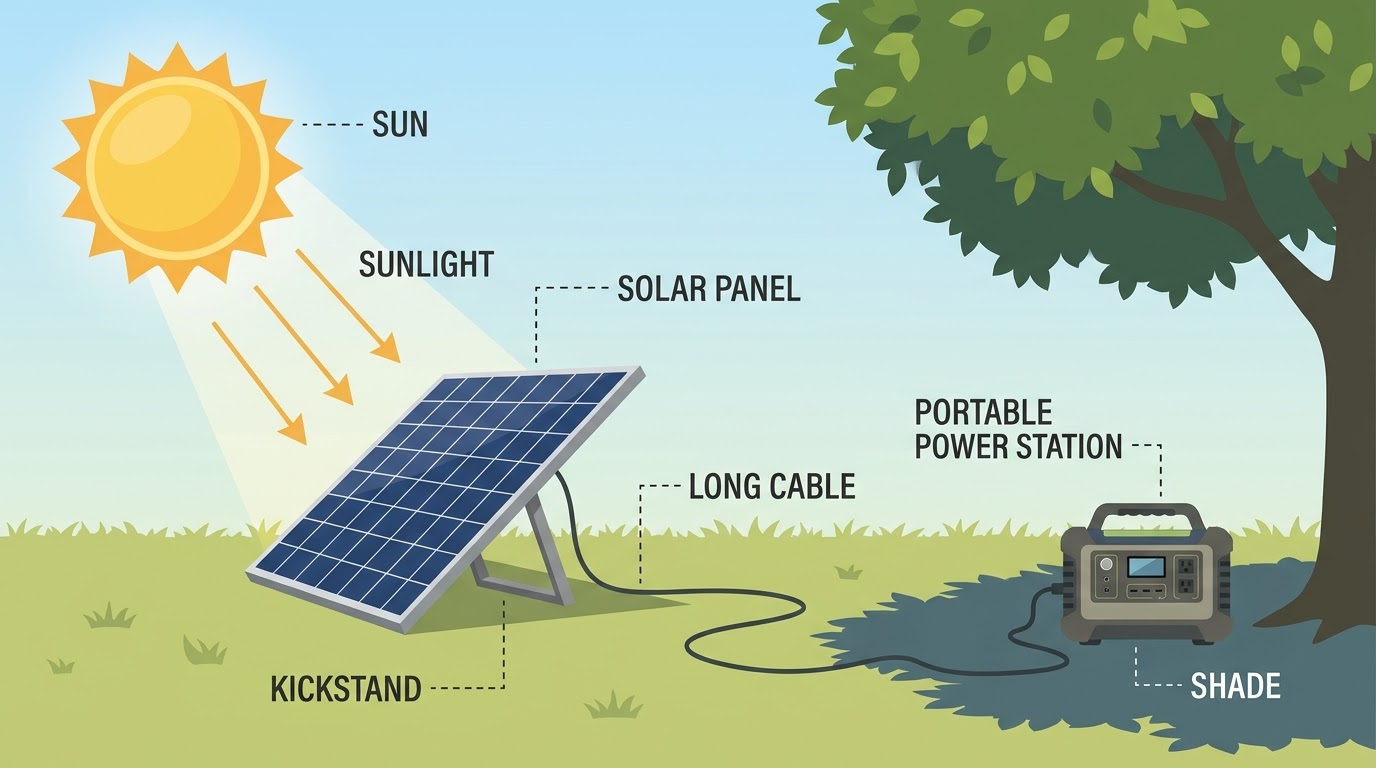
- Aim at the sun, not the sky. Goal Zero notes that panels should be flatter in summer, when the sun is high, and tilted more in fall and winter. Re-aim every couple of hours, or set the panel up on a kickstand facing south in the Northern Hemisphere.
- Avoid shade completely. Even a shadow from a single tree branch can drastically cut efficiency. Move the panel, not the camp, and run a longer cable so the station stays in shade.
- Keep panels cool. Heat lowers efficiency, and Goal Zero advises elevating panels off hot asphalt or rock so air can circulate. Morning sun is cooler and charges efficiently.
- Keep the station in the shade. Batteries last longer and charge better away from direct sun and heat. Our hot garage storage guide explains why, including for hot cars.
- Use short, thick cables between panel and station to cut losses.
- Clean the panel of dust and pollen with a soft cloth.
- Secure it against wind and theft. A panel on a kickstand can tip over in a gust, so weigh down the base.
- Use pass-through carefully. Many stations can power devices while charging, but check the manual.
Cold, Clouds and Shoulder Seasons
In cold weather, panels can produce well because cold improves their electrical efficiency, but the battery may refuse to charge if it is below its charging floor, typically around 32°F for many lithium units. Keep the station insulated or in a tent vestibule.
Our cold weather charging guide covers this in detail. On cloudy days, output may be a fraction of normal, so plan on rationing: lights and phones first, fridge second, laptop last.
Camping Power Without Panels
Panels are one of three recharge methods. The others are the wall before you leave and a vehicle's 12V outlet while driving, which is slow but reliable. Many campers top up from the car on the way to camp, then use panels to extend the trip. If you also need backup for home outages, the same panels and station serve double duty; see our outage checklist for renters and hurricane checklist.
What Not to Do
- Do not run a generator or gas appliance inside a tent. See the CPSC's carbon monoxide guidance.
- Do not leave a power station in a hot car or direct sun.
- Do not connect panels whose combined voltage exceeds the station's input limit.
- Do not cover the panel with anything while connected, which can heat it unevenly.
- Do not expect a space heater, kettle or hair dryer to run from camp solar. See our space heater guide.
Buying Checklist
- Your daily Wh and your station's maximum solar input.
- A panel size from the formula, not from the box.
- Connector and voltage compatibility.
- Weight and packed size if you hike in.
- A kickstand or a way to aim it.
- Weather resistance, such as an IP rating, and a cable long enough to keep the station in shade.
- A warranty and a return window.
FAQ
How many watts of solar do I need for camping?
About 50 to 100W for phones and small electronics, and about 200 to 300W with a camp fridge and laptop.
Can I plug a solar panel directly into a phone?
Small USB panels can, but output swings with the sun. A panel into a power station, then devices from the station, is steadier.
Will a panel charge on a cloudy day?
Yes, but output can fall to a fraction of normal.
How long does a 100W panel take to charge a power station?
At 5 peak sun hours it yields about 375Wh a day, which is about 3 days for a 1,000Wh unit from empty.
Are foldable panels worth it?
Yes for portability. Rigid panels are heavier but cost less per watt.
Can I run a camp fridge on solar?
Yes with about 200 to 300W of panels and a 1,000Wh class battery, if the fridge averages around 30W. Measure yours.
The Bottom Line
Camping solar is simple arithmetic: add up your daily watt-hours, divide by peak sun hours x 0.75, and buy that many panel watts with a battery big enough to cover cloudy days. A 100W panel suits phones and lights, and 200 to 300W suits a fridge and laptop. Aim the panel, keep it cool and out of shade, and keep the battery warm and shaded.
Specifications vary by product, so check your power station's manual for solar input limits before you buy.