Last updated: November 2026. Method note: safety rules come from the U.S. Consumer Product Safety Commission (CPSC) Portable Generator Safety Alert; the outage statistic comes from the U.S. Energy Information Administration; everything else, including every sizing and cost figure, is our own arithmetic with the assumptions shown. We have not tested any generator, and this site does not sell them. Prices, fuel costs and fuel burn vary by model and location, so replace our example numbers with yours.
Affiliate disclosure: some links on this page may earn Trendifacts a commission at no extra cost to you. It does not change what we recommend. This site focuses on battery power stations, and we say plainly below when a generator is the better tool.
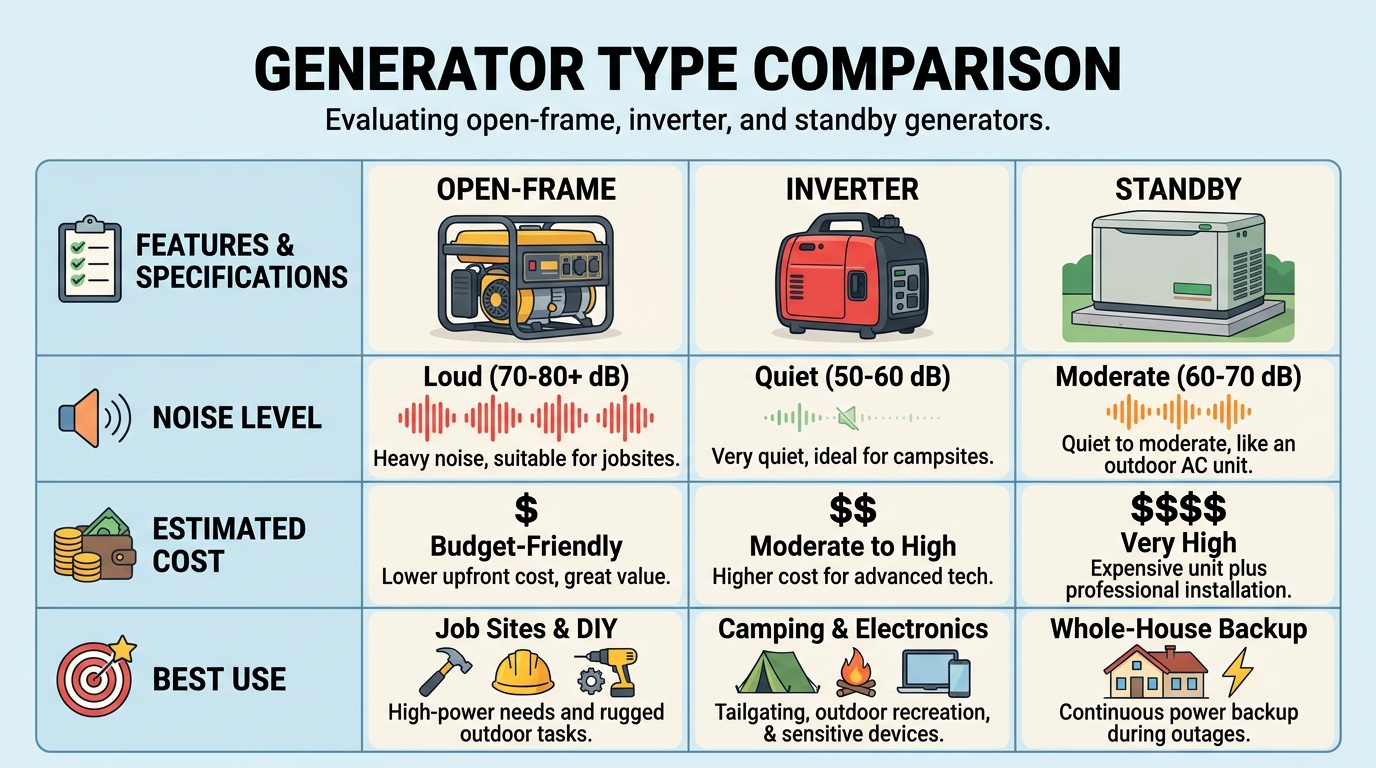
A backup power generator is the right tool when you need to run heavy or continuous loads, such as a well pump, central air conditioner, electric range or a whole house, for days, and you have a safe outdoor place to run it. Choose among three types: portable open-frame generators (cheapest per watt, loud), portable inverter generators (quieter and more fuel efficient, costlier per watt) and permanently installed standby generators (automatic, expensive, professionally installed). Size one by adding the running watts of what you want on, then making sure its starting watts cover your largest motor. Never run any generator indoors, in a garage or within 20 feet of doors, windows or vents.
This guide covers the types and fuels, a step-by-step sizing method with a worked example, the safety rules that prevent carbon monoxide deaths, a realistic cost view, and an honest section on when a battery power station is the better choice.
The Short Answer
| Type | Typical use | Strengths | Weaknesses |
|---|---|---|---|
| Portable open-frame | Several appliances or tools, days of use | Lowest cost per watt | Loud, less fuel efficient, manual setup |
| Portable inverter | Electronics, fridge, camping, quiet needs | Quieter, efficient at light load, clean power | More expensive per watt, smaller outputs |
| Dual-fuel portable | Flexibility of gasoline or propane | Propane stores well | Slightly lower output on propane |
| Standby (permanent) | Whole house, automatic start | Starts itself, runs on natural gas or propane | High cost, professional installation, permits |
First, the Safety Rules (From the CPSC)
Generators are the most dangerous backup option because they burn fuel and make carbon monoxide (CO). The CPSC's Portable Generator Safety Alert says:
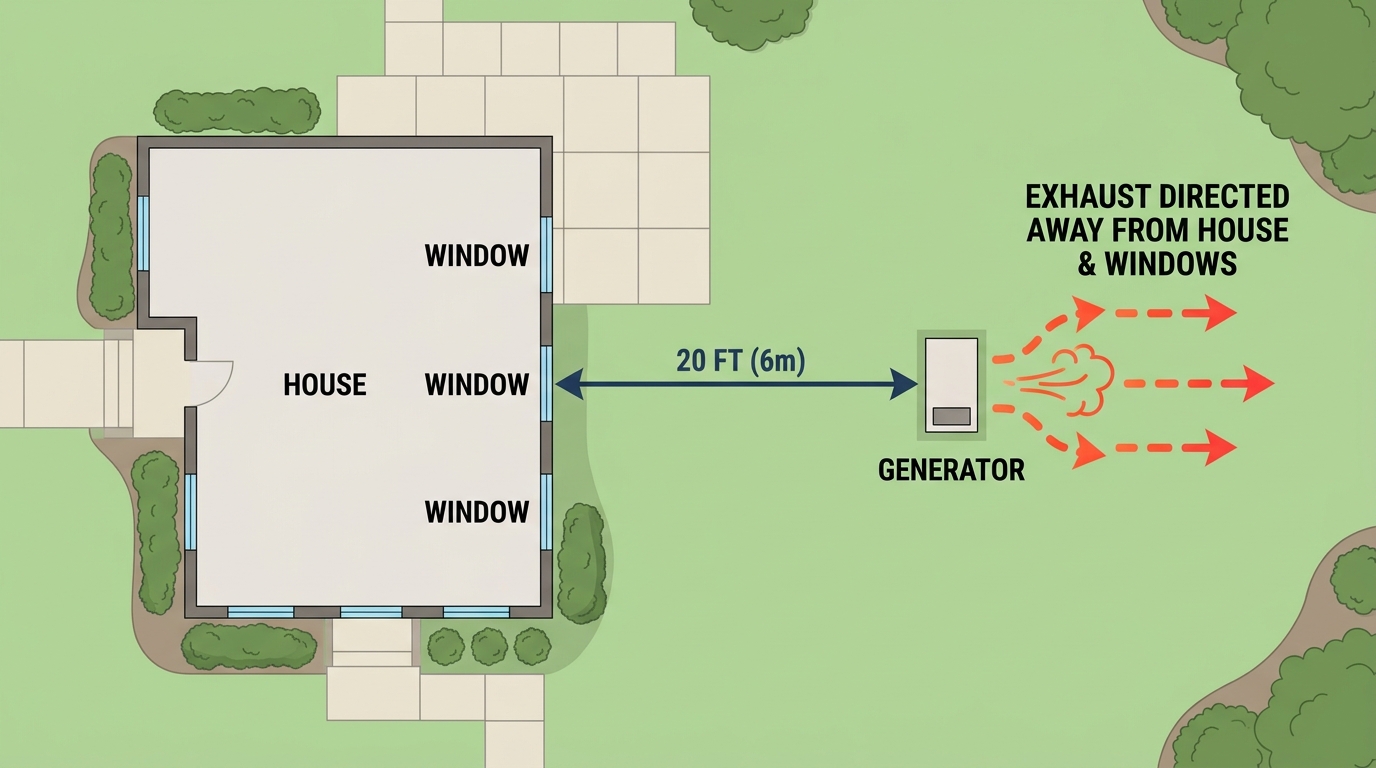
- Use portable generators outside only, at least 20 feet from doors, windows and vents. Never in a home, garage, crawlspace or shed, even with windows or doors open.
- Install battery-operated or battery-backup CO alarms certified to UL 2034, IAS 6-96 or CSA 6.19.01, and test the batteries monthly.
- Never plug a generator into a wall outlet to power house wiring. This "backfeeding" can electrocute utility workers and your neighbors.
- Use heavy-duty, outdoor-rated extension cords with a wattage rating above your total load, three-prong plugs, no damage, and not pinched in doors or windows.
- Store fuel outdoors, in labeled, non-glass safety containers, away from fuel-burning appliances.
- Turn the generator off and let it cool before refueling, because spilled gasoline on hot parts can ignite.
The CPSC's carbon monoxide information center offers more, and we repeat its figure that generator CO causes about 100 deaths a year in the U.S. Most incidents involve generators used indoors or in partly enclosed spaces. Two practical consequences for readers:
- An apartment balcony is not "outside" for a generator. It is typically too close to windows and doors, and often prohibited by lease or fire code.
- A garage with the door open is still unsafe. CO drifts into the house.
If safe outdoor placement is not possible, choose a battery power station. See our power station vs generator comparison.
Types and Fuels in More Detail
Portable open-frame generators are the traditional, least expensive way to get thousands of watts. They are loud, and their engines run at a constant speed regardless of load, so they burn more fuel at light loads.
Portable inverter generators produce AC, convert it to DC and invert it back, which gives cleaner power for electronics and lets the engine speed vary with load, saving fuel and noise. Output tends to be lower, commonly in the low thousands of watts.
Standby generators are installed outside the house, connected to the home's gas supply and to the electrical panel through an automatic transfer switch. They start themselves within seconds of an outage. They need professional installation, permits and often a maintenance plan.
Fuels:
| Fuel | Pros | Cons |
|---|---|---|
| Gasoline | Widely available, high output | Degrades in storage, needs stabilizer, supply shortages in disasters |
| Propane | Stores for years, burns cleaner | Slightly lower output, tanks needed |
| Natural gas | Unlimited supply during an outage if lines work | Needs a gas connection; standby units |
| Diesel | Efficient, durable | Heavy, costly, mostly larger units |
How to Size a Generator, Step by Step
- List what you want to run and note each item's running watts (from the label or a plug-in watt meter).
- Find starting watts for motors. A fridge compressor may start at two to five times its running watts, and well pumps and air conditioners often need more.
- Add the running watts of everything that will run together.
- Add the single largest starting surge on top of the running total, because motors rarely start at the same instant.
- Add 20% margin so the engine is not at its limit.
- Check the 240V needs. Well pumps, central air and ranges may need 240V outlets, so verify the generator provides them.
Worked example
A homeowner wants a fridge, a furnace fan, a sump pump, a router and modem, lights and phone chargers. We assume these figures, which you should replace with your own:
| Item | Running watts | Starting watts (assumed) |
|---|---|---|
| Refrigerator | 150W | 600W |
| Furnace blower | 600W | 1,200W |
| Sump pump | 800W | 2,400W |
| Router and modem | 18W | 18W |
| LED lights | 100W | 100W |
| Phone and laptop charging | 80W | 80W |
- Running total: 150 + 600 + 800 + 18 + 100 + 80 = 1,748W.
- Largest additional starting surge: the sump pump's extra 1,600W (2,400 minus its 800W running).
- Peak requirement: 1,748 + 1,600 = about 3,350W.
- With 20% margin: about 4,020W. A 4,000 to 4,500W generator is the sensible class.
If the same homeowner only wanted the fridge, router, lights and phones, the running total is 348W and a small inverter generator or a power station would do. That is why the loads you choose matter more than the house you live in.
Runtime and Fuel: An Illustrative Calculation
Fuel burn varies widely by model and load, so use the manufacturer's runtime-at-half-load figure. As an illustration, assume a generator that burns about 0.5 gallon an hour at half load, a 5-gallon fuel supply and gasoline at $3.50 a gallon.
- Runtime: 5 / 0.5 = about 10 hours.
- Fuel cost: 10 hours x 0.5 gallon x $3.50 = $17.50.
- For a 3-day outage at 12 hours a day, that is 36 hours x 0.5 = 18 gallons, about $63, so you need to store or obtain that fuel safely. Do not store more gasoline than local rules allow.
Compare this with a power station: a 4,000Wh class battery has about 3,400Wh usable and, at a 348W load, lasts about 9.8 hours. For days of runtime, a generator's strength is that you refill the tank, while a battery needs solar or grid power to refill. See our 4,000Wh runtime guide and solar sizing guide.
Connecting a Generator to Your House Safely
There are three safe ways:
- Plug appliances directly into the generator with outdoor-rated cords. Simple and safe, but cords snake into the house.
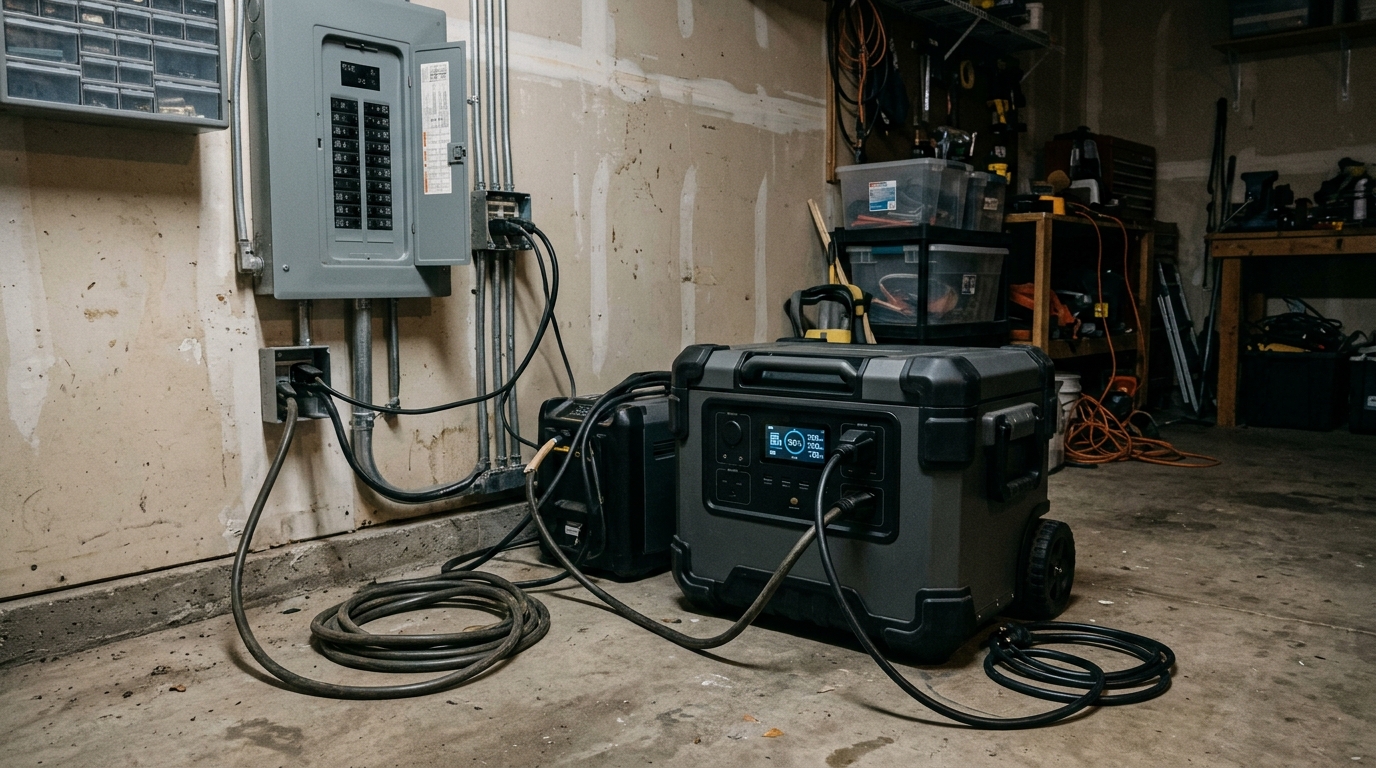
- Use a power inlet box with a transfer switch or interlock, installed by a licensed electrician, to power selected circuits through your panel.
- Install a standby generator with an automatic transfer switch.
The one unsafe way is backfeeding through a dryer or wall outlet using a "suicide cord." Do not do it. Ask your utility and electrician about permits and local rules.
Noise, Placement and Neighbors
Buying guides commonly describe portable generators at roughly 50 to 85 dBA, which is vacuum cleaner level or louder, for as long as they run. Place the generator on level, dry ground under a ventilated canopy designed for generators, with the exhaust pointing away from your home and neighbors, and at least 20 feet from openings. Many cities limit generator noise or hours. Our noise comparison shows how much quieter a power station is.
Maintenance and Readiness
- Test run monthly under a light load for 15 to 30 minutes.
- Change oil per the manual.
- Use fuel stabilizer in gasoline stored for months, or run the carburetor dry per the manual.
- Rotate stored fuel and keep it in approved containers outdoors.
- Keep spark plugs and air filters fresh.
- Write down the startup steps and keep them with the unit.
- Pre-stage cords and a CO alarm check before storm season.
A generator that has not been run in a year is the one most likely to fail when you need it.
Cost: What to Compare
Prices vary with brand, features and the market, so we avoid quoting figures we cannot source. Compare these on equal terms:
- Purchase price per running watt. Open-frame models usually win.
- Fuel cost per hour at your typical load.
- Annual maintenance and fuel rotation.
- Installation costs for a transfer switch or standby unit.
- Noise and neighbor tolerance, which is a cost too.
Outages in the U.S. averaged about 11 hours per customer in 2024, with major events accounting for nearly 9 of those hours, per EIA. If your outages are that short, a generator is used rarely, which strengthens the case for a battery. If you face multi-day events, the generator's fuel-based endurance matters more. For the battery alternative, see our home battery backup guide.
When a Battery Is the Better Choice
- You live in an apartment, condo or tight lot where you cannot safely place a generator.
- Your needs are a CPAP, router, phone, lights and perhaps a fridge. See our CPAP picks and sizing chart.
- You want silent, instant power overnight, for example for a medical device.
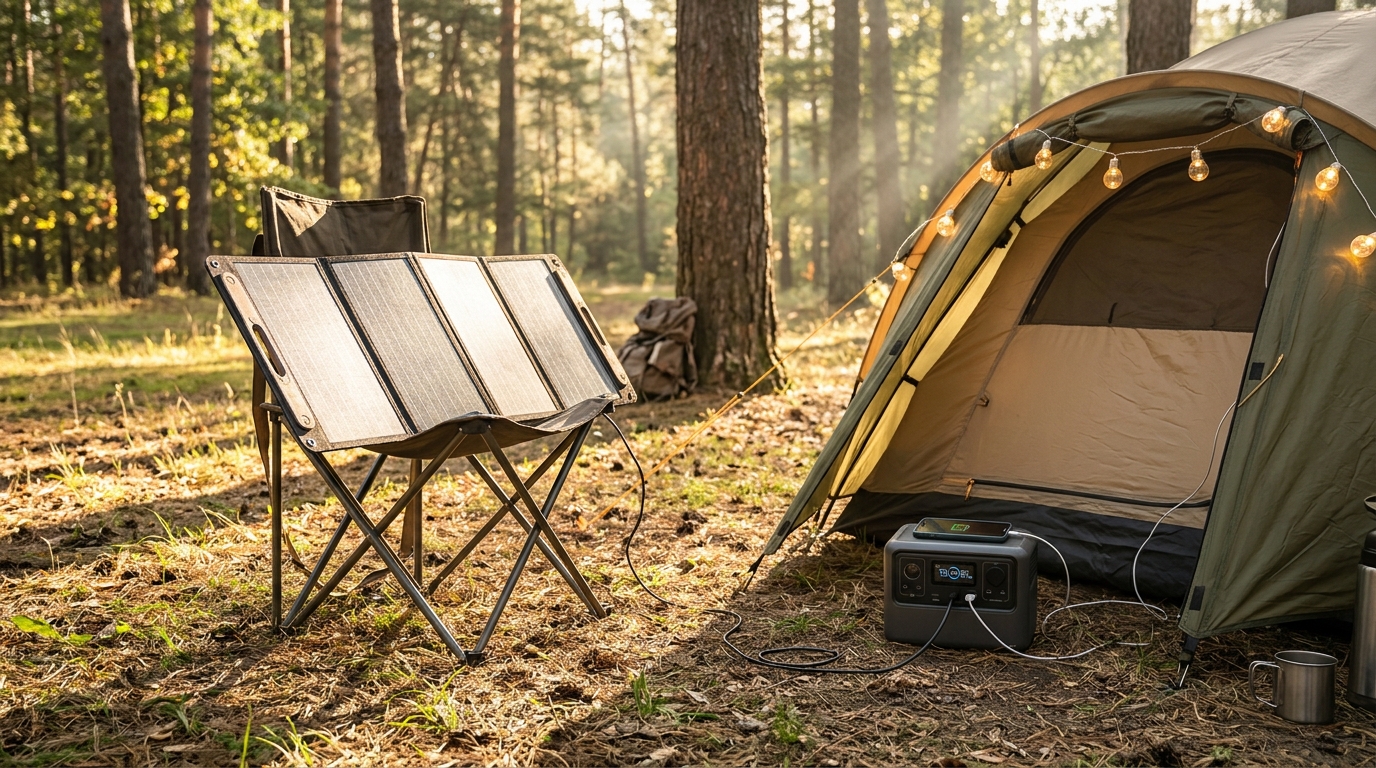
- You want a unit that also works for camping and travel. See our portable solar power stations guide.
- You are unlikely to maintain a generator.
When a Generator Is the Better Choice
- You need to run a well pump, central air or other heavy loads for days.
- Your outages are long and you can store fuel safely.
- You have a house with room to place the unit 20 feet from openings.
- You can afford a transfer switch or standby system and the upkeep.
Many households use both: a power station for the essentials and a generator for heavy loads or for recharging the station on very long outages. Our hurricane checklist and winter storm guide show how to plan around both.
FAQ
What size backup generator do I need?
Add the running watts of everything you want on, add the largest motor's starting surge, then add about 20% margin. Our example reached about 4,000W.
Can I run a generator in my garage with the door open?
No. The CPSC says to run portable generators outdoors only, at least 20 feet from doors, windows and vents.
Can I plug a generator into a wall outlet?
No. Backfeeding is dangerous. Use a licensed electrician to install a transfer switch or interlock.
Is an inverter generator worth it?
For electronics, quiet and fuel efficiency at light loads, yes, if its output covers your loads.
How long can a generator run?
As long as it has fuel and maintenance, but check the manual for continuous-run limits and refuel only after shutting it off and letting it cool.
Are generators or batteries better for hurricanes?
Often both. Use batteries for essentials and a generator for heavy loads, always outdoors.
The Bottom Line
A generator buys you the most watts and the longest runtime per dollar, and it demands fuel, noise, maintenance and a safe outdoor spot. Size it from your own loads, connect it only with proper equipment, treat CO as a lethal risk, and choose a battery when you cannot place a generator safely or only need essentials.
Safety guidance comes from the CPSC and may be updated. Follow the manufacturer's instructions and local codes for any generator.