Of all the things people ask a power station to do, running an air conditioner is the one most likely to end in disappointment. The unit starts, the room cools for a couple of hours, and then the battery is empty by mid-afternoon.
This article does the math in advance so you know what to expect, which size of window AC is realistic, and what to do when the numbers say no.
How Many Watts Does a Window AC Use?
Running watts scale with the unit’s BTU rating and efficiency. PickHVAC’s wattage chart uses a 10-12 EER range:
| Window AC Size | Running Watts | Estimated Starting (Surge) Watts |
|---|---|---|
| 5,000 BTU | 417-500W | ~1,585-2,400W |
| 6,000 BTU | 500-600W | ~1,900-2,880W |
| 8,000 BTU | 667-800W | ~2,535-3,840W |
| 10,000 BTU | 833-1,000W | ~3,165-4,800W |
| 12,000 BTU | 1,000-1,200W | ~3,800-5,760W |
The surge column is derived from the source’s statement that starting wattage runs 3.8 to 4.8 times the running wattage, so treat it as a planning estimate. Your unit’s nameplate or manual is the real answer.
As we covered in our sump pump surge guide, a power station’s surge rating, not its watt-hour capacity, decides whether a motor-driven appliance starts at all.
The same source notes that window units cycle on and off, so a 1,000W unit may average no more than about 650W over an hour. That duty-cycle figure is what makes runtime math possible.
Runtime Math
Using the site’s standard ~85% usable-capacity assumption and the roughly 65% duty cycle above (an estimate applied across sizes, not a measurement of each), here is how long common power station sizes keep a window AC going:
| AC Size | Avg Draw (cycling) | 1,000Wh Station | 2,000Wh Station | 3,000Wh Station |
|---|---|---|---|---|
| 5,000 BTU | ~290W | ~2.9 hrs | ~5.8 hrs | ~8.7 hrs |
| 6,000 BTU | ~360W | ~2.4 hrs | ~4.8 hrs | ~7.1 hrs |
| 8,000 BTU | ~480W | ~1.8 hrs | ~3.6 hrs | ~5.3 hrs |
| 10,000 BTU | ~600W | ~1.4 hrs | ~2.8 hrs | ~4.3 hrs |
The honest read: a 1,000Wh station gives you an afternoon at best with the smallest unit. Even a 3,000Wh station does not cover a full day for any of these sizes.
Running a 5,000 BTU unit around the clock averages roughly 7 kWh per day on these assumptions, which is more than twice the capacity of a 3,000Wh station.
Which Power Stations Can Even Start One?
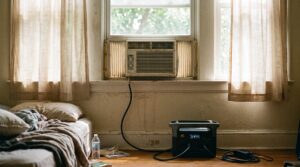
Capacity is the second question. The first is whether the station can start the compressor. A small 300W-class station, like several in our under-$500 roundup, cannot run even the smallest window AC. A 1,000-2,000W-class unit may handle a 5,000-6,000 BTU unit if its surge rating clears the estimates above, but many sit right at the borderline; larger units need a bigger system like the EcoFlow Delta Pro, whose 3,600W output we cover in detail.
Always compare the AC’s starting watts, from its nameplate, against the station’s rated surge output with real margin.
Can Solar Keep Up?
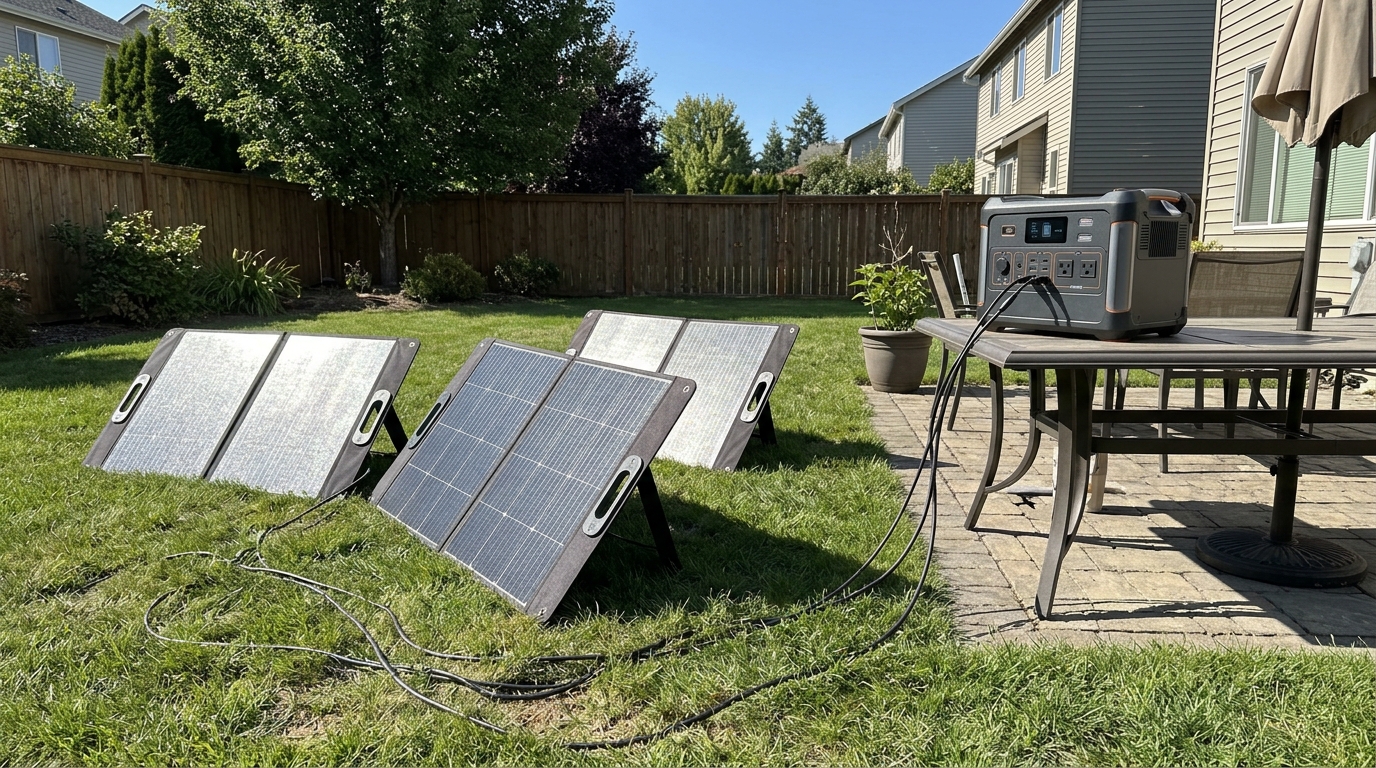
Not in any realistic portable setup. A 5,000 BTU unit running daytime hours alone draws roughly 3.5 kWh across 12 hours on the estimates above. A single portable panel measured at about 180W in full sun (per independent testing) falls well short of that, and under clouds the same panel measured around a quarter of its rating. See our solar panel guide and recharge time chart. Solar can stretch runtime a little; it can’t power an AC on its own.
Smarter Strategies Than Cooling the Whole Room All Day
Because continuous AC is out of reach, the goal is to use your limited watt-hours where they count:
- Cool one small room only, the bedroom, and keep the door closed.
- Run the AC in blocks. Pre-cool the room in the early evening, then run it intermittently overnight, rather than continuously through the hottest afternoon hours.
- Seal and shade. Close blinds, hang reflective material in sun-facing windows, and stop heat getting in before you try to remove it.
- Pair with low-draw cooling. Fans use a small fraction of an AC’s power. Use them to keep air moving once the room is cool.
- Use a hybrid plan. Prioritize the things a power station does best, like medical devices and communication, and treat AC as a bonus. Our sizing chart shows how to budget watt-hours across devices.
Heat Is a Safety Issue, Not Just Discomfort
Extreme indoor heat can be dangerous, especially for older adults, young children, and people with certain health conditions. The CDC’s guidance on preventing heat-related illness during a power outage is to move to a place with air conditioning, keep up fluid intake, and cool off with a cool bath or wet cloth.
If your power station can’t keep your home safe, a cooling center or a friend’s home is the right answer, not an experiment with a window unit.
For more outage planning, see our hurricane season prep checklist.
When a Generator Makes More Sense
If long summer outages are common where you live and cooling is a must, this is one of the few use cases where a generator may genuinely fit, with all the carbon monoxide and placement rules covered in our power station vs. generator comparison. It is not an option for apartments.
The Bottom Line
A power station can run a small window AC for a few hours; it cannot run one through a multi-day heat wave. A 5,000-6,000 BTU unit on a 2,000-3,000Wh station gets you roughly half a day of cycling cooling at best.
Size your expectations accordingly: cool one room in blocks, protect the loads that matter most, and have a plan for getting somewhere cool if the heat gets dangerous.
Wattage figures vary by unit and condition. Check your air conditioner’s nameplate for exact running and starting watts.
This article is general planning information, not medical advice; seek medical help for symptoms of heat illness.