Last updated: November 25, 2026
How we built this guide: Rather than hands-on lab testing, Trendifacts evaluates home backup power stations using published manufacturer specifications, seasonal price-per-watt-hour benchmarks, and real-world runtime math (calculating 85% of rated capacity as usable energy after AC inverter losses). Holiday pricing and retailer bundles shift rapidly, so always confirm current checkout prices, exact model numbers, and warranty terms directly on the retailer's page before ordering.
Affiliate disclosure: Some links on this page may earn Trendifacts a commission at no extra cost to you. We select and rank backup units by household load fit, battery specifications, and price per watt-hour—never by commission rate.
The best portable power station for home backup is never the biggest battery on the shelf—it is the smallest reliable unit that covers your must-run appliances for your longest realistic outage.
For a household running a CPAP machine, Wi-Fi router, and phones overnight, that sweet spot is a 1,000Wh to 1,200Wh station such as the Anker SOLIX C1000X or the Bluetti AC180.
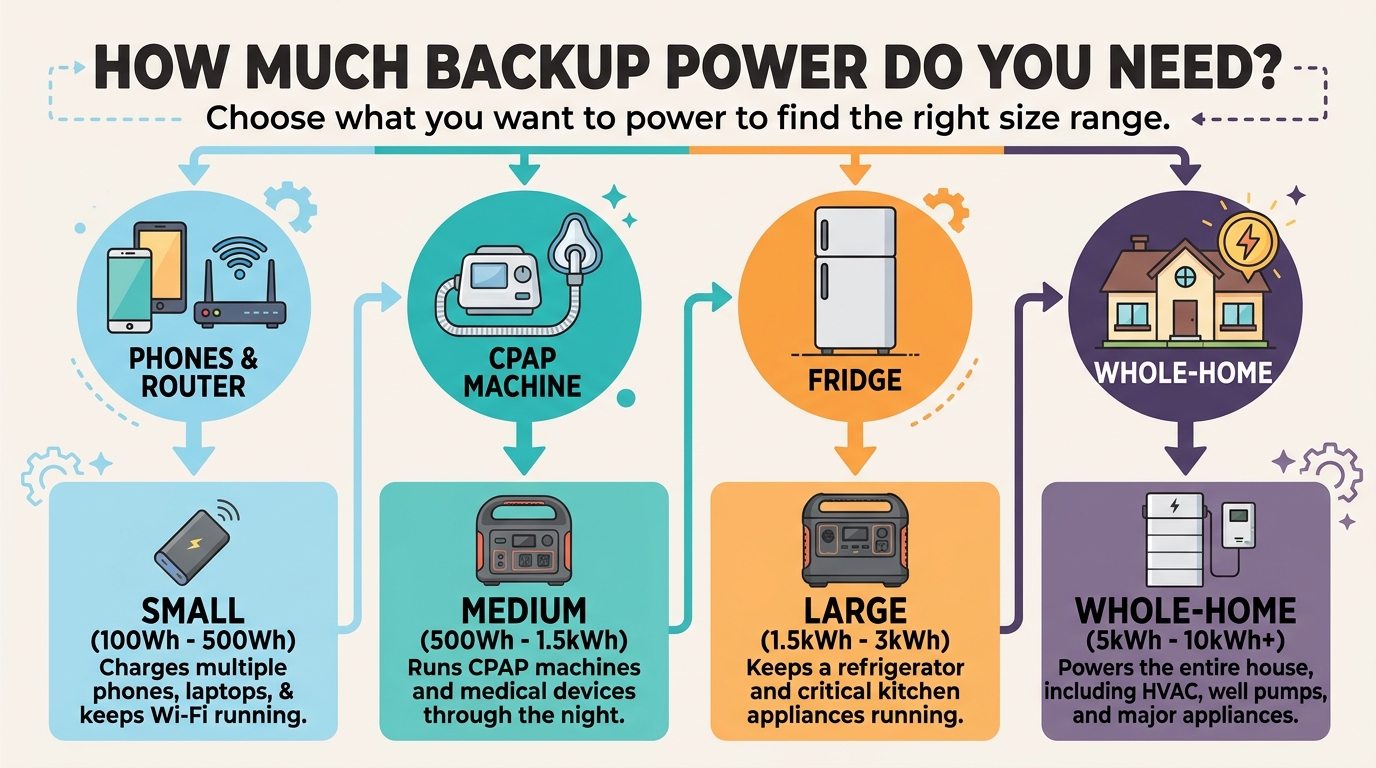
If you want to keep a full-size refrigerator cycling alongside household essentials, you need to step up to the 1,500Wh to 3,000Wh tier.
And for multi-day storms or heavy 240V household circuits, flagship units like the EcoFlow DELTA Pro 3 and Anker SOLIX F3800 occupy a separate league—with the weight and budget to match.
Start by matching your home to one of our four outage load profiles, compare realistic runtimes without recharging, and then use price per watt-hour to pick the smartest value in your tier.
The Short Answer: Best Home Backup Picks by Household Need
| If Your Household Needs... | Our Top Pick | Rated Capacity | Why It Fits |
|---|---|---|---|
| Phones, Wi-Fi router, and lights on a tight budget | Bluetti AC70 | 768Wh | Best all-around compact value under $500; 22.5 lb with 2,000W Power Lifting |
| CPAP, router, and phones for a full night | Anker SOLIX C1000X | 1,056Wh | LiFePO4 cells, 1,800W output, 5-year warranty, 28.4 lb |
| 1,000Wh class at the lowest price per Wh | DJI Power 1000 V2 | 1,024Wh | ~$0.39/Wh holiday benchmark; 2,600W output, 26 dB quiet charging |
| Extra capacity margin for a CPAP household | Bluetti AC180 | 1,152Wh | Clears the full ~1,090Wh needed for a 24-hour Profile B day; 1,800W output, 5-year warranty |
| Intermittent fridge backup plus daily essentials | Jackery Explorer 1500 v2 | 1,536Wh | 2,000W continuous (4,000W surge) in a manageable 32 lb frame |
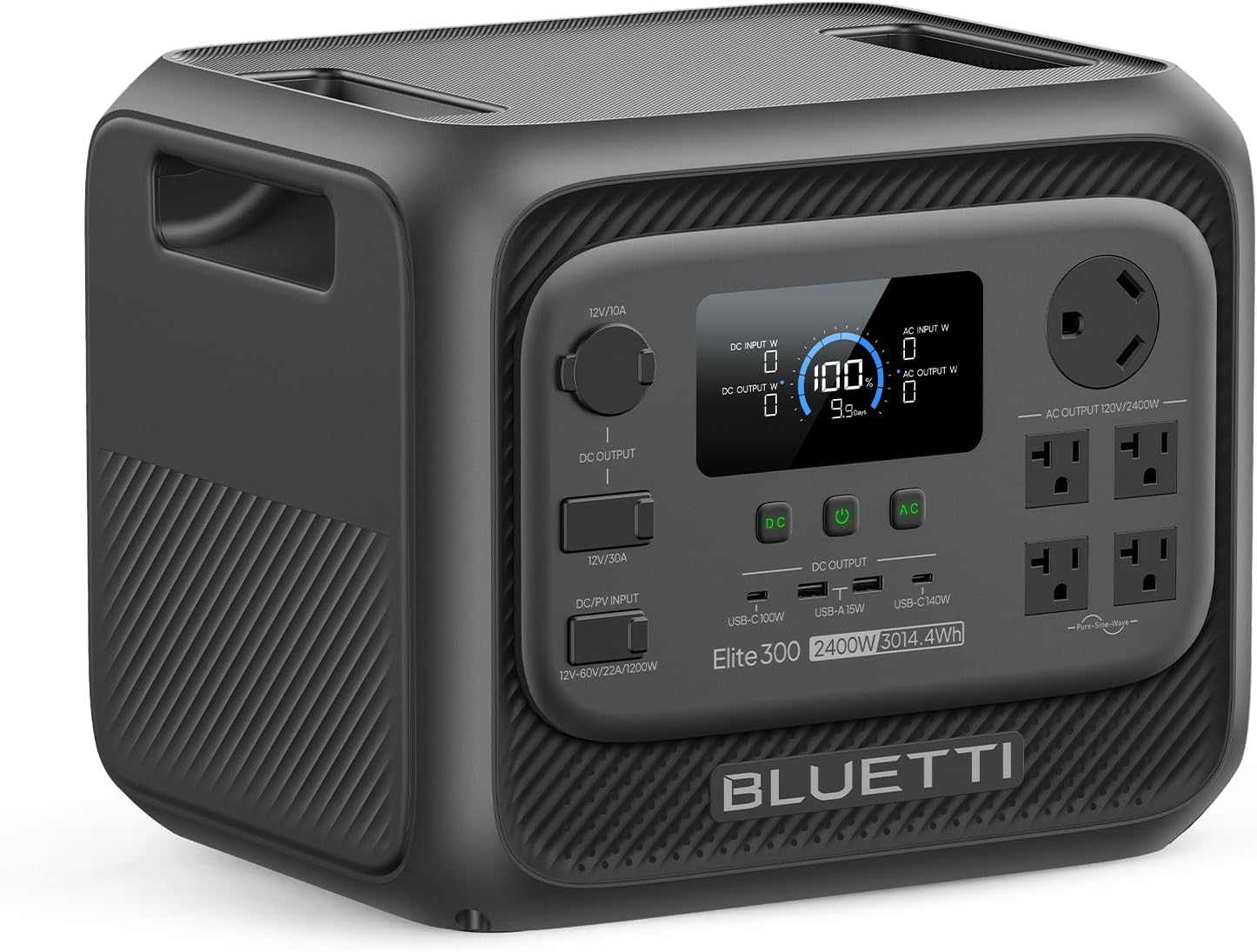
| Large multi-day capacity for the money | Bluetti Elite 300 | 3,014Wh | ~$0.40/Wh holiday benchmark; 2,400W output, 6,000+ LFP cycles, 10 ms UPS |
| Whole-home essentials and 240V circuits | EcoFlow DELTA Pro 3 or Anker SOLIX F3800 | 4,096Wh / 3,840Wh | 4,000W to 6,000W output with transfer-switch readiness |
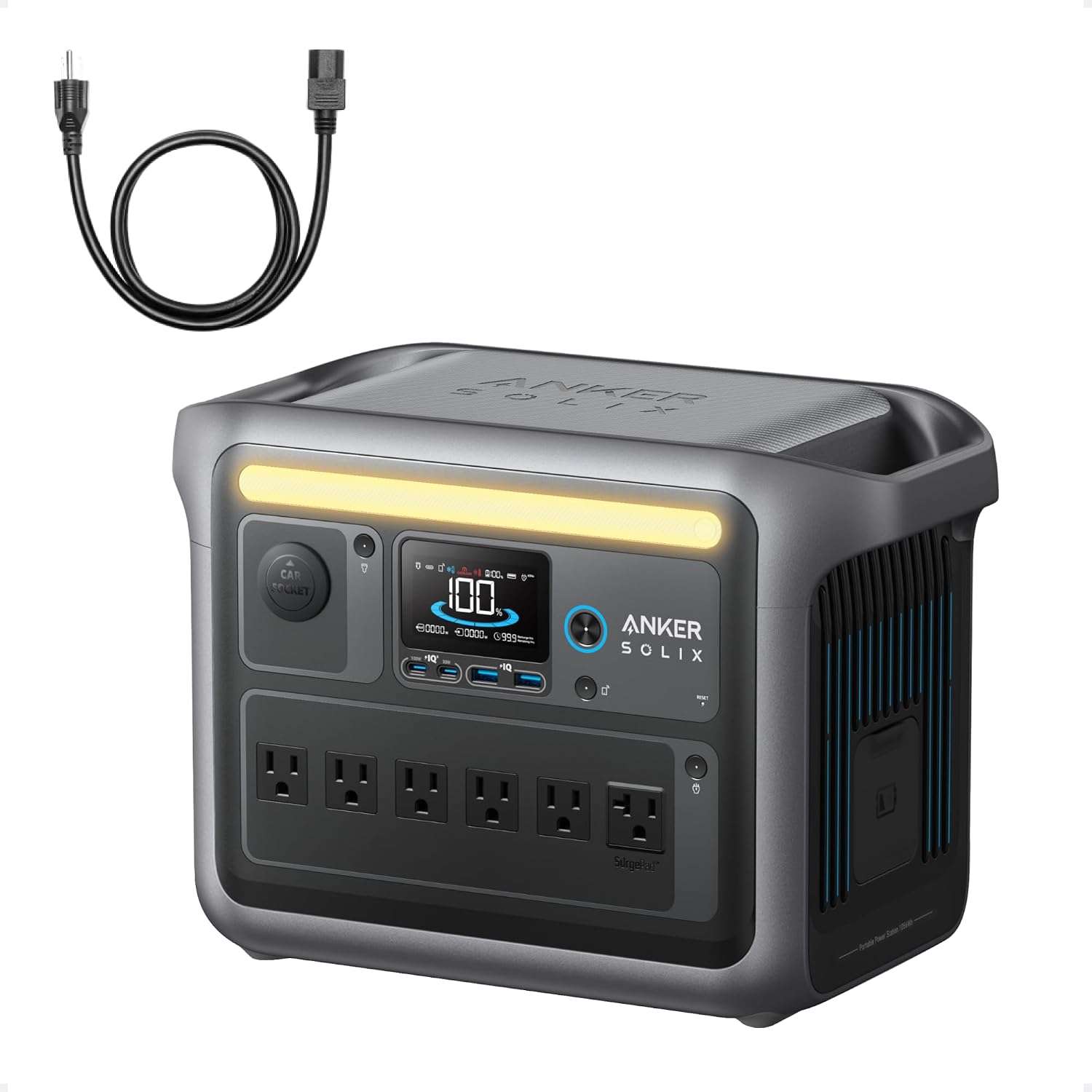
Anker SOLIX C1000X (1,056Wh)
The most well-rounded starting point for everyday home backup: LiFePO4 longevity, 1,800W pure sine wave output, 600W solar input, and a 5-year warranty in a 28.4-pound package.
How We Selected These Home Backup Tiers
- Matched to real household load profiles. Not every home needs a 120-pound battery wired into a breaker panel. Every recommendation below maps directly to the four daily outage profiles in our portable solar power station sizing guide:
- Profile A (Wi-Fi router, modem, and phones): ~447Wh per day
- Profile B (Adds a CPAP machine): ~927Wh per day
- Profile C (Adds a work laptop and LED lighting): ~1,287Wh per day
- Profile D (Adds a full-size refrigerator): ~2,787Wh per day
- Evaluated by price per watt-hour ($/Wh). Holiday banners advertise huge percentage discounts off shifting list prices. Dividing checkout price by rated watt-hours strips away the marketing—see our power station price-per-watt-hour guide and Black Friday power station deals 2026 guide for the full math across major brands.
- Filtered for home-ready fundamentals. For indoor outage use, we prioritize pure sine wave AC inverters, surge capacity for motor-driven appliances, long-cycle LiFePO4 (LFP) battery chemistry, practical solar recharge limits, and multi-year manufacturer warranties.
- Verified against official manufacturer spec sheets. Because brands frequently update model revisions (such as Gen 1 vs. Gen 2 or V2 variants), we cite published manufacturer specifications and flag exact model-naming nuances to verify before clicking Buy.
How Long Each Pick Runs (No Recharging)
A power station does not deliver 100% of its rated capacity to AC wall outlets; inverter conversion typically uses 10% to 15%. The table below calculates usable energy at a conservative 85% efficiency and divides it by each household profile's daily watt-hour load (Days = Usable Wh ÷ Daily Wh):
| Power Station | Rated Wh | Usable Wh (85%) | Profile B (927Wh/day) | Profile C (1,287Wh/day) | Profile D (2,787Wh/day) |
|---|---|---|---|---|---|
| DJI Power 1000 V2 | 1,024Wh | 870Wh | 0.9 days | 0.7 days | 0.3 days |
| Anker SOLIX C1000X | 1,056Wh | 898Wh | ~1.0 days (97%) | 0.7 days | 0.3 days |
| Jackery Explorer 1000 v2 | 1,070Wh* | 910Wh | ~1.0 days (98%) | 0.7 days | 0.3 days |
| Bluetti AC180 | 1,152Wh | 979Wh | 1.1 days | 0.8 days | 0.4 days |
| Jackery Explorer 1500 v2 | 1,536Wh | 1,306Wh | 1.4 days | 1.0 days | 0.5 days |
| DJI Power 2000 | 2,048Wh | 1,741Wh | 1.9 days | 1.4 days | 0.6 days |
| Bluetti Elite 300 | 3,014Wh | 2,562Wh | 2.8 days | 2.0 days | 0.9 days |
| Anker SOLIX F3800 | 3,840Wh | 3,264Wh | 3.5 days | 2.5 days | 1.2 days |
| EcoFlow DELTA Pro 3 | 4,096Wh | 3,482Wh | 3.8 days | 2.7 days | 1.2 days |
*Note: Early Jackery Explorer 1000 v2 batches are rated at 1,070Wh, while some updated US listings show 1,024Wh—confirm the exact rating on the product page before purchasing.
Two critical realities stand out immediately from this math. First, no standalone unit under 3,000Wh covers a full-size refrigerator household (Profile D) for a complete 24 hours without recharging.
Second, adding solar panels dramatically extends every tier: a 400W foldable solar array in 5 peak sun hours at 75% real-world efficiency (400W × 5 × 0.75) harvests roughly 1,500Wh per day, which is enough to replenish an entire Profile C household load every sunny afternoon.
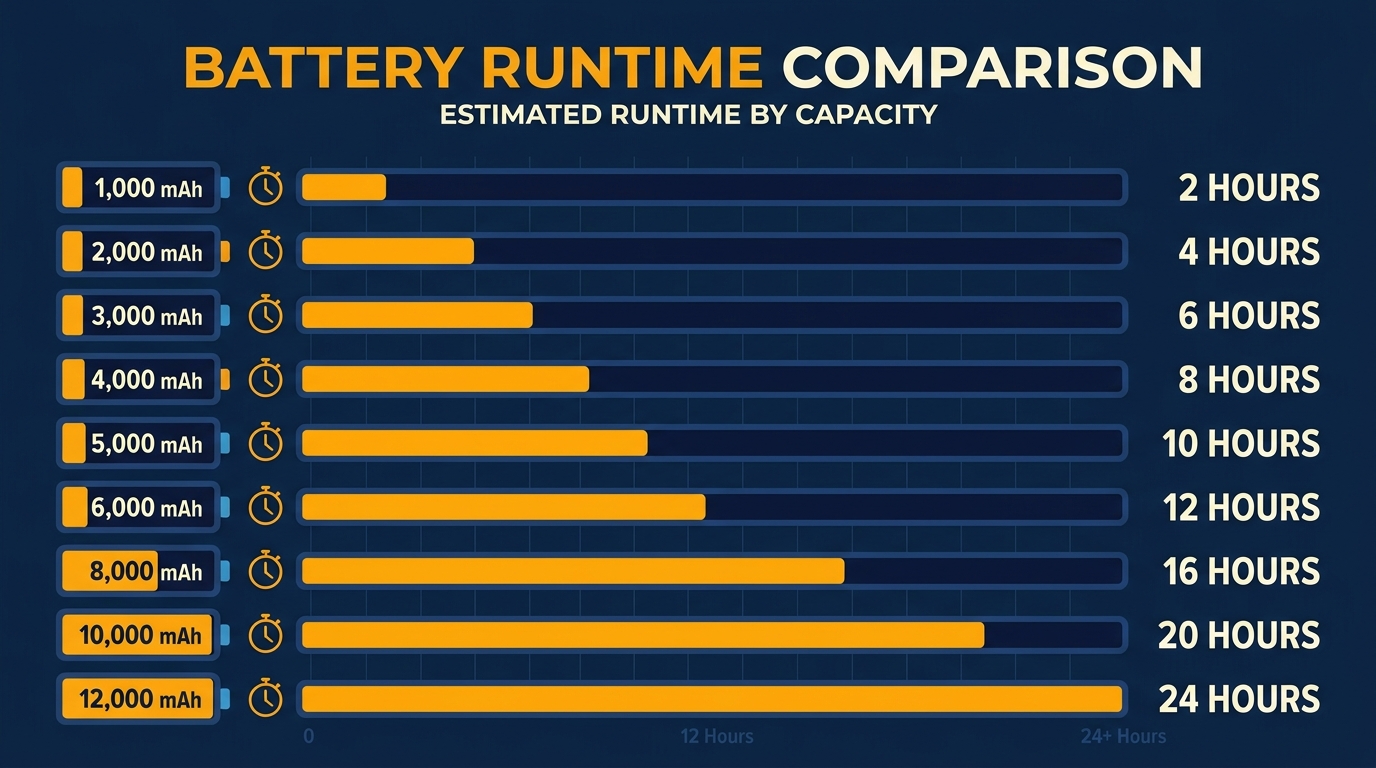
Want to plug in your own appliances instead of using standard averages? Run your exact household setup through our calculator below:
The Best Home Backup Power Stations in Detail.
Best Overall for Overnight Essentials & CPAP: Anker SOLIX C1000X.
The Anker SOLIX C1000X delivers 1,056Wh of LiFePO4 battery storage, 1,800W of continuous pure sine wave AC output across six outlets, 20 ms UPS switchover, up to 600W of solar input, battery expansion up to 2,112Wh, and a 5-year warranty—all at an official net weight of 28.4 lb (12.9 kg).
That compact footprint makes it practical to carry from a hallway closet to a bedroom nightstand during an unexpected storm. For a deeper look at its ports and charging curve, read our Anker SOLIX C1000X review.
Pay close attention to naming when shopping: the standard Anker SOLIX C1000 (~$499.99 seasonal benchmark, ~$0.47/Wh) and the newer SOLIX C1000 Gen 2 (~$549.99) appear alongside the C1000X in search results, so verify the exact variant and included accessories on the listing. If your main goal is powering a CPAP machine—especially with a heated humidifier—check our dedicated guide to the best portable power stations for CPAP machines and our 1,000Wh CPAP runtime breakdown to match your exact DC cable and watt draw.
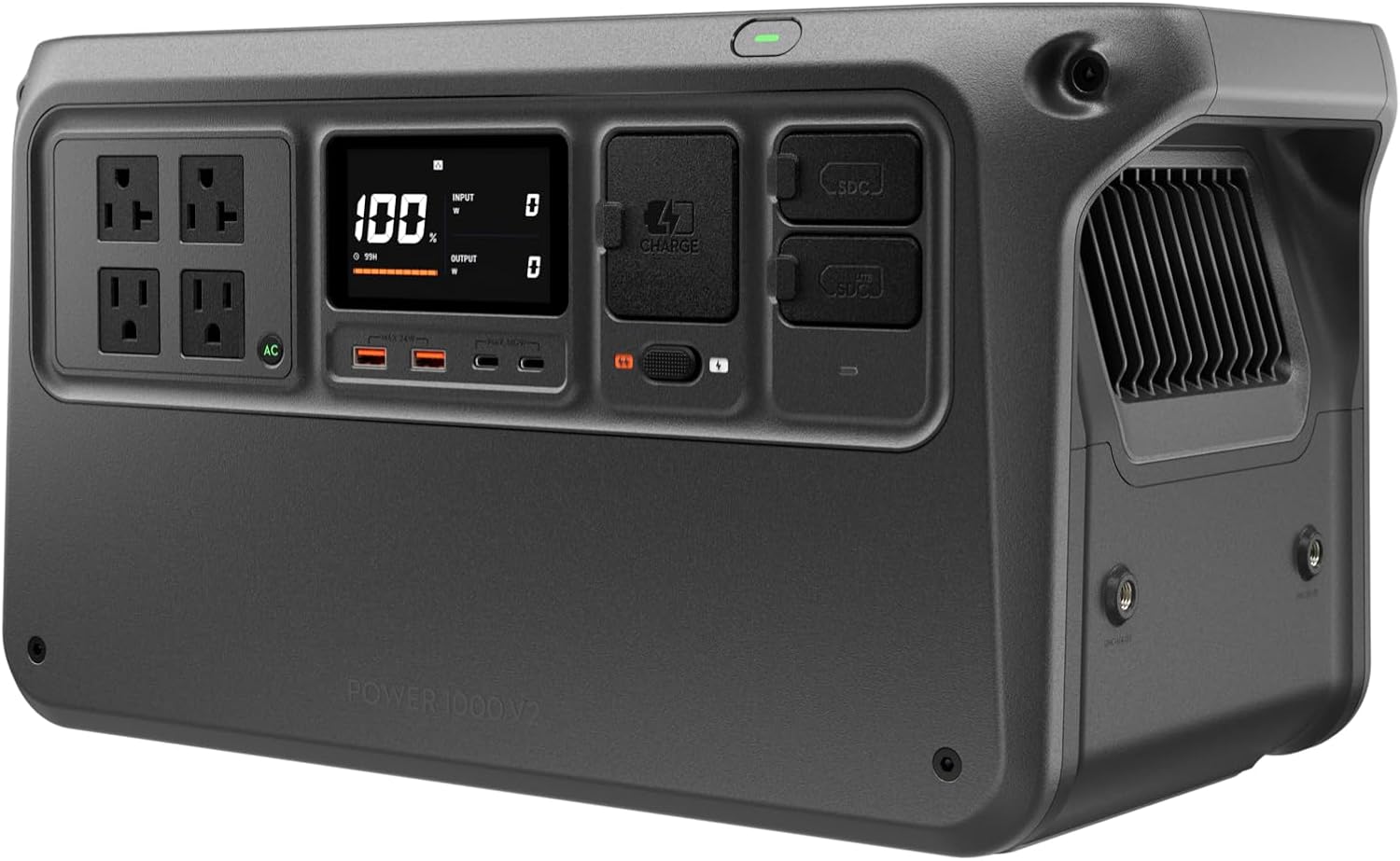
Best Value 1,000Wh Class: DJI Power 1000 V2
At a seasonal benchmark of $399.98 for 1,024Wh (~$0.39 per Wh), the DJI Power 1000 V2 stands out as one of the sharpest price-per-watt-hour values in the 1,000Wh class. Official DJI specifications pack serious hardware into its ~31.3 lb (14.2 kg) frame: 1,024Wh LiFePO4 cells rated for 4,000 cycles, a high 2,600W continuous AC output (4,400W peak), 0–100% wall recharging in 56 minutes, dual 140W USB-C ports, UPS mode, and whisper-quiet 26 dB operation during standard charging.
One important compatibility check before buying: DJI uses proprietary SDC ports for solar recharging, meaning connecting standard MC4 solar panels requires the separate DJI Power Solar Panel Adapter Module (MPPT) or DJI's super-fast solar/car charger. Confirm your exact regional warranty terms and bundle accessories on the product page before checking out.
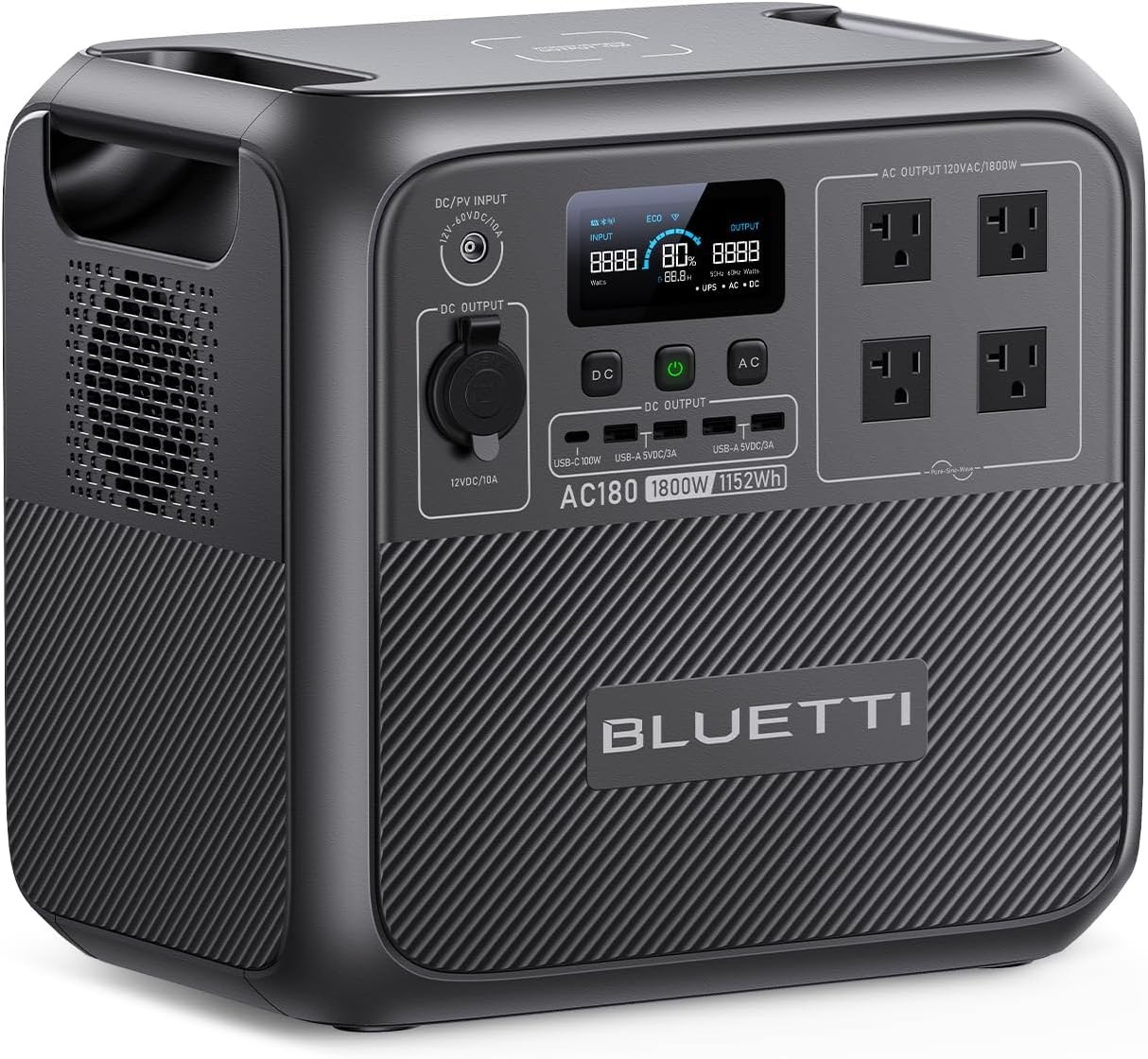
Best Step-Up for a Full-Day Profile B Household: Bluetti AC180
With 1,152Wh of rated LiFePO4 capacity (~979Wh usable, rated for 3,500+ cycles), the Bluetti AC180 is the first unit in our table that cleanly clears the roughly 1,090Wh rated capacity threshold needed to run a complete Profile B household (CPAP, Wi-Fi router, modem, and phone charging) for a full 24 hours without recharging. Official Bluetti specs include 1,800W continuous pure sine wave AC output across four outlets (2,700W Power Lifting / surge), 500W max solar input, 1,440W Turbo AC charging (0–80% in about 45 minutes), 20 ms UPS switchover, a 35.3 lb weight, and a 5-year warranty.
At a seasonal benchmark around $499 (~$0.43 per Wh), it offers meaningful extra headroom over standard 1,024Wh boxes without stepping up to a 1,500Wh price tag. Compare its wall-charging speed against competing brands in our EcoFlow vs. Jackery vs. Bluetti recharge times guide.
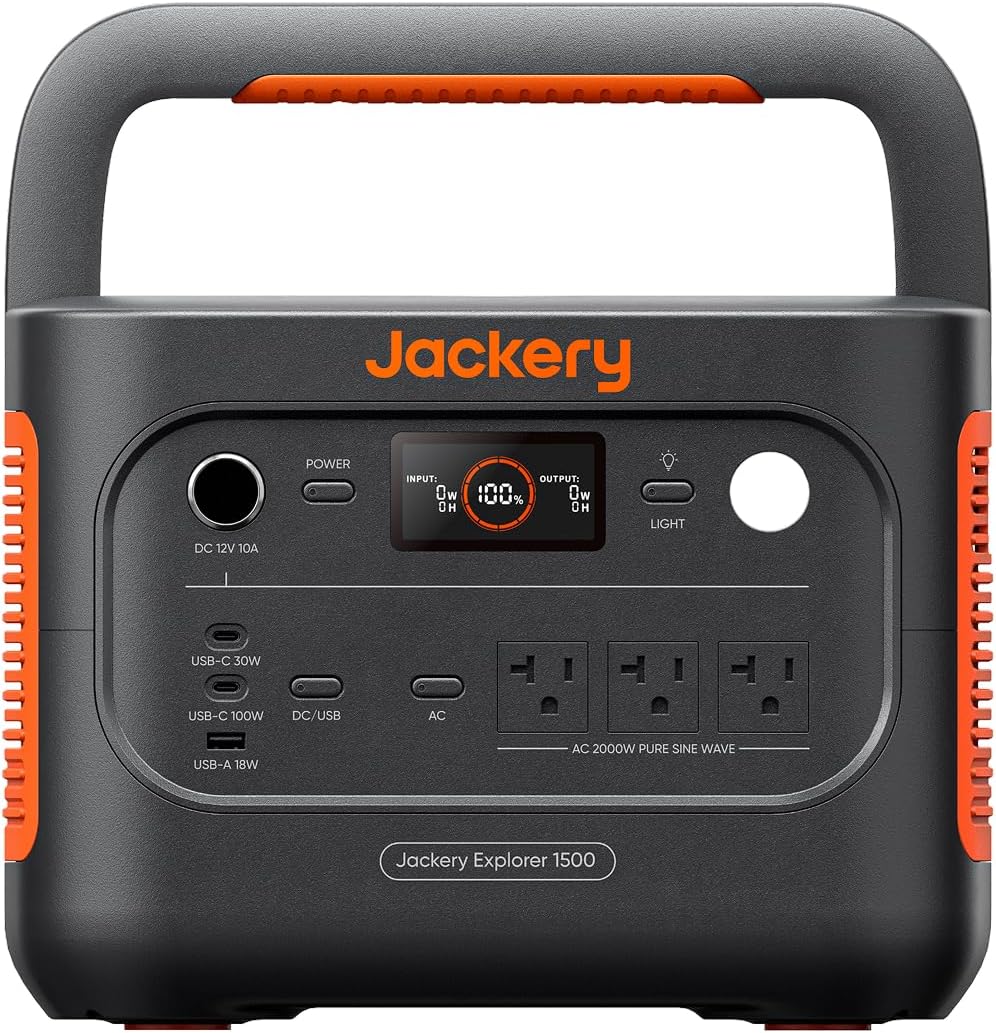
Best for Light Fridge Use & Home Offices: Jackery Explorer 1500 v2
Stepping up to 1,536Wh (~1,306Wh usable) of 6,000-cycle LiFePO4 storage, the Jackery Explorer 1500 v2 pairs 2,000W continuous output, a 4,000W surge ceiling, 10 ms UPS switchover, 400W max solar input, and a 5-year warranty (3 years standard plus 2 extended) in a 32 lb (31.97 lb) chassis. That 4,000W surge rating easily handles refrigerator compressor startups and kitchen appliances that can trip smaller inverters. It is a clear capacity and output upgrade over the smaller Jackery Explorer 1000 v2 (1,070Wh on earlier batches / 1,024Wh on updated listings, 1,500W continuous, 3,000W surge, 23.8 lb, LiFePO4), which we compare side by side in Jackery Explorer 1000 vs. 1500.
Keep fridge expectations realistic: a full-size refrigerator averaging 1,000 to 2,000Wh per day will deplete a 1,536Wh station in roughly a day or less if run continuously alongside other devices. For multi-day storms, plan on cycling the fridge in timed cooling blocks or pairing the unit with solar panels.
Best Large Capacity for the Money: Bluetti Elite 300 (and DJI Power 2000 Alternative)
For households that want 3,000Wh-class storage without crossing the $2,000+ whole-home threshold, the Bluetti Elite 300 delivers 3,014.4Wh (~2,562Wh usable) at an early-season benchmark of $1,199 (~$0.40 per Wh). Official Bluetti specs back up that price with 6,000+ LiFePO4 cycles, 2,400W continuous AC output (4,800W surge / Power Lifting), four standard AC outlets plus an RV-ready NEMA TT-30 port, 1,200W max solar input, ≤10 ms UPS switchover, a 58.0 lb (26.3 kg) weight, and a 5-year warranty. That capacity covers Profile C (CPAP, Wi-Fi, laptop, and LED lighting) for two full days without recharging, or nearly a full day of Profile D fridge-plus-essentials loads.
If you prefer a slightly lighter 2,000Wh-class option instead, the DJI Power 2000 (2,048Wh LFP rated for 4,000 cycles, ~$749.99 benchmark at $0.37 per Wh) brings 3,000W continuous AC output, under 30 dB standard recharge noise, expansion up to 22,528Wh, a ~48.5 lb (22 kg) footprint, and a 5-year warranty on official US purchases.
Best Whole-Home Essentials & 240V Backup: EcoFlow DELTA Pro 3 vs. Anker SOLIX F3800
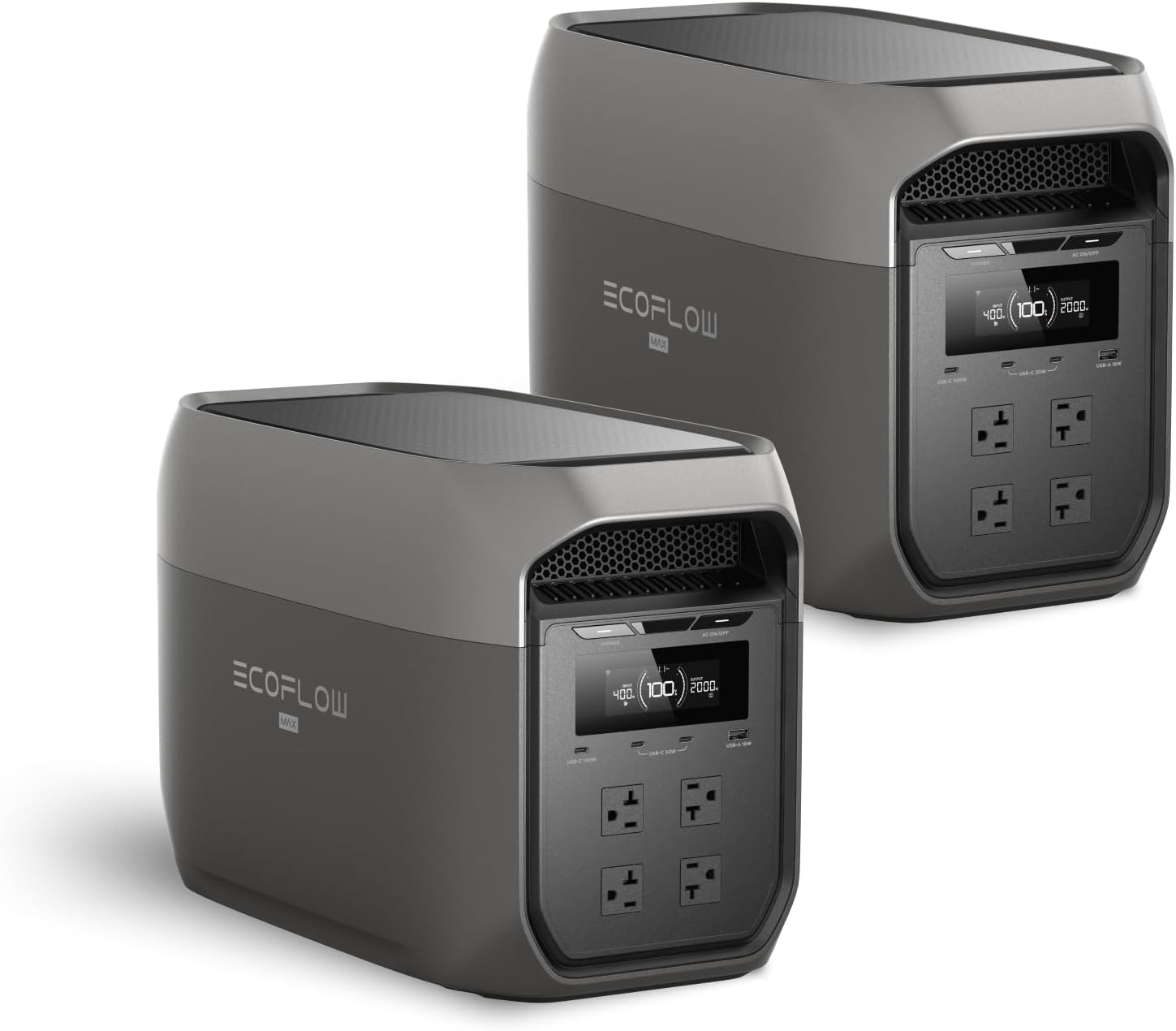
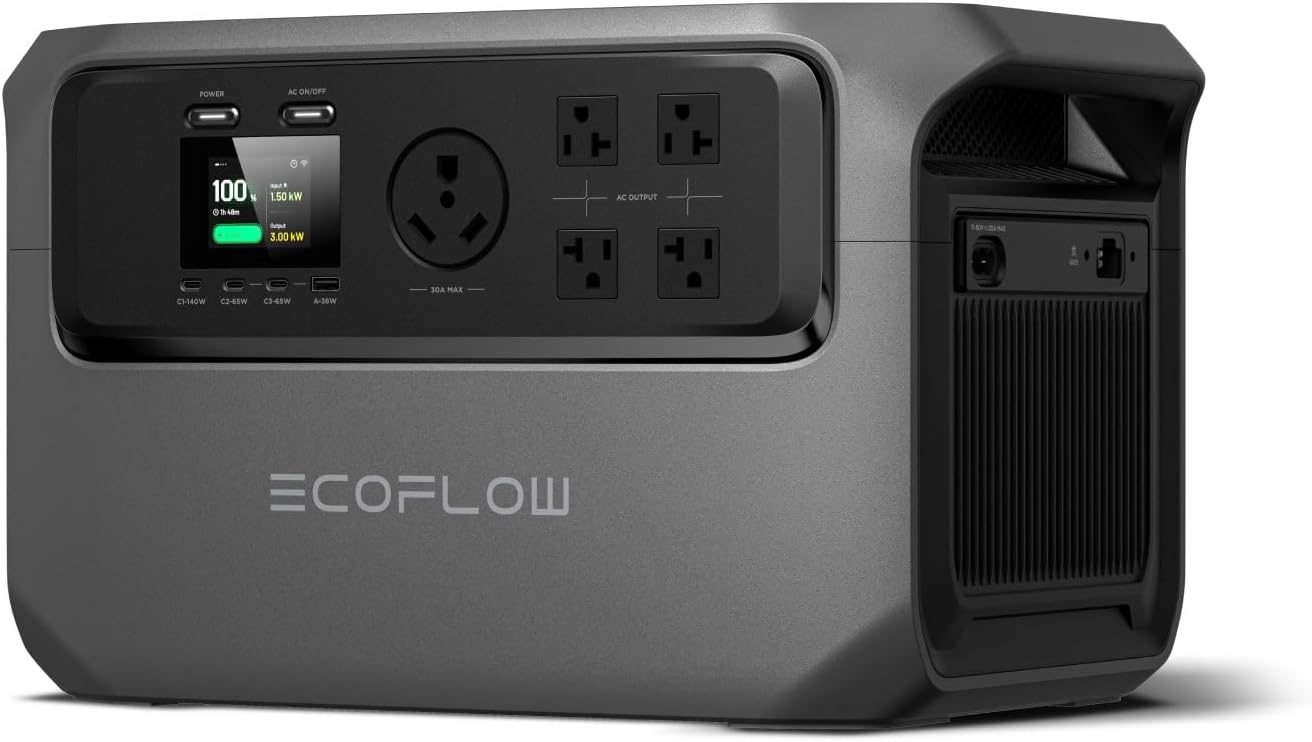
When you need to back up a refrigerator, well pump, sump pump, home office, and critical 240V circuits simultaneously, standard portable power stations are not enough. The EcoFlow DELTA Pro 3 and Anker SOLIX F3800 are wheeled, heavy-duty home backup anchors built to integrate with a manual transfer switch or smart home panel:
| Specification | EcoFlow DELTA Pro 3 | Anker SOLIX F3800 |
|---|---|---|
| Base Battery Capacity | 4,096Wh (~3,482Wh usable) | 3,840Wh (~3,264Wh usable) |
| AC Output | 4,000W continuous (120V/240V) | Up to 6,000W continuous (120V/240V) |
| Weight | 113.5 lb | 132.3 lb |
| Max Solar Input | Up to 2,600W | Up to 2,400W |
| Max Expansion Capacity | Up to ~12kWh (with extra batteries) | Up to 26.88kWh (with expansion packs) |
Both units are stationary, garage-or-utility-room investments rather than grab-and-go camping batteries. Dive into our full EcoFlow DELTA Pro 3 review and Anker SOLIX F3800 review to compare ports and expansion ecosystems, then check what a 4,000Wh power station can actually run and our guide to sizing solar panels for a 4,000Wh station.
Safety note: Connecting any 240V power station to your home's electrical breaker panel requires an approved manual transfer switch or interlock kit installed by a licensed electrician. Never backfeed a wall outlet with a double-male cord.
Best Budget Compact Backup: Bluetti AC70
Not every homeowner or apartment renter needs 1,000Wh+ right away. The Bluetti AC70 packs 768Wh (~653Wh usable), 1,000W continuous output (1,500W surge plus 2,000W Power Lifting Mode for resistive loads), expansion support up to 1,574Wh, and a 5-year warranty in a 22.5 lb package around $359—making it our top compact recommendation in our best power stations under $500 guide. It easily runs a Wi-Fi router and modem for over 36 hours, or covers a router plus a non-humidified CPAP for roughly 9 hours overnight.
Worked Example: Sizing Backup for a Storm-Prone Family of Three
To see how profile math prevents overspending—or running dry halfway through a storm—walk through a real 48-hour blackout scenario for a family of three running Profile D: a Wi-Fi router and modem (18W), a CPAP without humidifier (~45W), LED lighting (~100W), a work laptop (~60W), phone charging (~30W), and a full-size refrigerator—totaling roughly 2,787Wh per day.
- Two full days with zero recharging: 2 × 2,787Wh = 5,574Wh usable energy required. Accounting for 85% inverter efficiency (5,574 ÷ 0.85), you would need roughly 6,560Wh of rated battery storage. That is too big for any single standalone portable unit without expansion batteries.
- Two days paired with a 400W solar array: In clear post-storm sunshine (5 peak sun hours at 75% efficiency), a 400W panel array produces about 1,500Wh per day. That cuts the net daily draw on your battery down to 2,787 - 1,500 = 1,287Wh per day, or 2,574Wh usable across two days.
- The 3,014Wh Bluetti Elite 300 (2,562Wh usable) lands right on the razor's edge—it works if the sun cooperates and you trim minor loads, leaving virtually zero buffer for cloudy skies.
- The 4,096Wh EcoFlow DELTA Pro 3 (3,482Wh usable) leaves roughly 908Wh of safety margin, easily absorbing a cloudy afternoon.
- The budget reality: At ~$0.40/Wh, a 3,000Wh-class battery costs roughly $1,200 before solar panels, while a 4,000Wh flagship costs significantly more.
- The smart lower-cost alternative: Drop the full-size fridge from the battery plan. According to USDA food safety guidelines, an unopened refrigerator keeps food at safe temperatures for roughly 4 hours (and a full, unopened freezer stays frozen for 24 to 48 hours). By relying on ice chests or brief cooling cycles instead of 24/7 fridge power, the same family drops from Profile D to Profile B/C—meaning a $400 to $500 1,000Wh unit comfortably protects their CPAP, Wi-Fi, lights, and phones through the storm.
The right purchase almost always comes down to one decision: whether keeping your refrigerator powered continuously is worth tripling your battery budget.
⚡ Power Station Size Calculator
Enter your appliance's wattage to see exactly which portable power station you need.
7 Things to Verify Before Clicking Buy
- Continuous and surge output watts. Match the inverter rating against your highest-draw appliance—especially motor-driven loads like refrigerators or sump pumps (see our sump pump surge-watt breakdown) and high-wattage heaters (check our space heater runtime guide before trying to heat a room with a battery).
- Battery chemistry. Look for LiFePO4 (LFP) cells, which deliver 3,000+ charge cycles and better thermal stability than older lithium-ion NMC packs—read the full breakdown in our LiFePO4 vs. lithium-ion power station guide.
- Maximum solar input and voltage (Voc). Confirm both the maximum solar wattage and open-circuit voltage limit so you do not buy panels the internal charge controller cannot accept.
- Warranty length and service support. Favor 5-year warranties from established brands with accessible customer support.
- Authorized seller and return window. Check the "Sold by" line on Amazon or buy directly from the manufacturer so your warranty stays valid and returns are hassle-free.
- Charging temperature limits. Nearly all LiFePO4 batteries stop accepting a charge below 32°F (0°C) and degrade faster when stored in 110°F summer garages—review our cold-weather charging limits guide and winter storm power outage prep checklist before storing your unit outside conditioned living space.
- Fan noise for bedroom placement. If the battery will sit near your bed to run a CPAP overnight, check the decibel (dB) rating under light 50W–100W loads—compare top brands side by side in our power station noise levels comparison.
When a Portable Power Station Is Not the Right Buy
- You need multi-day central air, electric cooking, or heavy well pumps: Portable batteries hit their physics and budget limits quickly on continuous 3,000W+ heating and cooling loads. Compare fuel and whole-house alternatives in our backup power generators guide, power station vs. generator comparison, and home battery backup systems guide.
- You live in a small apartment with minimal loads: If you only want Wi-Fi, phone charging, and a laptop during short outages—and want to recharge from a balcony—start with our best power stations under $500 and balcony solar kits for renters guide.
- You are shopping for someone else: Capacity mistakes happen easily when buying blind; check our Power Station Gift Guide 2026 for recipient-based sizing tips.
Frequently Asked Questions
What size portable power station do I need for home backup?
Plan on roughly 1,090Wh rated capacity to cover a CPAP, Wi-Fi router, and phones for a full day (Profile B), 1,515Wh if you add a work laptop and LED lighting (Profile C), and 3,280Wh+—or a 2,000Wh unit paired with solar panels—to cover a full-size refrigerator plus essentials for a day (Profile D).
Can a portable power station run my whole house?
Only the largest 240V-capable models (like the EcoFlow DELTA Pro 3 or Anker SOLIX F3800 with expansion batteries) can back up critical household circuits through an electrician-installed transfer switch, and even then you must manage heavy loads like central air conditioning and electric dryers carefully.
Is Black Friday a good time to buy a home backup power station?
Yes, provided you track price per watt-hour rather than percentage-off banners. Aim for roughly $0.37 to $0.45 per Wh on 1,000Wh+ LiFePO4 models—see our Black Friday power station deals 2026 guide for exact benchmarks.
Which is better for a CPAP: a 1,000Wh or 1,500Wh power station?
Either size comfortably covers a full 8-hour night without a heated humidifier. Stepping up to 1,500Wh gives you multi-night peace of mind or the extra headroom required if you run a heated humidifier and heated hose overnight.
Do I need solar panels for home backup?
For short 4-to-12-hour outages, wall charging is plenty. For multi-day storms, foldable solar panels turn a finite battery into a renewable outage kit—just confirm your home has sunny yard, patio, or balcony access and check our best solar panels for power stations guide before buying a bundle.
How does Trendifacts evaluate these home backup picks?
We rank units transparently using published manufacturer specifications, 85%-efficiency runtime math across four standardized household load profiles, and seasonal price-per-watt-hour benchmarks. Because brands occasionally revise output specs, cables, and warranties between production runs, always verify live specifications and seller authorization on the product page before purchasing.
Making the Final Call
Size your household profile first, then let price per watt-hour narrow your shortlist. A 1,000Wh to 1,200Wh unit covers most CPAP and home-office blackouts cleanly, a 1,500Wh station adds short-term refrigerator flexibility, and 3,000Wh to 4,000Wh+ models paired with solar panels tackle multi-day storms and fridge loads. Verify continuous output watts, LiFePO4 battery chemistry, warranty terms, and authorized seller status on the live product page, and you will end up with a quiet, reliable backup system that actually matches your home when the grid goes down.