Last updated: November 20, 2026. Method note: sale prices and capacities come from Bob Vila's early Black Friday power station deals page, which published them on November 12, 2026 and did not verify them live. Last year's prices come from TechRadar's roundup, last updated November 25, 2025. Every price-per-Wh figure, lifetime-cost figure and example is our own arithmetic. We have not tested these products, and prices change constantly.
Affiliate disclosure: some links on this page may earn Trendifacts a commission at no extra cost to you. It does not change what we recommend.
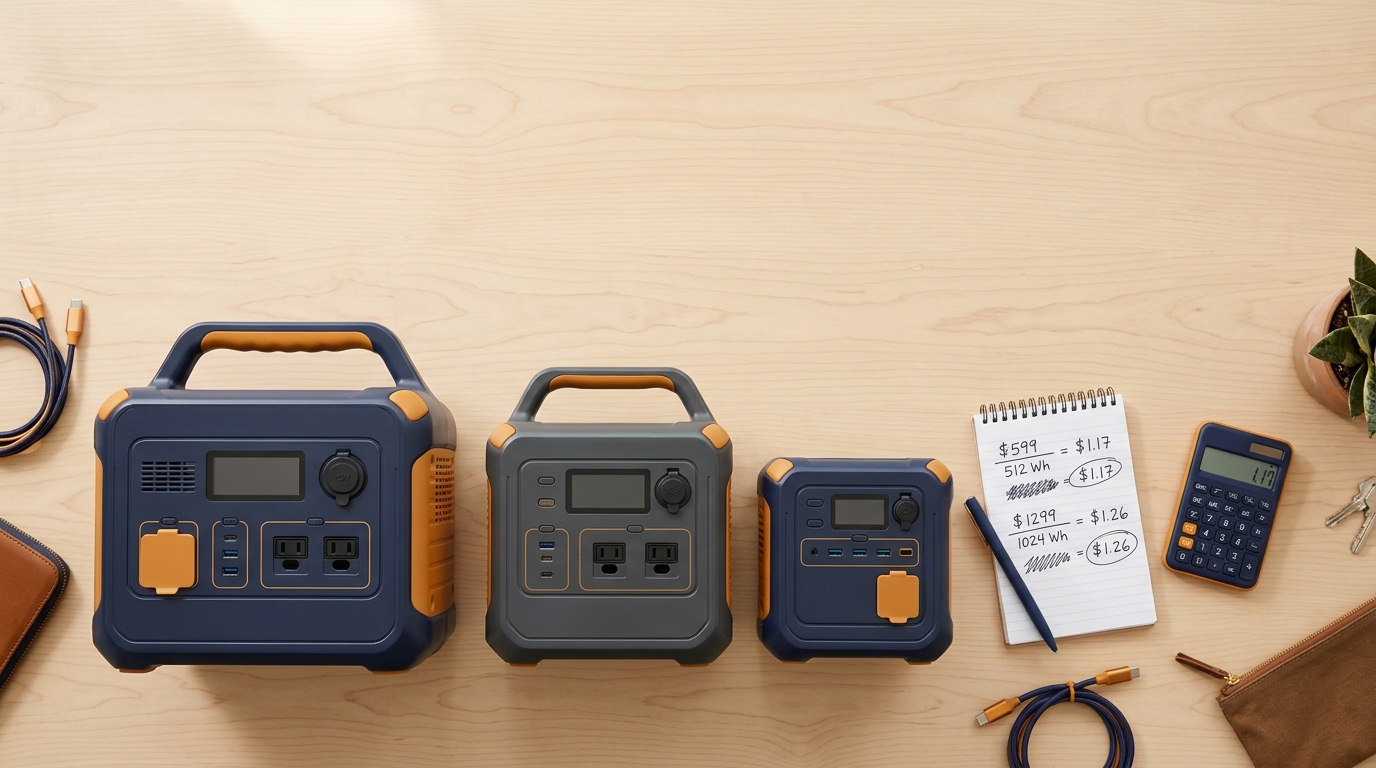
Price per watt-hour is the sale price divided by the battery's rated capacity in watt-hours. It is the fairest single number for comparing power stations of different sizes, because it measures what you pay for each unit of stored energy. In the November 12, 2026 sale data, units of 1,000Wh and up cost roughly $0.37 to $0.59 per Wh, while 288Wh units cost about $1.01 to $1.15 per Wh. But price per Wh ignores output power, chemistry, warranty and solar input, so use it to narrow the field and then check the specs.
This guide explains the formula, shows a dated comparison table, adds three more cost metrics that matter (cost per rated watt, cost per cycle and cost of your own plan), and gives a worksheet you can fill in before any sale.
The Short Answer
| Metric | Formula | What it tells you |
|---|---|---|
| Price per Wh | Price / rated Wh | Cost of stored energy |
| Price per usable Wh | Price / (rated Wh x 0.85) | Cost of energy you can actually use on AC loads |
| Price per output watt | Price / continuous AC watts | Cost of the power you can draw at once |
| Cost per cycle | Price / (cycles claimed) | Cost of each full charge-discharge over the claimed life |
| Cost of your plan | Needed rated Wh x price per Wh | What your outage plan will cost |
The Basic Formula
Price per Wh = sale price / rated capacity in Wh.
A $400 unit with 1,024Wh costs $400 / 1,024 = about $0.39 per Wh. A $290 unit with 288Wh costs about $1.01 per Wh. Because we plan on about 85% of rated capacity being usable for AC loads, you can also compute price per usable Wh by dividing again by 0.85: $0.39 / 0.85 = about $0.46 per usable Wh.
Always use the rated capacity in Wh, not "peak watts" or "surge watts." Marketing headlines sometimes feature a large peak-watt number, which says nothing about how long the battery lasts. If a listing does not state Wh, find it on the manufacturer's spec sheet. Roundups often leave it out, as the Bob Vila page did for several bundles.
A Dated Comparison (November 12, 2026 Early-Sale Snapshot)
| Model | Capacity (Wh) | Sale price | Price per Wh | Price per usable Wh |
|---|---|---|---|---|
| DJI Power 2000 | 2,048 | $749.99 | $0.37 | $0.43 |
| DJI Power 1000 V2 | 1,024 | $399.98 | $0.39 | $0.46 |
| Bluetti Elite 300 | 3,014 | $1,199 | $0.40 | $0.47 |
| EBL (999Wh) | 999 | $399.99 | $0.40 | $0.47 |
| Bluetti Elite 100 Mini | 1,005 | $428.99 | $0.43 | $0.50 |
| Bluetti Elite 200 V2 | 2,073 | $898.99 | $0.43 | $0.51 |
| Bluetti AC180 | 1,152 | $499 | $0.43 | $0.51 |
| Anker SOLIX C1000 | 1,056 | $499.99 | $0.47 | $0.56 |
| Bluetti Elite 100 V2 | 1,024 | $498.99 | $0.49 | $0.57 |
| Bluetti FridgePower | 2,016 | $999 | $0.50 | $0.58 |
| Anker SOLIX C1000 Gen 2 | 1,024 | $549.99 | $0.54 | $0.63 |
| Anker SOLIX S5000 | 5,024 | $2,939 | $0.59 | $0.69 |
| Bluetti Elite 30 V2 | 288 | $289.99 | $1.01 | $1.18 |
| Anker SOLIX C300 | 288 | $329.98 | $1.15 | $1.35 |
Patterns worth knowing:
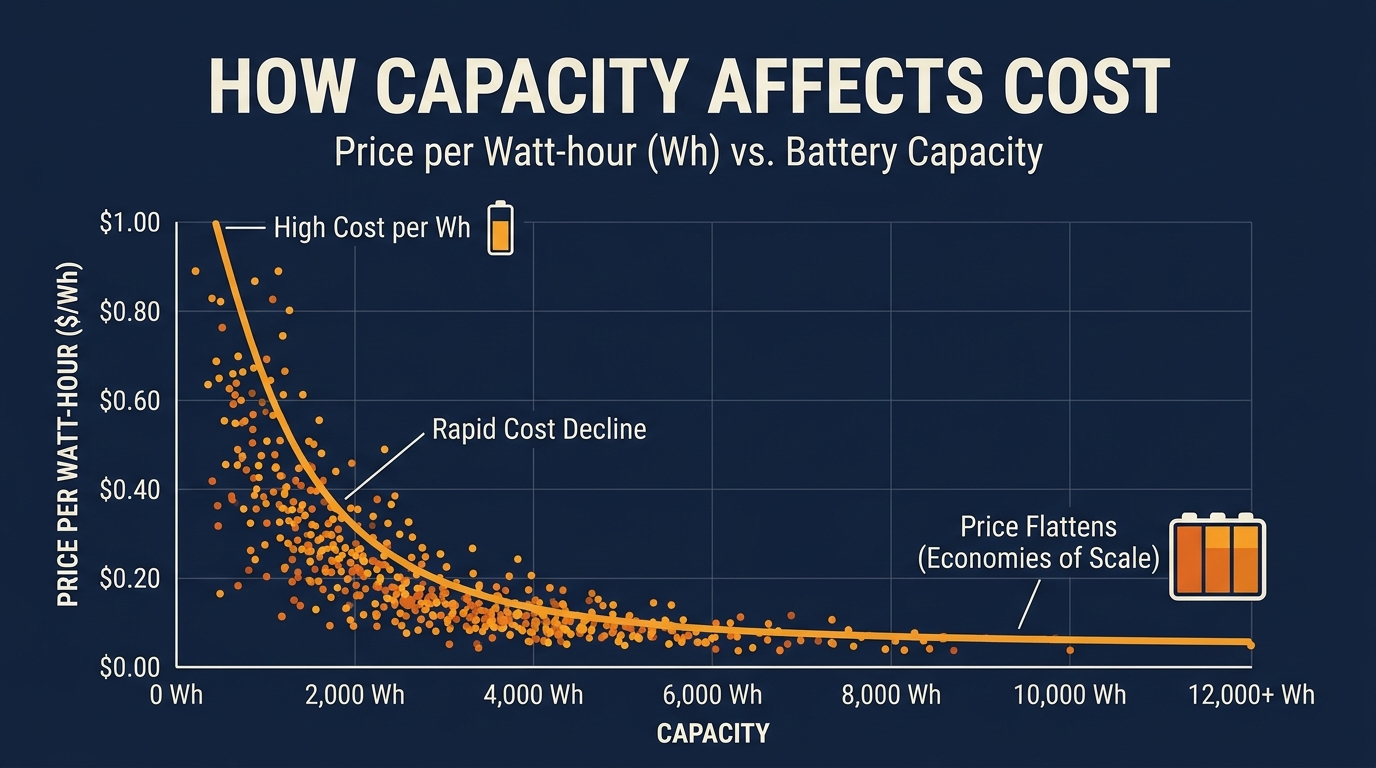
- There is a size premium at the bottom. Small units cost more than double per Wh because the inverter, case and electronics are a bigger share of the cost.
- The curve flattens in the middle. Between roughly 1,000 and 3,000Wh, prices cluster near $0.37 to $0.55 per Wh.
- The top end can get expensive again. The 5,024Wh Anker S5000 costs $0.59 per Wh in this snapshot, which buys output power and expandability rather than the cheapest energy.
- A "bigger discount" is not a "better price." Compare the Bluetti Elite 100 V2 at 44% off ($0.49 per Wh) with the Bluetti AC180 at 29% off ($0.43 per Wh).
Last Year Versus This Year
| Model | Capacity | Nov 2025 | Nov 12, 2026 | Per Wh then / now |
|---|---|---|---|---|
| Anker SOLIX C1000 Gen 2 | 1,024Wh | $349 | $549.99 | $0.34 / $0.54 |
| Bluetti Elite 200 V2 | 2,073Wh | $699 | $898.99 | $0.34 / $0.43 |
These are not like-for-like, since retailers, bundles and timing differ. But they show why a target price per Wh set in advance is more useful than any percentage off. For a live check of deals, see our Black Friday power station deals guide.
Metric 2: Cost per Output Watt
A cheap-per-Wh unit may be unable to run your appliances. Divide the price by the continuous AC output in watts. For example, our earlier coverage lists the Jackery Explorer 1000 v2 at 1,500W continuous and the Explorer 1500 v2 at 2,000W. At an illustrative $700 and $1,000, that is $0.47 and $0.50 per output watt. If you need to run a 1,200W appliance, the cheaper unit with a 1,000W output cannot do it at any price per Wh. See our Jackery 1000 vs 1500 comparison and our 1000Wh runtime chart for what output levels actually run.
Metric 3: Cost per Cycle (and Why It Is Not a Savings Plan)
Battery chemistry affects how many times a unit can be charged and discharged. LiFePO4 units are commonly rated for 3,000 or more cycles by their manufacturers, which are claims we have not verified; see our chemistry guide. Take a $499 unit with 1,024Wh and a claimed 3,000 cycles:
- Lifetime energy if used fully every cycle: 1.024 kWh x 3,000 x 0.85 = about 2,611 kWh.
- Cost per kWh delivered: $499 / 2,611 = about $0.19 per kWh.
That is close to typical grid electricity prices, which is the honest conclusion: power stations are not a way to save on your electric bill. They are insurance and convenience. Almost nobody cycles a backup battery 3,000 times, so cost per cycle matters most if you also use it for camping or daily solar. For a backup-only buyer, price per Wh, warranty and reliability matter more. See our yearly running cost guide.
Metric 4: What Your Own Plan Costs
Multiply the rated Wh you need by the price per Wh. This turns a catalog into a budget.
| Household profile | Daily energy | Rated Wh needed | Cost at $0.40/Wh | Cost at $0.55/Wh |
|---|---|---|---|---|
| A: wifi and phone | about 447Wh | about 525Wh | about $210 | about $289 |
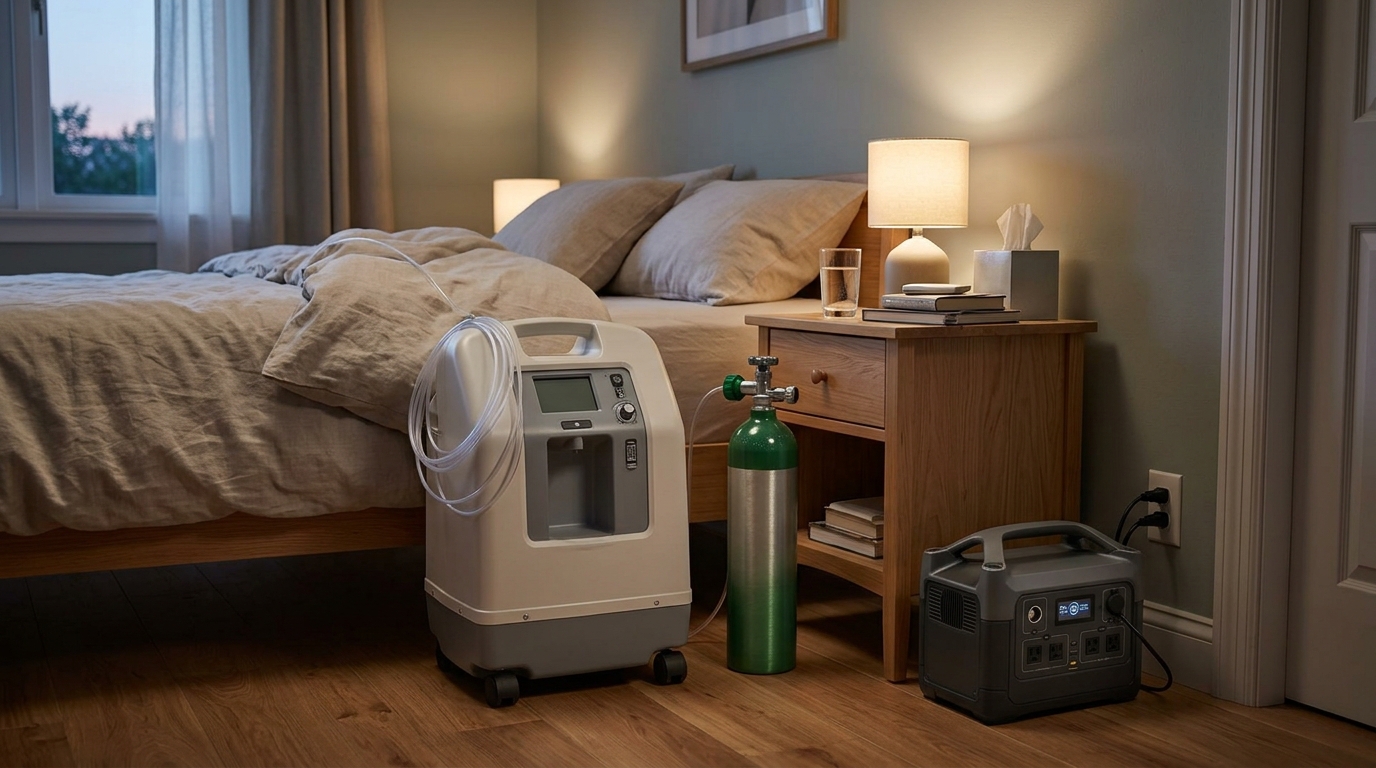
| B: plus CPAP | about 927Wh | about 1,090Wh | about $436 | about $600 |
| C: plus laptop, lights | about 1,287Wh | about 1,515Wh | about $606 | about $833 |
| D: plus full-size fridge | about 2,787Wh | about 3,280Wh | about $1,312 | about $1,804 |
These profiles come from our sizing chart. The costs assume you buy a unit at about the needed capacity and pay the stated price per Wh; in practice small units cost more per Wh, so Profile A at $0.40 is optimistic.
Worked Example: Two Ways to Cover a CPAP Night
A user needs about 927Wh a day for a CPAP, router and phone, and compares two options.
- Option 1: a 1,024Wh unit at $399.98 ($0.39 per Wh), usable about 870Wh. That covers about 94% of 927Wh, fine for a CPAP-only night.
- Option 2: a 1,152Wh unit at $499 ($0.43 per Wh), usable about 979Wh, covering the full 927Wh with about 52Wh spare.
Option 2 costs $99 more for about 109Wh more usable energy, or about $0.91 per extra usable Wh, which is why paying up a size is expensive at the margin. The right choice depends on whether the last 6% of the day matters. For a medical device, check compatibility and spare capacity first; see our CPAP picks.
What Price per Wh Hides
- Output watts. Covered above.
- Chemistry and cycle life. Not all units are LiFePO4.
- Warranty. A 5-year warranty is worth more than a small discount.
- Solar input. If you plan to recharge from panels, the maximum input watts decides how fast. See our solar recharge chart.
- Recharge speed from the wall. Matters in rolling outages.
- Weight and size. A 99 lb unit is hard to move.
- Expandability. See our expansion battery guide.
- Ports and UPS mode. Useful for a home office; see our home office guide.
- Seller and returns. Part of the real price.
Fill-In Worksheet
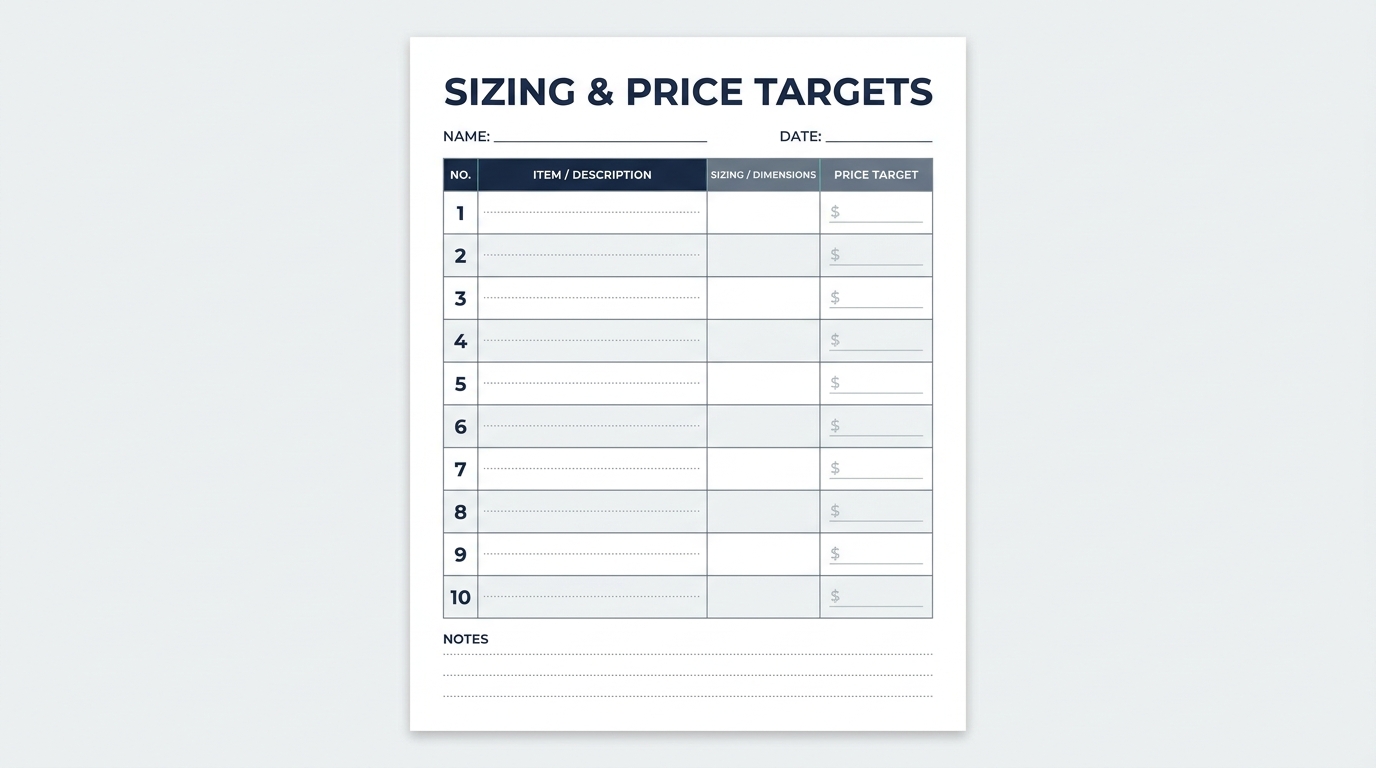
- Daily Wh need: ______ (use the profiles above or add up your devices)
- Rated Wh needed = daily Wh / 0.85: ______
- Longest outage you want to cover without recharging (days): ______
- Target price per Wh: ______ (for example, $0.40)
- Maximum budget = rated Wh needed x target: ______
- Required continuous output (watts): ______
- Required solar input (watts), if any: ______
- Candidate unit price and Wh: ______ , price per Wh: ______
- Warranty years and chemistry: ______
- Seller and return window: ______
If a unit fails any hard requirement (output watts, solar input, compatibility), it is not a deal at any price.
⚡ Power Station Size Calculator
Enter your appliance's wattage to see exactly which portable power station you need.
FAQ
What is a good price per Wh for a power station?
In the November 12, 2026 snapshot, about $0.37 to $0.45 per Wh for 1,000Wh and larger units. Smaller units cost more.
Is cheaper per Wh always better?
No. Output power, chemistry, warranty and solar input also matter.
Why are small power stations so expensive per Wh?
The inverter, case and electronics are a bigger share of the cost on small units.
Should I use rated Wh or usable Wh?
Compare rated Wh across units for fairness, and use usable Wh (about 85% for AC loads) when sizing your needs.
Do power stations save money on electricity?
Generally not. Our lifetime-cost example came to about $0.19 per kWh, close to grid prices.
Where can I see live deals?
Check our Black Friday power station deals guide and the manufacturer's own site.
The Bottom Line
Use price per Wh to compare, then use output watts, chemistry, warranty and solar input to decide. Set your target price before the sales start, compute what your own plan costs, and buy at your number. A power station is insurance, and the best value is the unit that reliably covers your loads at a fair price per Wh.
Prices are snapshots from third-party roundups and may be out of date. Confirm current price and specifications with the seller.