Affiliate disclosure: some links on this page may earn Trendifacts a commission at no extra cost to you. It does not change what we recommend, and this article mostly argues against relying on a heater.
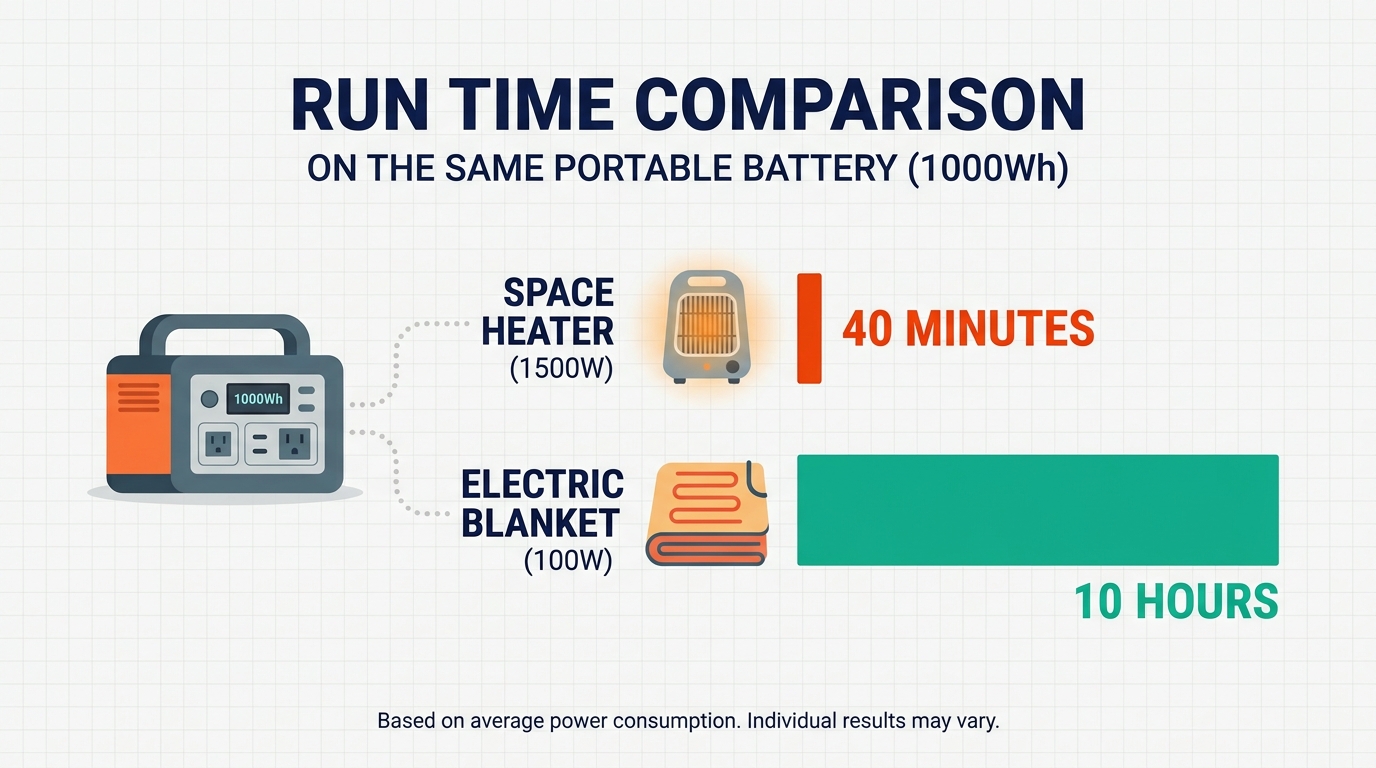
Yes, a power station can run a space heater, but only for a short time: about 30 minutes on a 1,000Wh unit at 1,500W, and about 2 hours on a 3,600Wh unit. That makes a heater a way to take the chill off a room, not a way to heat a home through a winter blackout. An electric blanket, at 60 to 100W, gives many hours of warmth from the same battery. If you do use a heater, plug it directly into the station (not a power strip), keep it at least 3 feet from anything that can burn, and never leave it running while you sleep or leave the room.
This guide gives heater wattages, runtime tables for common station sizes, the output limits that matter before runtime does, a more efficient plan for staying warm, and the safety rules that apply to any electric heater.
The Short Answer
| Setup | Runtime on a 1,000Wh station (about 850Wh usable) |
|---|---|
| 1,500W heater, continuous | about 34 minutes |
| 750W heater, continuous | about 1.1 hours |
| Electric blanket (about 80W) | about 10.6 hours |
How Many Watts Does a Space Heater Use?
Most electric space heaters draw 750 to 1,500 watts, depending on type and setting:
| Heater type | Typical wattage |
|---|---|
| Ceramic heater, low setting | 500 to 750W |
| Oil-filled radiator | 600 to 1,500W |
| Infrared or quartz heater | 600 to 1,500W |
| Fan-forced heater, high setting | 1,200 to 1,500W |
A correction to an earlier version of this article: we said a heater draws its full wattage continuously. In fact, a heater with a thermostat cycles on and off once the room reaches the set temperature, so its average draw can be lower than its label. In a cold room, though, especially during a winter outage when you open doors and heat leaks out, the heater may run most of the time. Plan for the label wattage and treat any thermostat savings as a bonus.
The Real Math: How Long Will It Run?
We use 85% usable capacity because the inverter wastes some energy as heat.
| Power station | Usable | 750W heater | 1,500W heater |
|---|---|---|---|
| 300Wh unit | about 255Wh | about 20 minutes | not recommended; many 300Wh units cannot output 1,500W |
| 1,000Wh unit | about 850Wh | about 1.1 hours | about 34 minutes |
| Jackery Explorer 1500 v2 (1,536Wh) | about 1,306Wh | about 1.7 hours | about 52 minutes |
| EcoFlow DELTA Pro (3,600Wh) | about 3,060Wh | about 4.1 hours | about 2 hours |
| EcoFlow DELTA Pro 3 (4,096Wh) | about 3,480Wh | about 4.6 hours | about 2.3 hours |
| Anker SOLIX F3800 (3,840Wh) | about 3,260Wh | about 4.3 hours | about 2.2 hours |
The pattern holds across brands: even a large, expensive unit gives about two hours of full-power heat, not an overnight solution. Running at 750W instead of 1,500W doubles the time. These runtimes also assume nothing else is running from the same battery. If you run a fridge, a CPAP and a router, the heater competes with them; see our sizing chart.
Check the Output Rating First
Before runtime, there is a harder limit: the station's continuous AC output must exceed the heater's wattage with some margin. A 1,500W heater needs a station rated for meaningfully more than 1,500W continuous. Many mid-range units sit right at that ceiling. For example, the Jackery Explorer 1000 v2 is rated 1,500W continuous with a 3,000W surge, while the 1500 v2 offers 2,000W continuous, according to Jackery's comparison page. A heater at the ceiling can trip an overload shutdown instead of delivering steady heat. See our Jackery comparison for the specs.
Also watch for other loads running at the same time. A heater plus a kettle can exceed the limit in seconds.
The Better Answer: Heat the Person, Not the Room
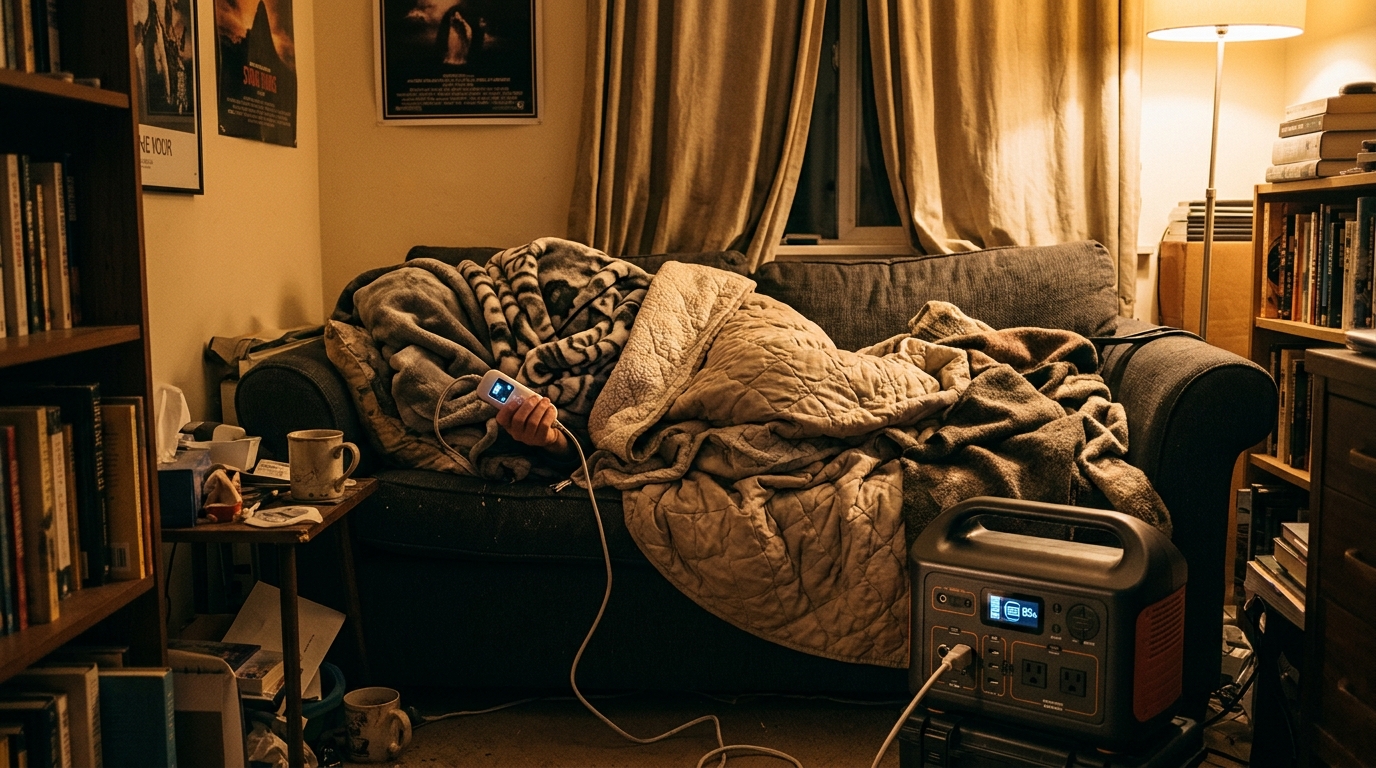
An electric blanket draws only about 60 to 100 watts, according to Anker's electric blanket guide, depending on size and setting, with single-person blankets at the low end. That is the same order as a CPAP machine, not a heating appliance. On 850Wh usable:
| Blanket draw | Runtime on 1,000Wh station | Compared with a 1,500W heater |
|---|---|---|
| 60W | about 14 hours | about 25 times longer |
| 80W | about 10.6 hours | about 19 times longer |
| 100W | about 8.5 hours | about 15 times longer |
If your goal is body warmth during a short outage, which it usually is, a blanket does more per watt-hour than heating the air. Pair it with layered clothing, a hat, a sleeping bag rated for cold, and one warm room.
Safety for electric blankets: use a modern blanket with automatic shut-off, don't use it folded or bunched, inspect it for damage, and don't use it with people who can't tell if it's too hot, such as infants or people with reduced sensation.
A Heat Budget Example
Suppose you have a 1,000Wh station, a CPAP (about 480Wh a night at 60W for 8 hours) and a router and modem (about 432Wh a day at 18W). That already uses more than the 850Wh the station can deliver. Add an electric blanket at 80W for 6 hours, 480Wh, and the budget breaks. In that situation, you need to prioritize or add capacity. Our CPAP runtime guide and router guide show each load's numbers. Decide the order in advance: medical devices first, communication next, warmth third, and use blankets and clothing for warmth rather than a heater.
Space Heater Safety Rules
Electric heaters are a leading source of home fire risk, and a power station does not change that. Follow the fire-safety guidance:
- Plug the heater directly into the power station's outlet, or a wall outlet, not a power strip or extension cord. Local fire-safety guidance based on NFPA advice, such as this Columbus, Indiana fire department page, says to plug heaters directly into the wall outlet and never use an extension cord. The U.S. Consumer Product Safety Commission's winter storm tips say to plug electric heaters into a wall outlet, never a power strip, and not to run the cord under rugs (CPSC).
- Keep 3 feet of clearance on all sides from beds, clothes, curtains, papers and anything flammable, and from people.
- Never leave it unattended. Turn it off and unplug it when you leave the room or go to sleep.
- Choose a heater with automatic tip-over shut-off, and place it on a flat, hard surface.
- Don't use a fuel-burning heater indoors. Gas, kerosene and charcoal appliances produce carbon monoxide. See the CPSC's carbon monoxide guidance.
- Install smoke and CO alarms and test them. Alarm batteries matter in an outage.
Because a heater at full load also drains a power station quickly, it is a poor candidate for overnight use. Sleeping next to a running heater is where most heater fires and burns happen.
When a Space Heater Still Makes Sense
- Short warm-ups. Run it 20 to 30 minutes to take the chill off a room, then switch to blankets.
- With a high-capacity station like the DELTA Pro 3, where two hours of heat is a real option, though it uses most of the battery.
- On the lowest setting that gives the comfort you need.
- In a small, closed room where heat is retained, with the door shut.
- While you are awake and attending it, with safe clearances.
Other Ways to Stay Warm Without a Heater
- One warm room. Close doors, hang blankets over windows and doorways, and put towels at door gaps.
- Layers and insulation. Wool or synthetic layers, hats and socks.
- Sleeping bags and extra blankets rated for cold.
- Warm food and drinks, heated safely. Do not use camp stoves or grills indoors; see our winter storm guide.
- Body heat. Staying close together in one room helps.
- Know the warning signs of hypothermia, and know when to leave for a warming shelter.
If the building is getting dangerously cold, leave for a warming center or a friend's home rather than trying to power a house.
A Worked Example: A Cold Night in a Small Apartment
Say the heat is out, it is 35°F outside, and you have a 1,500Wh station (about 1,275Wh usable). You want to stay warm for a 10-hour night. Running a 750W heater would use up the battery in about 1.7 hours. Running an 80W electric blanket for 10 hours uses 800Wh, leaving about 475Wh for a CPAP (480Wh at 60W for 8 hours) or a router. So the blanket alone nearly consumes the budget, which tells you two things: warmth is expensive even when efficient, and a plan with a bigger battery or solar recharge is worth considering before winter. Many people choose a lower blanket setting, an insulated sleeping bag, a smaller room and layered clothing, which reduce the load further. If you rely on a CPAP, count its watt-hours first and heat second. Our CPAP runtime guide has the numbers.
Heat Pumps, Oil Radiators and Other Alternatives
An oil-filled radiator still draws 600 to 1,500W, though its thermal mass keeps radiating after it cycles off, which can smooth the draw. A small ceramic heater on low (about 500W) trades power for less heat. A mini heater designed for a desk uses 200 to 400W and warms only a person. None of these changes the arithmetic enough to make a battery a whole-home heat source. If you often lose power in winter, a larger system, solar, or a fuel-based plan with proper safety may be worth discussing with a qualified professional.
Cold Affects the Battery Too
A power station stored in an unheated garage may deliver less than its rated capacity, and it cannot be charged below freezing. Bring it inside before the storm. See our cold-weather charging guide and our LiFePO4 chemistry guide.
FAQ
Can a 1,000Wh power station run a space heater? Yes, for about 34 minutes at 1,500W or about 1.1 hours at 750W, if its output rating allows.
How long will a power station run a 1,500W heater? About 2 hours on a 3,600Wh unit, about 34 minutes on a 1,000Wh unit.
What is better than a space heater on a power station? An electric blanket at 60 to 100W lasts many times longer.
Can I plug a heater into a power strip on a power station? No. Plug it directly into the station.
Is it safe to sleep with a heater running? No. Turn it off and unplug it when you go to bed.
Will a power station run an oil-filled radiator? Yes, if the output rating is high enough, but expect short runtimes.
The Bottom Line
A portable power station can run a space heater, but the runtime, typically 30 minutes to about 2 hours, makes it a poor heating strategy for an overnight outage. Use it for short warm-ups at most, keep it plugged directly into the station and attended, and lead with an electric blanket, layers and one insulated room.
Wattages and runtimes are estimates. Check your heater's label, your station's output rating and your local fire-safety guidance.