Transparency note: this review is built from Anker's published specifications and a hands-on review by TechRadar, both cited below. We have not run our own bench tests on this unit, so every measured result belongs to the named source. The main review we rely on was published in January 2024, so pricing and some details may have changed.
Affiliate disclosure: if you buy through links on this page, Trendifacts may earn a commission at no extra cost to you. It does not change what we recommend, and we explain who should skip this unit.
The Anker SOLIX F3800 is one of the few portable power stations that outputs both 120V and 240V power, which is why it shows up in conversations about home backup rather than camping. It stores 3,840Wh, delivers up to 6,000W, and can be expanded to a very large system. It is also very heavy, very large, and priced accordingly.
This review explains what those numbers mean in practice: what the F3800 can run and for how long, what the 240V output actually does, how expansion works, how it compares with the EcoFlow DELTA Pro 3, and who should buy it. If you are still choosing between sizes, start with our sizing chart.
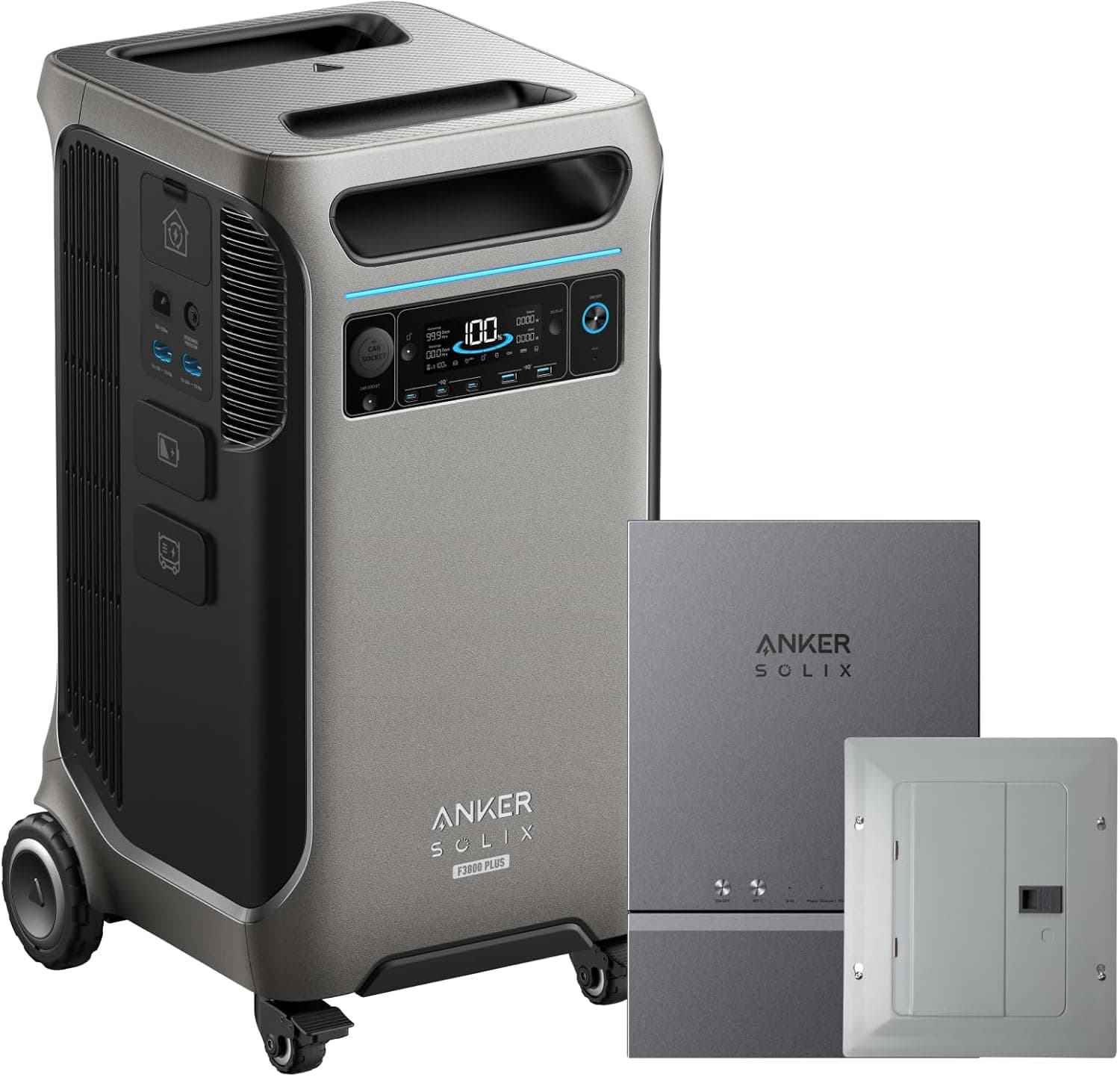
Anker SOLIX F3800 Plus Portable Power Station
Check Price on Amazon ↗The Short Verdict
- Best for: homeowners who want 240V output for larger loads, people planning a system that grows over time with expansion batteries, and anyone who values a large port selection.
- Skip it if: your needs are wifi, phones, lights and a CPAP. A far cheaper unit covers that. See our budget power station roundup.
- Strengths: 6,000W of output, 120V and 240V, three UPS-labeled outlets, strong expansion potential, an easy app, and high build quality in the reviewer's view.
- Weaknesses: 132.3 lb, a large footprint, a high price, and one compatibility quirk in testing: it refused to charge a large EcoFlow unit.
Key Specifications
| Spec | Anker SOLIX F3800 |
|---|---|
| Capacity | 3,840Wh |
| AC output | Up to 6,000W, 120V and 240V (US and Canada) |
| AC input (US and Canada) | 1,800W |
| Cycle life | 3,000 charge cycles (TechRadar) |
| Weight | 60 kg (132.3 lb) |
| Dimensions | 27.6 x 15.1 x 14.6 in, including wheels |
| Solar input | About 2,400W for the standard F3800 (the newer F3800 Plus raises it to 3,200W, per TechRadar) |
| Expansion | Up to 26,880Wh with expansion batteries; up to 53,760Wh with two F3800 units (TechRadar) |
| Recharging temperature | 32°F to 104°F |
| Connectivity | Wi-Fi and Bluetooth app |
Sources: Anker's F3800 specification page and TechRadar's F3800 review. Anker's page did not list surge rating, battery chemistry, solar input or expansion figures, and TechRadar did not state continuous versus surge output or battery chemistry. Confirm those details on Anker's current product page before you buy.
What the 240V Output Means
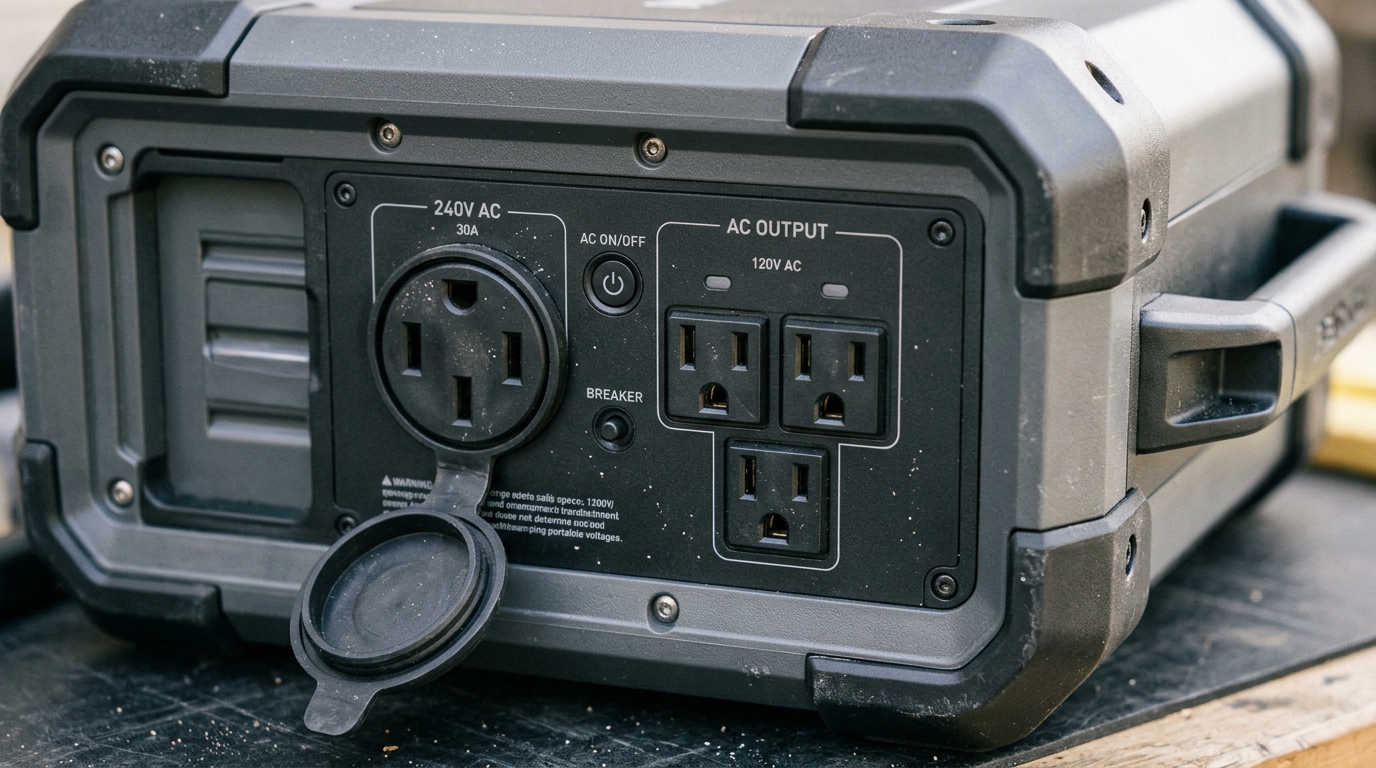
Most portable power stations only output 120V, the standard US wall outlet voltage. The F3800 adds a 240V split-phase output through ports such as a NEMA 14-50 and an L14-30R, which TechRadar lists among its connections. According to the review, the 240V output works on one 240V device at a time.
Why does that matter? Some larger appliances, including certain well pumps, dryers and large air conditioners, run on 240V. A 120V-only station cannot power them at all. The F3800's 240V ports open that door, but a high-draw device still has to fit within 6,000W and drains the battery fast. We cover the well-pump and central-air limits in our 4,000Wh appliance chart and in our guide to running central air on a power station.
Runtime: What 3,840Wh Gets You
Using the 85% usable-capacity assumption we apply throughout this site, the F3800 provides about 3,260Wh of usable AC power. Here is what that works out to for loads we have sourced in other articles:
| Load | Draw | Estimated Runtime |
|---|---|---|
| Wifi router + modem | about 18W | about 180 hours (7.5 days) |
| CPAP, moderate settings | about 60W | about 54 hours |
| Laptop | 60-100W | about 33-54 hours |
| Full-size fridge (1.5 kWh/day) | about 62W average | about 52 hours (2.2 days) |
| Chest freezer (about 0.59 kWh/day) | about 25W average | about 5.5 days |
| 1/2 HP sump pump, heavy storm | see below | about 3 hours of continuous running |
For the fridge and chest freezer, the daily consumption figures come from our fridge and food safety articles. The sump pump in a heavy storm cycles on and off rather than running constantly, so real-world coverage is longer than the continuous-run figure, as we explain in our sump pump guide.
TechRadar's reviewer estimated the F3800 could run his whole house for about four hours on the main battery, about a day with expansion batteries, and roughly two and a half days with a second F3800. He was clear that this was a calculation from his usage data. He did not wire the unit into his breaker panel. We would treat it the same way: a useful sense of scale, not a promise.
Expansion: Where the F3800 Is Strongest
The F3800's expansion headroom is its most distinctive feature. TechRadar lists up to 26,880Wh with expansion batteries, and up to 53,760Wh with two F3800 units. Even if you never get near those numbers, the point is that the system can grow with your needs and budget instead of forcing you to replace the main unit. Before spending on expansion, read our analysis of whether expandable power stations are worth it, because the cost per added watt-hour matters.
UPS Behavior and Outlets
The F3800 labels three of its AC ports as UPS outlets that connect to an uninterruptible power supply. In plain terms, equipment plugged into those ports keeps running when grid power drops. The remaining AC ports only work when the unit is running on battery with grid power disconnected, according to TechRadar. That is an important detail: if you plug a device into a non-UPS port while the grid is on, it may not receive power the way you expect. Read the manual and test your setup before an outage. TechRadar did not give a switchover time in milliseconds, so if a sensitive device such as a desktop computer or medical equipment depends on instant switching, check the specification with Anker first.
Charging and Solar
On US and Canadian outlets, Anker lists 1,800W of AC input. From empty, that implies a recharge measured in hours, not minutes. Solar is the way to avoid waiting on the grid: about 2,400W for the F3800 and 3,200W for the Plus, according to TechRadar. Whether you can use that much depends on the panels. Our solar panel guide shows what independent testing found in sun and cloud, and our guide to sizing panels for a 4,000Wh station works through the numbers with this class of unit in mind.
Temperature matters too. Anker lists a recharging range of 32°F to 104°F. Do not charge the unit below freezing, which is a limit shared by lithium batteries generally (our cold-weather guide).
Compatibility Quirk to Know About
TechRadar reported that the F3800 refused to charge a large EcoFlow DELTA 2 Max and displayed a risk-of-damage warning. If you plan to chain or cross-charge different brands of power station, check compatibility first. Cross-brand charging is an edge case for most buyers, but it is a useful reminder that large systems are not always interchangeable.
Connecting to a Home
The F3800 is designed to integrate with a home panel through Anker's home backup accessories, including a "home panel" port TechRadar lists among its connections. That is an electrician's job. Never plug a power station into a wall outlet to feed the house, and never wire it into your breaker panel yourself. Backfeed can seriously harm utility crews and people inside your home. Utility guidance, such as this safety advisory from Guadalupe Valley Electric Cooperative, says to have a licensed electrician install a transfer switch and to check with your utility about connection rules. This site focuses on plug-in use and does not offer installation instructions.
Size, Weight and Portability
At 132.3 lb, the F3800 is heavier than the EcoFlow DELTA Pro 3, and it measures roughly 27.6 x 15.1 x 14.6 inches. It has wheels, but moving it up stairs takes two people or a plan. TechRadar's cons list calls it very heavy, quite large and rather expensive. If you live in an apartment, this is not the right unit; our apartment renter checklist and balcony solar generator picks cover units that actually fit.
Price: What Reviews Show
TechRadar listed the F3800 at $1,999.99 at Best Buy, $2,199.99 at Amazon and Adorama, and $2,299.99 at Walmart, with some higher listings that the review did not explain. That was January 2024. Prices, bundles and newer versions have changed since, so check current listings. To judge value, divide the price by 3,840 to get the cost per watt-hour.
| Price You Find | Cost per Wh |
|---|---|
| $2,000 | about $0.52 |
| $2,500 | about $0.65 |
| $3,000 | about $0.78 |
For context, the BLUETTI AC70 is about $0.47 per Wh at its list price, and the Anker SOLIX C1000X launched near $1.23 per Wh. At the early-2024 prices, the F3800 was strong value for a 240V-capable unit. Do the same arithmetic today before you buy.
F3800 vs. EcoFlow DELTA Pro 3
These are the two units people most often compare. Based on the sources we opened:
| Feature | Anker SOLIX F3800 | EcoFlow DELTA Pro 3 |
|---|---|---|
| Capacity | 3,840Wh | 4,096Wh |
| AC output | 6,000W, 120V and 240V | 4,000W continuous (8,000W X-Boost surge); confirm US voltages |
| Weight | 132.3 lb | 113.5 lb |
| Solar input | about 2,400W (3,200W on Plus) | up to 2,600W |
| Cycle life | 3,000 cycles | 4,000 cycles to 80% |
| Expansion | up to 26,880Wh (TechRadar) | two extra batteries, about 12kWh (reviewer) |
The F3800 leads on raw output and 240V support; the DELTA Pro 3 leads on cycle life, capacity and weight. Read our full DELTA Pro 3 review and our earlier original DELTA Pro review before choosing.
Pros and Cons
Pros
- 6,000W of output with both 120V and 240V.
- Very large expansion potential.
- Three UPS-labeled outlets.
- Solid build and an easy app, according to TechRadar.
- A wide set of ports, including NEMA 14-50 and L14-30R.
Cons
- 132.3 lb and very large.
- Expensive, and prices vary a lot between retailers.
- Not waterproof, per Anker's page.
- No switchover time published in the sources we opened.
- Cross-brand charging limits, per the reviewer.
Who Should Buy It, and Who Should Not
Buy it if you need 240V output, want a system that can grow, or are building toward home-panel integration with a licensed electrician. It is a strong match for a rural home with a larger well pump or for a household that wants a long-term foundation rather than a single battery.
Look elsewhere if your needs are modest, you live in an apartment, or you need to run a central air conditioner for hours. A 3-ton central unit can draw 3,000 to 3,600W while running, according to Jackery's HVAC guide, which would empty a 3,840Wh battery in under two hours. For long outages with heavy loads, compare the economics in our power station vs. generator guide.
FAQ
Can the Anker F3800 run a whole house? Not for long without expansion. TechRadar's reviewer calculated about four hours for his whole house on the main battery, with more time from expansion batteries, but he did not wire it in to test.
Does it output 240V? Yes, in the US and Canada, through ports such as NEMA 14-50 and L14-30R. It powers one 240V device at a time, per TechRadar.
How heavy is the F3800? 132.3 lb (60 kg). Plan for two people.
How long does it take to recharge? Anker lists 1,800W AC input in the US and Canada, so expect several hours from empty. Solar can add up to about 2,400W.
Is the F3800 waterproof? No. Keep it dry and indoors or sheltered.
What is the difference between the F3800 and the F3800 Plus? TechRadar notes the Plus raises solar input from 2,400W to 3,200W. Check Anker's current page for other differences.
The Bottom Line
The Anker SOLIX F3800 is a high-output, expandable, 120V and 240V power station that fits households needing more than a plug-in battery can usually give. Its weight, size and cost make it a deliberate purchase, and it does not make central air or a whole house practical on its own. If you need 240V or want room to grow, it deserves a hard look next to the EcoFlow DELTA Pro 3. If you do not, buy less battery and spend the difference on solar or a second small unit.
Specifications and pricing come from the cited sources, including a review published in January 2024, and may have changed. Confirm current details on Anker's site before buying.