Last updated: November 2026. Method note: prices and specifications are from the cited reviews and listings and change often; currencies are noted where they differ. Cost-per-Wh figures are our own arithmetic. We have not tested these expansion systems ourselves.
Affiliate disclosure: some links on this page may earn Trendifacts a commission at no extra cost to you. It does not change what we recommend, and in several cases this article tells you not to buy expansion.
Expandable power stations are worth it in a narrow set of cases: when your capacity needs are uncertain, when you want to spread the cost over time, or when the brand prices its expansion batteries below a comparable stand-alone unit. They are often not cheaper. The base unit usually costs 20 to 30% more than a fixed-capacity model, expansion batteries are locked to one brand, and the total for a base unit plus add-on frequently exceeds a single larger unit of the same capacity. Run the cost-per-watt-hour math before you assume expansion is the budget route.
This guide explains what "expandable" really means, the cost math with real examples, the small energy loss from linking batteries, a decision framework, and which household profiles actually benefit.
The Short Answer
- Buy expandable if you might outgrow your unit, want to stage the purchase, and your brand's expansion pack is priced fairly per Wh.
- Buy fixed capacity if you can predict your needs and budget for them today.
- Always compare (base price + expansion price) divided by total Wh against a single larger unit.
- Never mix brands. Expansion packs only work with their own ecosystem.
What "Expandable" Actually Means
An expandable station has a port or bus for connecting extra battery packs, so total capacity can grow later. Two catches:
- A premium for the option. Expandable base units typically cost 20 to 30% more than an equivalent fixed model, because you pay for the expansion hardware whether or not you ever use it. That figure is from one buying-guide site, so treat it as a rough rule, not a law.
- Ecosystem lock-in. Jackery packs work with Jackery bases, EcoFlow with EcoFlow, and so on. Even within a brand, packs are model-specific: one Jackery retail listing for the Explorer 1000 v2 notes it is not compatible with the Explorer 1000 Plus battery pack. Always confirm compatibility on the manufacturer's page.

The Cost Math
Here is what marketing leaves out: the total of a base unit plus expansion often exceeds the price of a single larger system with the same final capacity. Expandability is mostly a way to spread payments, not a discount.
To check any deal, use this formula:
Cost per Wh = (base price + expansion price) / (base Wh + expansion Wh)
Then compare it with the cost per Wh of a fixed unit of the same total size.
Examples From Our Sources
| System | Price (as reported) | Capacity | Cost per Wh |
|---|---|---|---|
| FOSSiBOT F3600 Pro plus one expansion battery (deal listing) | about $1,878 | about 7,680Wh | about $0.24 |
| Jackery Explorer 2000 Plus expansion batteries (one buying guide) | about $0.49/Wh | up to 12,000Wh total | about $0.49 |
| EcoFlow DELTA Pro 3, launch special (AUD, Australia) | $4,099 AUD | 4,096Wh | about $1.00 AUD |
| EcoFlow DELTA Pro 3 Smart Extra Battery (AUD, Australia) | $3,999 AUD each | 4,096Wh each | about $0.98 AUD |
| BLUETTI AC70 (list price from our budget roundup) | about $359 | 768Wh | about $0.47 |
Sources: Slickdeals listing for the F3600 Pro, ThePowerStationGuide, and Cybershack's DELTA Pro 3 review. Deal prices expire, so check current numbers. The Australian prices are in Australian dollars and are not directly comparable with U.S. prices.
What the table shows: the F3600 Pro bundle is priced very well per Wh, while for the DELTA Pro 3 an extra battery costs almost as much as the whole base unit did at the launch price. In that case, you get no savings from "just adding a battery." You do get more storage without another inverter, which is useful if your output needs are already met and you only need more hours. To check the economics for a specific purchase, our guide to the EcoFlow DELTA Pro 3 lists the expansion options, and our Anker SOLIX F3800 review covers one that TechRadar says expands up to 26,880Wh.
The "Efficiency Tax"
Linking batteries has a small cost beyond price. The battery management system has to balance voltage between the base and the pack, which one guide estimates causes a 2 to 5% energy loss. That is a vendor-adjacent estimate, not a standard figure. In practice, plan on slightly less usable energy than the sum of the ratings. For a pair rated 2,000Wh in total, a 3% loss costs you about 60Wh, which is about an hour of a router and modem. It rarely decides a purchase, but it belongs in your runtime math. We cover the baseline 85% usable-capacity assumption in our sizing chart.
Capacity vs. Output: What Expansion Does Not Fix
Expansion adds watt-hours, which means more hours. It does not add watts, which means more things at once. If your base unit's inverter is 1,800W, a second battery will not let you run a 3,000W appliance.
Check the inverter rating before you buy. For example, the EcoFlow DELTA Pro 3 lists 4,000W continuous output, and the reviewer notes up to three units can be linked for up to 12,000W, which is a different (and more expensive) kind of expansion. If your problem is surge or output, see our sump pump guide and central air guide.
Some popular models have no expansion at all. For instance, a hands-on review of the Jackery Explorer 1500 v2 lists it as not expandable. That can be fine if its fixed capacity fits your needs. Our Jackery 1000 v2 vs 1500 v2 comparison walks through that decision.
When Expandable Makes Sense
- Your needs are likely to grow. You start with a CPAP and wifi today but might add a fridge later. Staging the purchase can beat committing to an oversized unit.
- Your budget works better in two payments. Buying a base unit now and a pack later is legitimate, even if it costs a little more in total.
- You are committed to one ecosystem and the pack is priced well per Wh.
- You want to add runtime without adding another inverter. A pack adds hours without a second box to manage.
- You plan to pair it with solar, where a larger battery lets you bank more daytime energy. See our solar recharge chart.
When Fixed Capacity Is the Better Buy
If you can predict your needs for the next several years and can afford that size now, a fixed unit is usually cheaper and simpler: no expansion premium, no lock-in, no balancing loss. Most people following our sizing chart land in Profile A, B or C, where needs are well defined and a 500 to 2,000Wh fixed unit covers them. See our under-$500 picks and C1000X review.
Where Expansion Matters Most: Fridge-Level Needs
The clearest case is Profile D in our sizing chart, which includes a full-size fridge. A fridge uses about 1 to 2 kWh a day, so even a 4,000Wh unit gives only about 56 hours at 1.5 kWh a day, as we show in the fridge runtime guide.
A second 4,096Wh pack roughly doubles that to about 4.5 days, which starts to look like real multi-day coverage. The cost is the question: use the formula above, and compare with solar, a generator (our comparison) or a smaller second station.
A Worked Example: Staging a Purchase
Say your household is Profile B in our sizing chart, wifi plus a CPAP, about 927Wh a day, and you think a fridge may join the list next year. Option A is a fixed 1,500Wh unit now, enough for about 1.4 days of Profile B and no fridge.
Option B is an expandable 1,000Wh base unit now plus a 1,000Wh pack next year. Suppose the base costs $700 and the pack $500, and a fixed 2,000Wh unit costs $1,200. The staged route totals $1,200 for 2,000Wh, the same as the fixed unit, but you pay $700 today and $500 later, which is the real advantage.
If the pack had cost $800 instead, the staged route would cost $300 more for the same capacity, which is the price of flexibility. Those prices are invented for illustration, so replace them with current ones.
The method is what matters: write down the total cost and total Wh for each route and compare them, including what you would do if your needs never grow.
Resale, Availability and Obsolescence
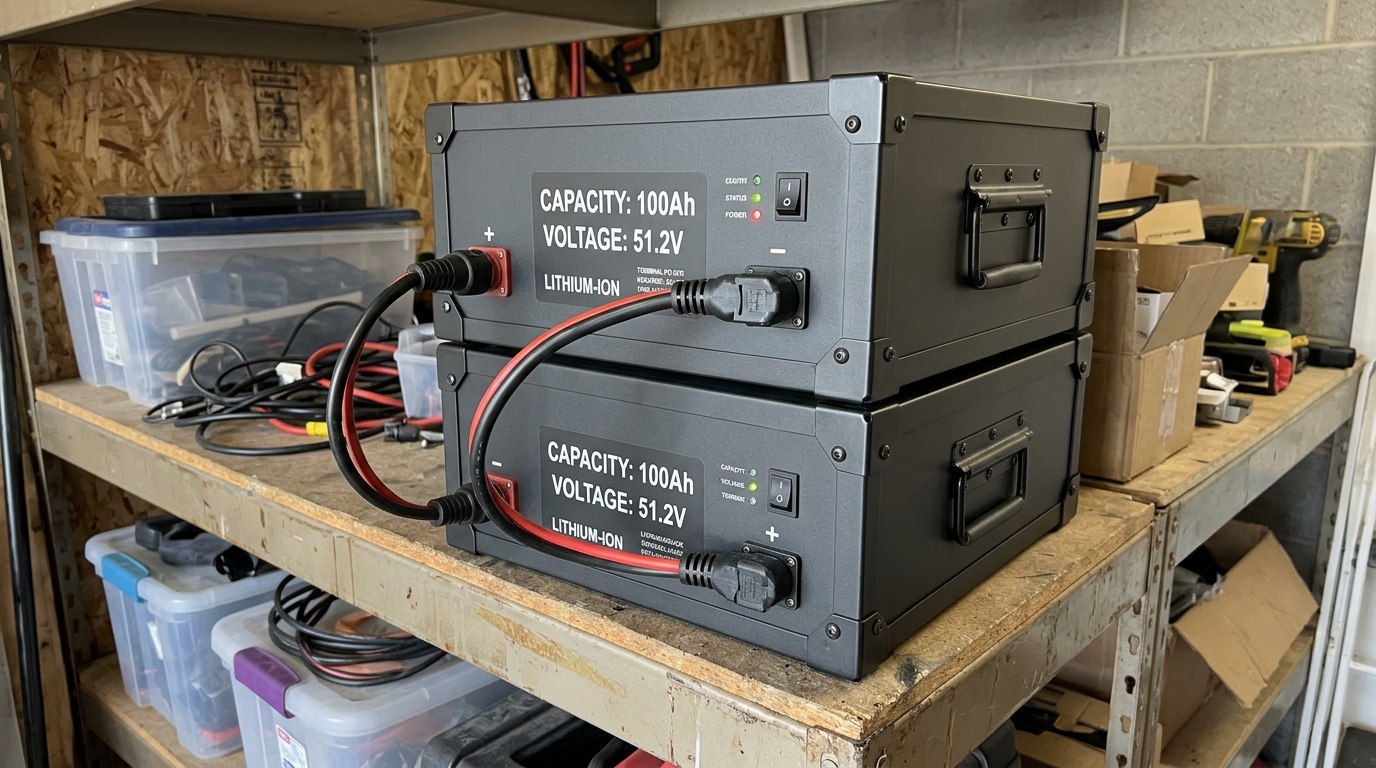
Packs are less liquid than whole stations. If you sell your base unit, a buyer may not want a pack tied to an older model, and manufacturers retire models faster than a battery wears out.
A battery rated for thousands of cycles can outlive the product line that supports it. Before you commit to an ecosystem, check how long the brand has supported earlier expansion packs, whether the pack is sold separately at a stable price, and whether the warranty on the pack matches the base. These questions cost nothing and often decide whether expansion is a safe bet.
A Decision Checklist
- Write down your daily watt-hours using our sizing chart.
- Price a fixed unit that covers it today.
- Price base plus expansion to the same total Wh.
- Divide each by its total Wh. If expansion is more than about 20% worse per Wh, the flexibility has a real price.
- Check output watts. Does the inverter cover your biggest appliance?
- Check availability. Will the pack still be sold in two years? Manufacturers change models, and old packs can become hard to find.
- Check the warranty on the pack and base separately.
- Consider two small units instead. Two 1,000Wh stations can be cheaper, portable and redundant.
Safety and Practical Notes
- Use the manufacturer's cable and connection method only.
- Do not connect third-party packs to a station.
- Keep linked units ventilated, and away from heat; see our hot garage storage guide.
- Heavy packs are a lifting risk. The DELTA Pro 3 weighs 113.5 lb on its own.
- Do not charge lithium batteries below freezing; see our cold-weather guide.
FAQ
Are expandable power stations worth it?
Only if your needs may grow, you want to spread the cost, or the pack is priced well per Wh. Otherwise a fixed unit is usually cheaper.
Can I use any brand's battery with my power station?
No. Packs are brand- and often model-specific.
Is it cheaper to buy a second power station or an expansion battery?
Check both per Wh. Sometimes a second small station costs less and adds redundancy.
Does adding an expansion battery increase output?
No. It adds capacity, not inverter watts.
How much energy is lost when linking batteries?
Estimates run about 2 to 5%, though figures vary.
What is the best use case for expansion?
Staged purchases and fridge-level capacity needs, where one battery is clearly not enough.
The Bottom Line
Expandable power stations are a tool for uncertain or growing needs and staged budgets, not a universal upgrade. Do the per-Wh math on the exact pack, check inverter output, and compare with a fixed unit and with solar. If your needs are already clear, a fixed-capacity station is usually the simpler and cheaper path.
Prices and specifications change often. Confirm current numbers, compatibility and warranty terms on the manufacturer's site before buying.