Before you can compare specific models, specs, or prices, there’s a more fundamental decision most buying guides skip entirely: do you actually need a generator at all, or is a power station the right tool for your situation?
We’ve spent this entire series comparing power stations against each other — this article steps back and compares the whole category against its older, louder alternative, using real safety data, cost figures, and output numbers rather than marketing claims from either side.
The Core Difference: Stored Energy vs. On-Demand Combustion
A portable power station is, fundamentally, a large rechargeable battery with an inverter built in — it stores energy ahead of time and releases it when you need it.
A gas, propane, or diesel generator does the opposite: it has no meaningful stored energy of its own, and instead burns fuel on demand to generate electricity in real time, for as long as you keep feeding it fuel.
That single distinction is the root of almost every other difference between the two categories — safety, runtime, noise, maintenance, and cost all flow directly from whether the device is storing energy or burning it.
Safety: The Factor That Should Decide This for Many Households
This is the most important section in this article, and it’s not close. Fuel-burning generators produce carbon monoxide, and the safety data on this is sobering.
According to the U.S. Consumer Product Safety Commission, carbon monoxide poisoning causes the greatest number of generator-related deaths of any hazard they create, and a National Institute of Standards and Technology analysis found at least 739 deaths from generator-related carbon monoxide poisoning between 1999 and 2012 alone.
One commonly cited CPSC figure: a single portable generator emits carbon monoxide at a rate comparable to roughly 450 idling cars.
What makes this especially dangerous is how often it happens despite people believing they’re being careful. A CPSC-commissioned survey found 47% of people incorrectly believed it was safe to run a generator in a basement with a window open — it isn’t, and that exact scenario has caused deaths. CPSC guidance is unambiguous: generators must run at least 20 feet from windows, doors, and vents, never in a garage, basement, crawlspace, or shed, even with ventilation.
This directly connects to something we’ve established throughout this site: generators simply aren’t an option for apartment dwellers. We covered why in our renter outage checklist — there’s no safe way to run a generator on a balcony, and FEMA and Ready.gov both prohibit it outright for exactly the reasons above.
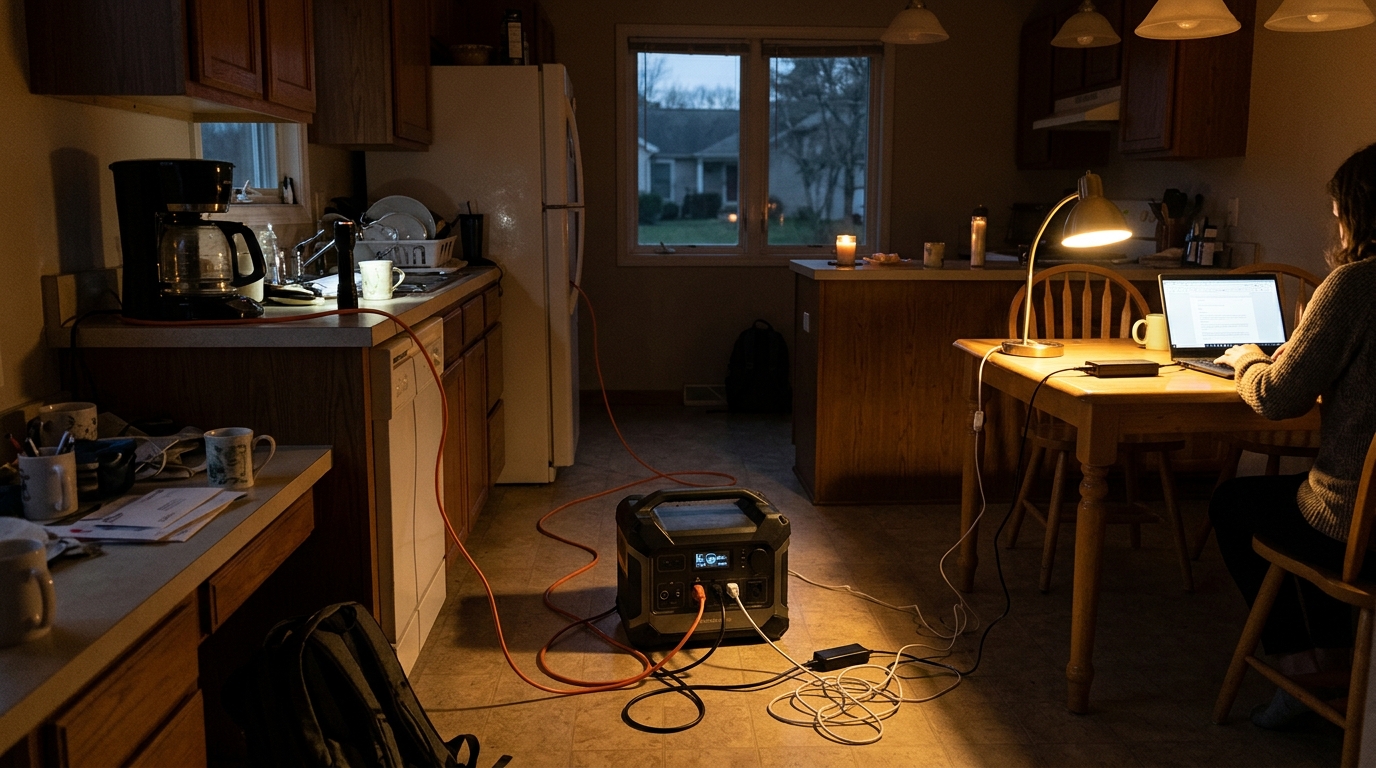
A power station carries none of this risk — no combustion, no carbon monoxide, genuinely safe to run indoors, which is why every article in this series has been able to recommend it for apartment and bedroom use without caveat.
Power Output: Where Generators Still Win
This is the category’s real advantage, and it would be dishonest not to say so clearly. Portable gas generators commonly deliver 1,500 to 10,000 watts of continuous output, while even the largest power station we’ve reviewed in this series — the EcoFlow Delta Pro — tops out at 3,600W continuous.
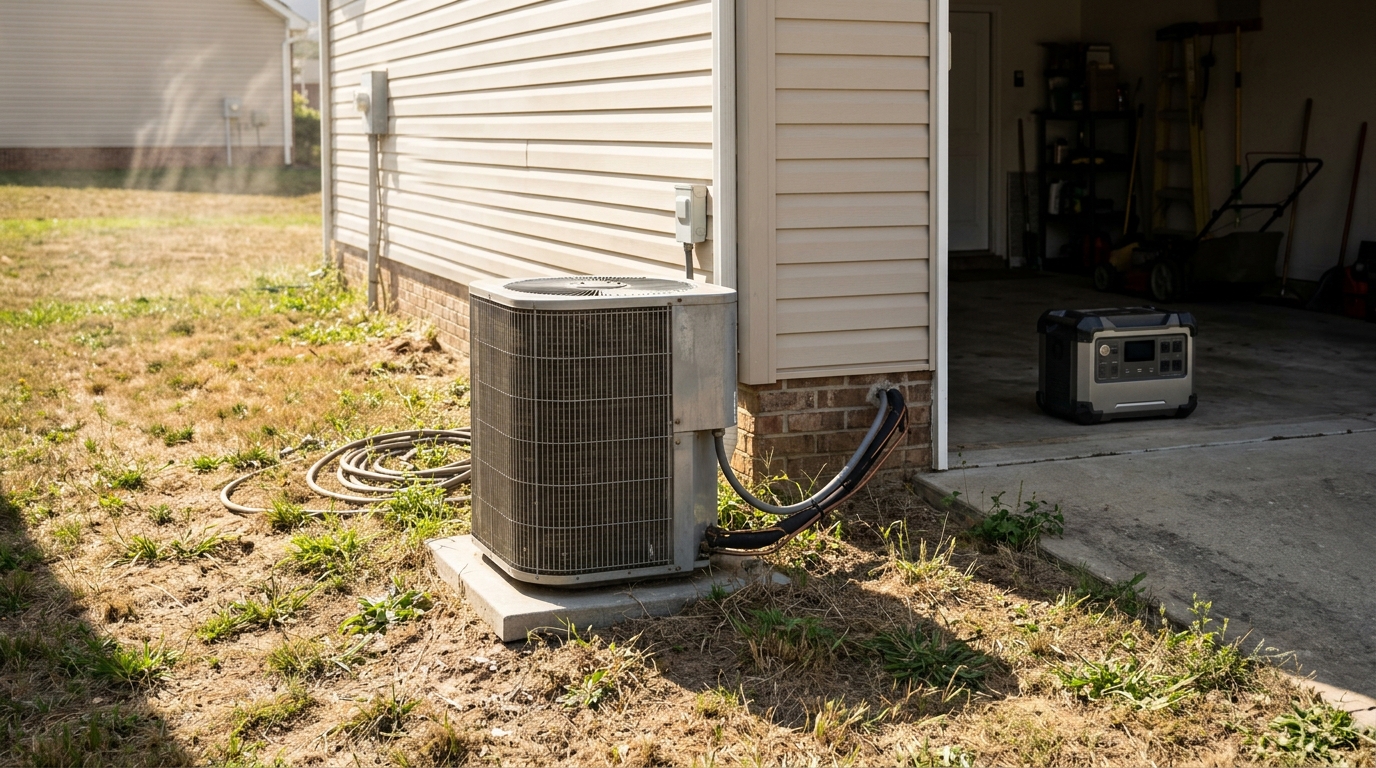
If your plan involves running a central AC compressor, a well pump, or multiple high-draw appliances simultaneously, a generator is likely the only realistic option in this comparison.
Runtime: Finite Battery vs. “As Long As You Have Fuel”
A power station’s runtime is fixed by its battery capacity — we’ve calculated this exhaustively throughout this series, from CPAP machines to full-size fridges.
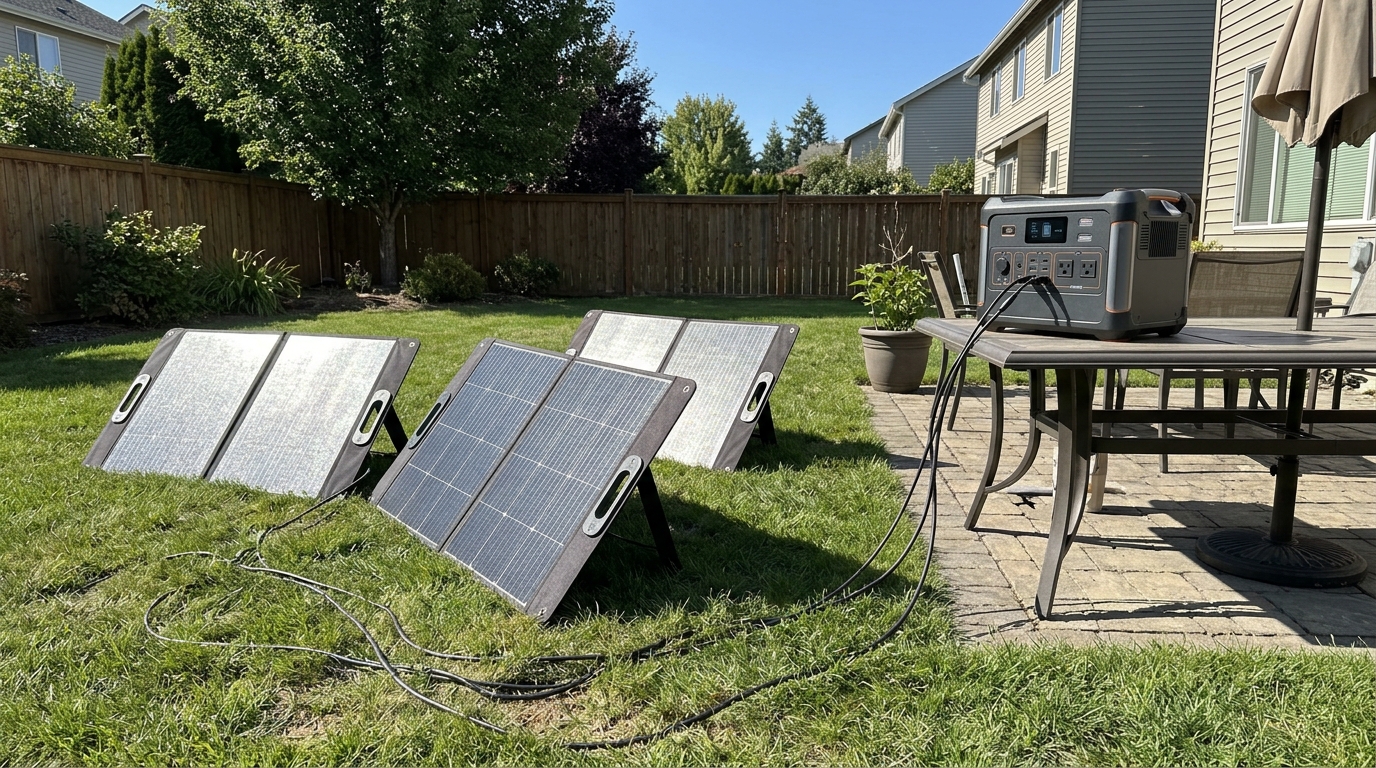
Once it’s empty, you need to recharge it, whether from a wall outlet, solar panels, or both. A generator’s runtime is limited only by your fuel supply — refill the tank, and it keeps running, which makes it the more realistic choice for outages genuinely expected to stretch beyond a few days without any way to recharge a battery.
Noise: Not Close
We’ve measured this in detail in our power station noise comparison — quality power stations run in the 20-45 dB range at idle, climbing to perhaps 40-70 dB under heavy load. Portable generators, by contrast, typically run in the 50-85 dBA range, comparable to a vacuum cleaner or louder, for the entire duration of use — not just briefly like a power station’s cooling fan.
If you’re running backup power overnight near where you or your neighbors sleep, this difference is hard to overstate.
Cost Comparison: Upfront, Fuel, and Maintenance
Here’s where the real total cost of ownership diverges, often in ways that aren’t obvious from the sticker price alone.
| Cost Factor | Portable Gas Generator | Portable Power Station |
|---|---|---|
| Upfront Price | $300–$1,500 for portable units | $200–$3,700 depending on capacity |
| Fuel Cost | $2–$5 per hour of operation, ongoing | $0 with solar, or minimal grid electricity cost to recharge |
| Annual Maintenance | $50–$400 — oil changes, fuel stabilizer, periodic test-running | Minimal — no combustion components to service |
| Break-even vs. fuel costs | N/A, fuel costs continue indefinitely | Often 3–7 years depending on usage, per industry cost comparisons |
The generator’s lower upfront price is real, but it’s not the full picture — fuel costs accumulate every single time you use it, in a way a power station’s “fuel” (sunlight, or a one-time electricity cost to recharge) simply doesn’t. For infrequent, short outages, the generator’s lower upfront cost often wins. For frequent use or longer events, the math shifts toward the power station over time.
Maintenance Burden
A generator needs to be started and run periodically even when not in an outage, to keep the engine in working condition — fuel stabilizer, oil changes roughly every 100-200 hours of use, and the kind of upkeep any small engine requires.
A power station has no engine, no oil, and no fuel to go stale — the closest equivalent maintenance is the state-of-charge management we covered in our hot garage storage guide, which takes minutes, not a maintenance schedule.

The Hybrid Approach: Using Both
For households with higher-wattage needs who’ve read this far and landed on “I think I need a generator, but I don’t love the safety profile” — a legitimate middle path exists: a power station for the devices in this series’ sweet spot (CPAP, wifi, laptops, lighting, even a fridge for part of a day) paired with a generator reserved specifically for the handful of high-draw appliances a power station can’t cover, run only outdoors per CPSC guidance, and only when genuinely needed rather than continuously.
This isn’t the answer for every household, but it’s worth considering if your power needs genuinely span both categories.
Decision Framework: Which Should You Actually Buy?
Match this against your actual situation, not against the device with the most impressive spec sheet:
- You live in an apartment or anywhere without safe outdoor generator placement: power station, full stop — a generator genuinely isn’t a safe option here, not just an inconvenient one.
- Your needs fit Profile A, B, or C from our sizing chart (communication, medical devices, light comfort use): a power station covers this comfortably, more quietly, and more safely than a generator built for far higher loads.
- You need to run central AC, a well pump, or several major appliances simultaneously for an extended outage: a generator is likely necessary — no power station in this series’ price range covers that load.
- Your outages are typically short (hours, not days) and infrequent: a power station’s lack of fuel costs and maintenance usually wins on total cost over a few years.
- Your outages are long, frequent, or you have no reliable way to recharge a battery: a generator’s “as long as you have fuel” runtime becomes the more realistic choice.
The Bottom Line
This isn’t really a competition with one universal winner — it’s two different tools solving overlapping but distinct problems. A generator wins on raw output and indefinite runtime, at the cost of real safety risk, ongoing fuel expense, and real noise.
A power station wins on safety, quiet operation, and near-zero maintenance, within a genuine capacity ceiling this entire series has mapped out in detail. For most apartment dwellers, renters, and households whose outage needs center on medical devices, communication, and keeping food cold rather than running a whole house at full power, the power station is both the safer and, over time, often the cheaper choice — which is exactly why this site has focused on them.
Prices and specs for both categories shift frequently — always confirm current numbers before buying either option.