Affiliate disclosure: some links on this page may earn Trendifacts a commission at no extra cost to you. It does not change what we recommend.
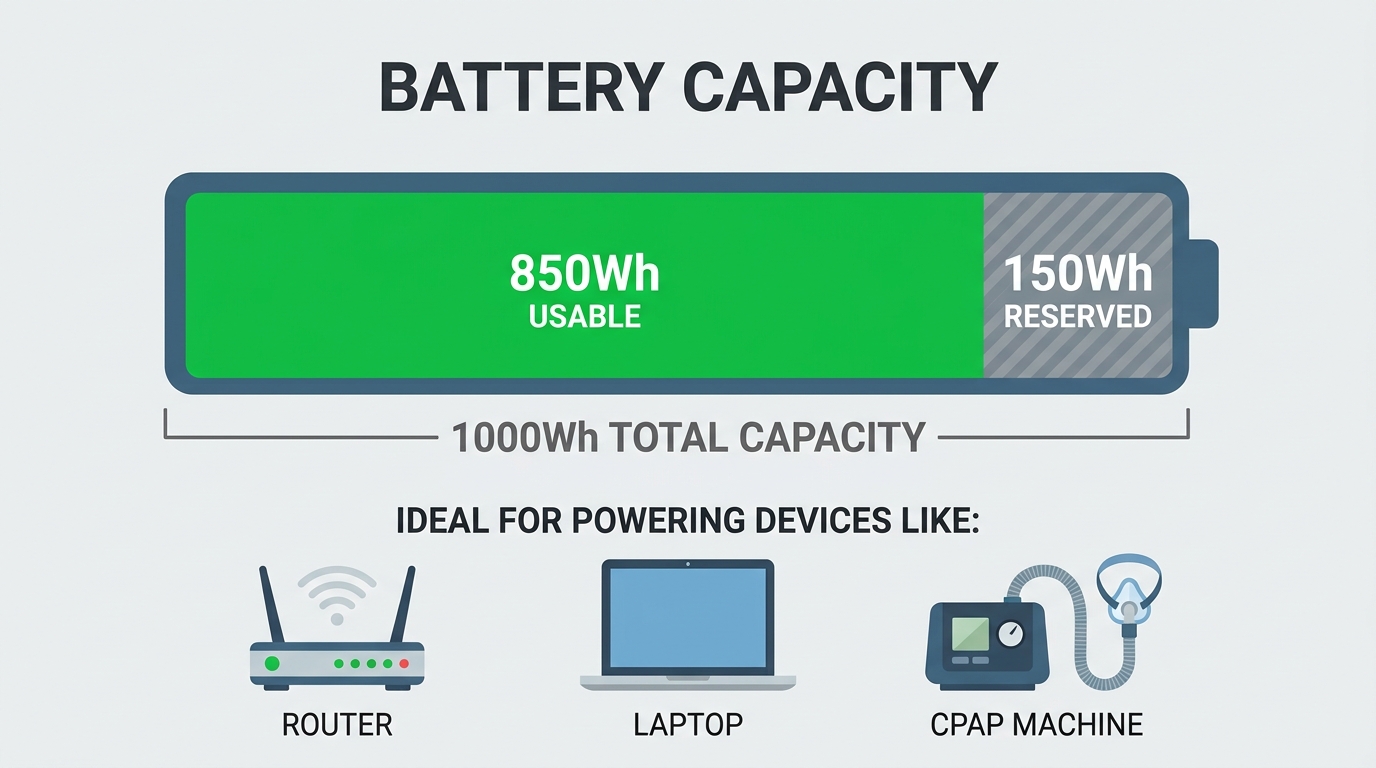
A 1000Wh power station will comfortably run phones, lights, a wifi router, a laptop, a CPAP without a humidifier and a small TV for many hours, and a mini fridge for most of a day. It will not run a space heater, kettle, microwave, hair dryer or air conditioner for any useful length of time. Two numbers decide everything: watt-hours (how long it runs) and watts (what it can start). With about 850Wh usable, divide 850 by your total load in watts to get hours.
This guide gives you the appliance chart, a list of what it cannot run, a step-by-step calculation, four realistic scenarios and the mistakes that make runtimes come up short.
The Short Answer
| Category | Verdict on a 1000Wh station |
|---|---|
| Phones, tablets, power banks | Dozens of recharges |
| Router, modem, lights | A day or two |
| Laptop, small TV, fans | Many hours |
| CPAP, no humidifier | About one to one and a half nights |
| Mini fridge or 12V cooler | Most of a day |
| Full-size fridge | About 10 to 20 hours, with surge caveats |
| Anything that makes heat | Not practical |
Wh vs. W in One Minute
- Watt-hours (Wh) is the size of the battery. It decides runtime.
- Watts (W) is how much power the inverter can deliver at once. It decides whether a device will start.
A 1000Wh station is not automatically a 1000W station. Many 1000Wh units output 1,000 to 2,000W, and some budget models of the same capacity output less.
For example, the Jackery Explorer 1000 v2 stores about 1,070Wh and delivers 1,500W continuous with a 3,000W surge, while the larger Jackery Explorer 1500 v2 stores about 1,536Wh and delivers 2,000W with a 4,000W surge.
Always check both numbers on the model you are buying; our Jackery 1000 vs. 1500 comparison shows how those specs differ.
Why You Get Less Than 1,000Wh
The battery's rated capacity is measured at the cell, but the inverter, the voltage conversion and the unit's own electronics all use some of it. For AC loads, we plan on about 85% of the rated figure, or about 850Wh for a 1000Wh station.
That is a planning number, not a guarantee: efficiency is worse at very low loads, where the inverter's own idle draw is a big share, and better at moderate loads. Running devices on DC or USB ports instead of the AC outlets avoids the inverter and can stretch runtime.
Appliance Chart
| Appliance | Running watts | Estimated runtime (850Wh usable) |
|---|---|---|
| Phone charger | 10 to 20W | about 42 to 85 hours |
| LED lights (a few bulbs) | 5 to 15W | about 56 to 170 hours |
| Wifi router and modem | about 18W (10 to 30W range) | about 28 to 85 hours |
| Laptop | 60 to 100W | about 8.5 to 14 hours |
| Small TV (32") | 30 to 50W | about 17 to 28 hours |
| Box or table fan | 20 to 100W | about 8.5 to 42 hours |
| 12V car cooler | 40 to 60W | about 14 to 21 hours |
| Mini fridge | 70 to 150W (300W or more surge) | about 5.7 to 12 hours |
| CPAP, no humidifier | 40 to 55W | about 15 to 21 hours |
| CPAP, humidifier on | 55 to 130W | about 6.5 to 15 hours |
| Coffee maker | 600 to 900W | about 0.9 to 1.4 hours |
Router, CPAP and fridge figures tie back to our detailed breakdowns: router wattage, CPAP runtime and full-size fridge. Remember that a fridge or mini fridge cycles on and off, so measured runtime depends on room temperature and how often the door opens.
What a 1000Wh Station Usually Cannot Run
These either exceed a typical 1,000W inverter or drain the battery in under an hour:
| Appliance | Running watts | Verdict |
|---|---|---|
| Microwave | 1,000 to 1,500W | Needs a higher-output station |
| Toaster or electric kettle | 1,200 to 1,800W | Needs a higher-output station |
| Hair dryer | 1,200 to 1,800W | Needs a higher-output station |
| Space heater | 750 to 1,500W | Drains the battery in an hour or less; see our space heater guide |
| Electric grill or hot plate | 800 to 1,200W | Marginal |
| Window air conditioner | several hundred to 1,500W | See our window AC guide |
A 1,800W-class inverter can start some of these, but the battery still runs down fast: 850Wh divided by 1,500W is about 34 minutes. Heat-producing appliances are the least efficient use of a battery.
Some power stations have a "boost" or similar mode that lets resistive heating loads run above the inverter rating at reduced power; check the manual, because it changes how the appliance performs.
How to Calculate Your Own Setup
- List what you want to run and read each device's wattage from its label. If only amps are listed, multiply amps by volts to get watts.
- Add up everything running at the same time. The total must stay below the station's continuous output rating.
- Check surge. Anything with a motor (fridge, pump, compressor) needs more power to start than to run, often 2 to 5 times. See our sump pump surge guide.
- Divide usable energy by total watts. Multiply the battery's Wh by 0.85, then divide by your load in watts.
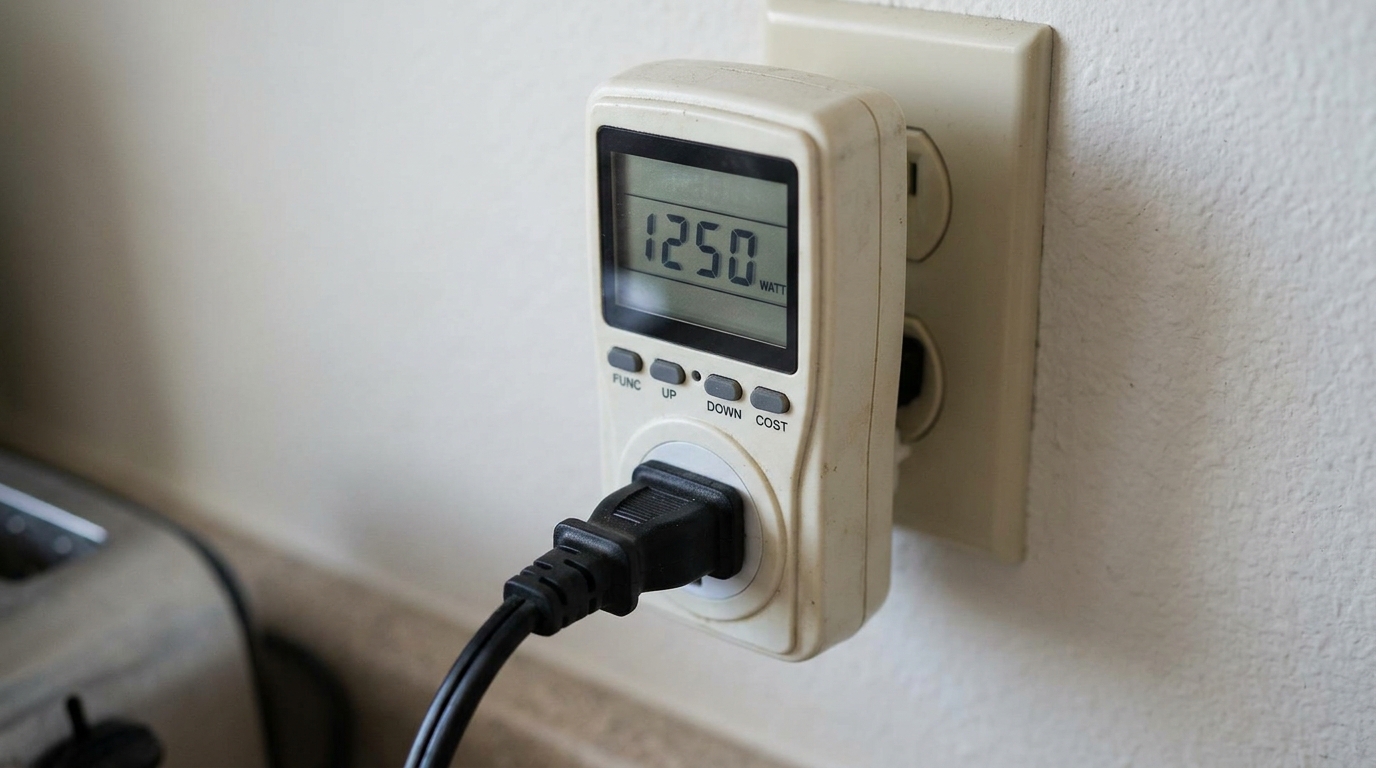
- Test it. A plug-in watt meter costs very little and replaces guesswork with your real numbers.
Worked example: a basic work-from-home outage
A laptop (60W), a router and modem (18W), and a few LED lights (10W) total about 88W. On a 1000Wh station that is 850 / 88 = about 9.7 hours. Add a 45W monitor and the total is 133W, which cuts runtime to about 6.4 hours. That is the lesson: every added device shortens everything else. Our home office guide walks through this in more detail.
Four Realistic Scenarios
1. The overnight essentials plan (about 8 hours). A CPAP without humidifier (45W), a router and modem (18W) and one LED light (10W) draw about 73W. Eight hours is 584Wh, so a 1000Wh station covers it with about 266Wh left, enough for a second, shorter night's use. With the humidifier on at 100W, the total is 128W and eight hours uses 1,024Wh, which exceeds the 850Wh usable, so you would need to lower the humidifier or recharge.
2. The "keep everyone connected" evening (about 5 hours). Router and modem (18W), a laptop (65W), a phone charging (15W) and a few lights (10W) total about 108W. Five hours is 540Wh, leaving about 310Wh.
3. The fridge plus connectivity day. A full-size fridge averages roughly 1 to 2kWh a day, which alone uses most or all of 850Wh. A smaller 12V compressor cooler averaging 30W uses 720Wh over 24 hours. If you need the full-size fridge for a day or two, a 1000Wh station is not enough, which is why we recommend running it in blocks and keeping the door closed, as explained in our fridge guide.
4. The cold-night plan. A fan-forced space heater is the thing people most want to run and the thing that fails first. Instead of heating a room, plan on blankets, a small heated throw (about 40 to 100W by label) and the CPAP. See our winter storm guide for safe heating rules.
Mistakes That Make Runtimes Come Up Short
- Using rated Wh instead of usable Wh. Always multiply by 0.85.
- Forgetting standby draw. Chargers, TVs and some power station displays draw a little even when idle.
- Ignoring surge. A mini fridge that runs at 80W may need 300W or more to start.
- Running a heated humidifier. It can double or triple a CPAP's draw.
- Cold batteries. Many units cannot charge below freezing, and capacity drops in the cold; see our cold weather guide.
- Starting from less than 100%. Charge fully before a storm.
- Draining to zero. Most units protect themselves by shutting off, so the last few percent are not usable.
How to Recharge and Stretch It
A 1000Wh station recharges from the wall in a couple of hours on most current models, and from solar at whatever your panels deliver. The solar formula we use is daily Wh equals panel watts x peak sun hours x 0.75. For example, a 200W panel with 5 peak sun hours yields about 750Wh a day. Our solar recharge chart explains realistic output, and our balcony solar guide covers renter-friendly options.
If You Need to Run More
If your list does not fit, you have three options: reduce what you run at once, move up to a larger station (our sizing chart shows how much capacity each household profile needs), or add an expansion battery, which we evaluate in our expandable battery guide. If you are shopping on a budget, see our under-$500 roundup, and the Anker SOLIX C1000X review for a current 1,000Wh-class option.
FAQ
Can a 1000Wh power station run a refrigerator?
For part of a day, yes. A full-size fridge uses roughly 1 to 2kWh a day, so a 1000Wh unit covers about 10 to 20 hours, depending on the fridge.
Can it run a CPAP all night? Usually yes, without a heated humidifier. A 55W CPAP runs about 15 hours on 850Wh.
Can it run a microwave? Only if the inverter rating is high enough, and then for a few minutes at a time.
How many phone charges is that? A typical phone battery holds roughly 12 to 20Wh, so 850Wh is dozens of charges, before efficiency losses.
Is a 1000Wh power station enough for a whole day without power? For essentials, yes. For heating, cooling or cooking, no.
What is the difference between 1000Wh and 1000W? Wh is capacity; W is output. They are different specs on the same unit.
The Bottom Line
A 1000Wh station comfortably runs the things most people prioritize in an outage: phones, lights, wifi, a laptop, a CPAP, a small TV and a mini fridge for part of a day. It cannot sustain heating or high-draw kitchen appliances. Match your devices' watts to the inverter, then divide the usable energy by the load to find your real runtime.
Wattage figures are general ranges and vary by model. Always check your appliance's label and your power station's specifications before relying on any estimate.