If your basement has ever flooded during a storm-related power outage, you already know the specific fear this article is about: the power goes out right when the rain is heaviest, and your sump pump — the one thing standing between you and a flooded basement — goes dead with it.
This is a different kind of backup power question than anything else in this series. It’s not about comfort or convenience; it’s about whether a device will actually start and keep starting, over and over, for as long as the storm lasts. Let’s get the numbers right.
How Many Watts Does a Sump Pump Actually Use?
Sump pumps are sized by motor horsepower, and the wattage range is wider than most people expect — both for running power and, more importantly, for the surge when the motor kicks on.
| Pump Size | Running Watts | Starting/Surge Watts |
|---|---|---|
| 1/4 HP | 400–700W | 800–1,800W |
| 1/3 HP | 500–900W | 1,200–2,400W |
| 1/2 HP | 700–1,200W | 2,400–3,000W |
| 3/4 HP | 1,000–1,500W | 3,000–4,500W |
These ranges come from BLUETTI’s sump pump wattage breakdown and a separate sump pump sizing guide covering startup surge, which puts startup surge at two to four times the running wattage — in line with what we found for fridge compressors in our full-size fridge runtime breakdown.
The exact number depends heavily on your specific pump, the lift height (how far it has to push water vertically), and installation details, so check the motor’s nameplate before relying on any of the ranges above.
Why Surge Capacity Is the Spec That Actually Matters Here
This is the single most important thing to understand before buying anything for sump pump backup: the running-watts number is almost irrelevant if the power station can’t clear the surge.
A sump pump motor doesn’t ramp up gradually — it demands a sharp spike of power the instant it switches on, and if your power station’s surge rating falls short, the pump won’t start at all.
It’ll hum, click, or trip the power station’s overload protection, repeatedly, which is the worst possible failure mode during an actual flood event.
A 1/2 HP pump — common in many homes — can surge as high as 3,000W. That rules out a lot of compact and mid-size power stations outright, even ones with plenty of rated watt-hours.
Before you buy anything for this purpose, find your pump’s starting wattage (check the nameplate or the installation manual) and confirm your power station’s surge watt rating, not just its continuous output rating, comfortably exceeds it — with real margin, not a number it barely clears on paper.
Sump Pumps Don’t Run Continuously — Here’s Why That Changes the Math
Unlike a fridge or a CPAP, a sump pump doesn’t run constantly even during a storm. It cycles on only when water in the pit reaches a trigger level, pumps it out in a burst of seconds to a couple of minutes, then shuts off until the pit refills.
That means the real energy question isn’t “how many watts does it draw continuously,” it’s how often does it cycle, and for how long, during your worst-case storm.
Using the running-watts-times-cycle-time approach from the OUPES sizing guide, here’s what a few realistic storm scenarios actually cost in energy:
| Scenario | Pump Load | Cycle Pattern | Energy Needed Over the Outage |
|---|---|---|---|
| Moderate rain | 700W pump | ~10 min/hour, 12 hours | ~1,400Wh |
| Heavy rain | 900W pump | ~15 min/hour, 8 hours | ~1,800Wh |
| Light but prolonged | 600W pump | ~5 min/hour, 24 hours | ~1,200Wh |
Add roughly 15–20% on top of the raw number for inverter conversion losses and a safety margin — the same approach we’ve used throughout this series for CPAP and fridge runtime math — and a moderate-rain scenario lands around 1,650Wh, a heavy-rain scenario closer to 2,100Wh.
That puts a genuinely useful sump pump backup setup solidly in 2000–3000Wh power station territory for anything beyond a brief, light event, not the 500–1000Wh range that covers wifi or a CPAP comfortably.
A Worked Example
Take a 1/2 HP pump (roughly 1,000W running, up to 3,000W surge) during a heavy, prolonged storm.
Using a 3,072Wh-class power station as a reference point — a size with real precedent for this exact use case — a straightforward runtime calculation (battery capacity ÷ running watts) suggests around 3 hours of continuous run time.
But because the pump actually cycles rather than running nonstop, that same battery stretched across realistic on/off cycling can cover considerably longer than 3 hours of storm duration — the 3-hour figure is a worst-case continuous-run number, not what you’d see in practice.
Either way, the takeaway is the same: this is not a job for an entry-level power station, and the surge rating has to clear the pump’s starting watts with real headroom, not just barely.
What to Actually Look For If You’re Buying for This
- Surge rating well above your pump’s starting watts — not equal to it, meaningfully above it. A pump with a 3,000W surge paired with a power station rated for exactly 3,000W surge is cutting it closer than you want during an actual emergency.
- At least 2000–3000Wh of capacity for anything beyond a short, light rain event — this is one of the few use cases in this series where the bigger, more expensive station is genuinely justified rather than overkill.
- A dedicated battery backup sump pump system as an alternative. Some sump pump setups support a purpose-built battery backup unit that wires directly into the existing pump system and switches over automatically — worth comparing against a general-purpose power station if sump pump backup is your main concern rather than one use case among several.
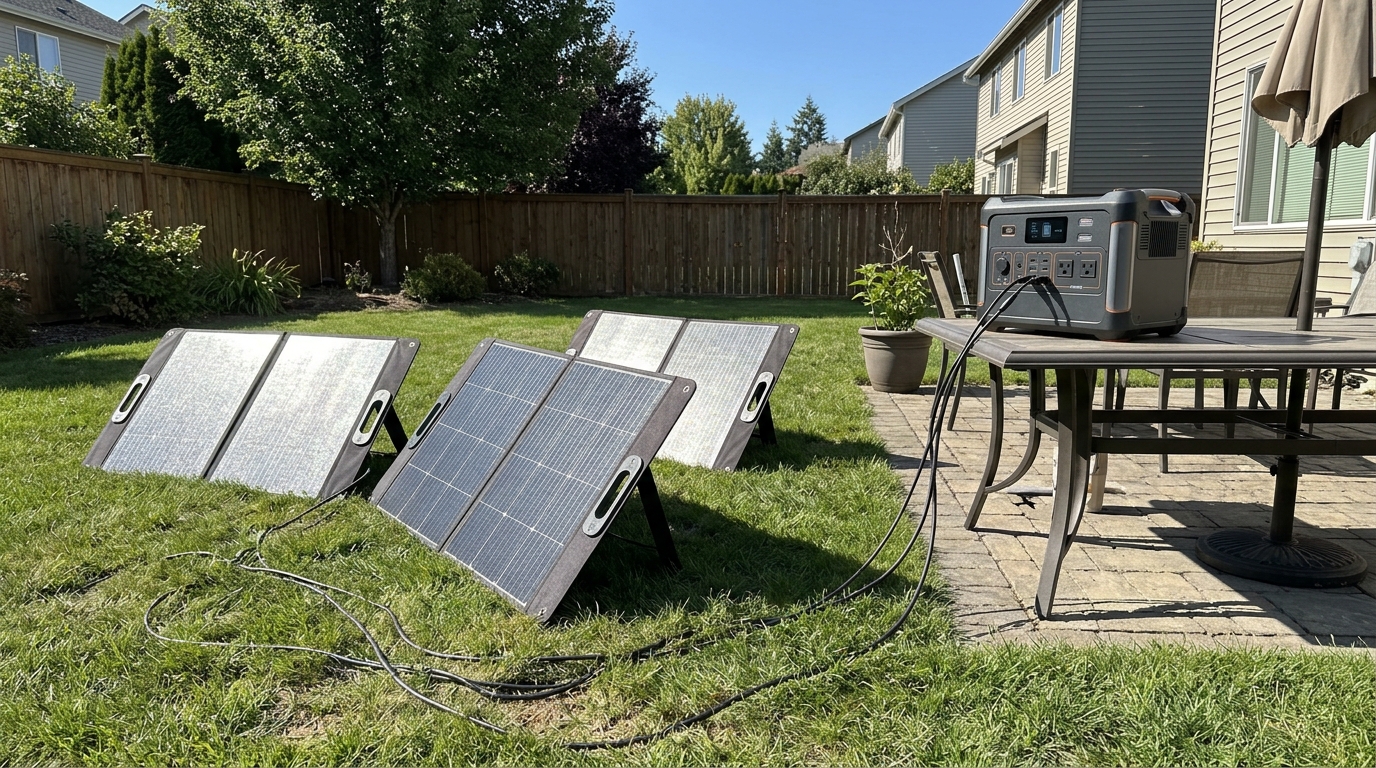
- Solar recharging if the outage might stretch beyond a single battery charge. We cover realistic recharge math in our solar panel wattage and recharge time guide.
- A plan for automatic switchover, not a reminder to manually plug things in once the basement is already taking on water. If you’re relying on a general-purpose power station rather than a dedicated backup system, test the full setup — pump plugged in, power station charged and ready — before you actually need it, not during the first storm of the season.
The Bottom Line
A sump pump is one of the few devices in this series where a power station’s advertised watt-hour capacity isn’t the number that decides whether it works — the surge rating is.
Check your specific pump’s starting wattage on its nameplate, make sure your power station’s surge capacity clears it with real margin, and size your battery capacity around realistic cycling during your worst storm scenario, not a single theoretical hour of continuous runtime.
Get the surge number wrong and none of the rest of the math matters, because the pump never starts in the first place.
Pump wattage varies by model, lift height, and installation — always confirm your specific pump’s running and starting wattage from its nameplate or manual before sizing a backup power setup.