Affiliate disclosure: some links on this page may earn Trendifacts a commission at no extra cost to you. It does not affect what we recommend.
When the severe weather alerts flash on your phone and the lights begin to flicker, your first thought isn't about the food in your refrigerator—it is about how you are going to safely sleep and breathe tonight. If you rely on a CPAP machine, a sudden power outage instantly transforms from a minor household inconvenience into a major medical anxiety.
You might frantically search online for an emergency battery backup, only to be met with confusing technical specs and bold manufacturer promises claiming a single portable power station will comfortably last you "up to three nights." But will it actually hold up under your specific prescribed settings?
The practical truth is that CPAP power consumption is notoriously misunderstood by the general public, and turning on a single heated setting on your machine can instantly cut a battery's promised runtime squarely in half. Before the grid unexpectedly fails, you need a resilient backup plan built on hard, realistic math, not just optimistic marketing hype.
Last updated: November 2026. Method note: the runtimes below are calculated from published power ratings and a stated efficiency assumption. We have not bench-tested a CPAP on a power station, and where a number comes from a vendor or retailer, we say so. Medical note: this is power planning, not medical advice.
Talk to your sleep physician or equipment supplier about your therapy and backup plan.
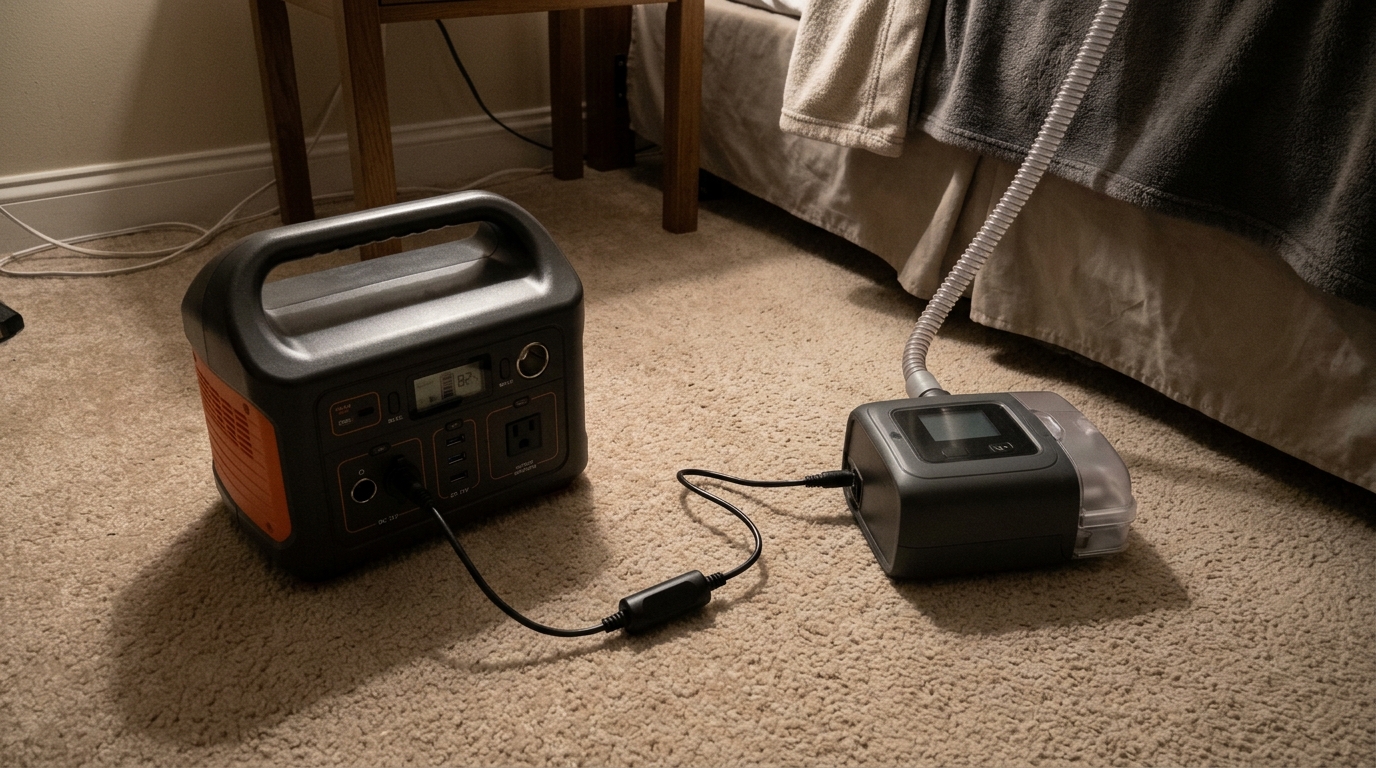
A 1000Wh-class power station will run most CPAP machines for about one to two nights. At 40 to 60 watts (humidifier off or low), expect roughly 14 to 21 hours of runtime, which is about 1.75 to 2.6 eight-hour nights.
With a heated humidifier and heated tube at higher pressure, draw can reach 90 to 130 watts, and the same battery gives you closer to 7 to 9 hours, which is under one full night. Your own machine's power supply label and your humidifier setting decide which end of that range you land on.
If your breathing therapy depends on electricity, "it depends" is not a plan. This guide walks through the real draw of common CPAPs, why a 1000Wh battery gives you about 850Wh of usable AC power, a runtime table for five battery sizes, the 24-volt trap that catches many ResMed owners, how to stretch the battery across several nights, and what to do before the storm arrives.
The Short Answer
- Humidifier off or low, moderate pressure (about 40-60W): about 14 to 21 hours on a 1000Wh station, roughly 2 nights.
- Heated humidifier at high settings (about 90-130W): about 7 to 9 hours, under one night.
- Multiple nights: use a larger battery, an efficient DC connection, or solar. See our sizing chart.
- Always: read the wattage on your own power supply label, and test your setup on a normal night before you need it.
How Much Power Does a CPAP Machine Use?
CPAP draw varies far more than people expect, mostly because of the heated humidifier and heated tubing. These ranges are typical published figures:
| CPAP model | Watts (humidifier off) | Watts (humidifier on) |
|---|---|---|
| ResMed AirSense 10 AutoSet | about 53W average, 90-100W at maximum pressure | about 90-130W |
| ResMed AirSense 11 | about 56W typical | up to about 73W typical, higher under load |
| Philips Respironics DreamStation Auto | about 45-91W | about 80-121W |
| Fisher & Paykel Icon Novo | about 40W average | about 75W maximum |
These figures are compiled by third parties, including SolarTech Online's CPAP power guide and this ResMed AirSense 10 power summary. They are not the manufacturers' own test reports, so treat them as ballparks.
The number that matters is the one on your own device: every CPAP ships with a power supply that lists its rated wattage on the label. That rating is a ceiling, not your average draw, but it tells you the worst case.
The gap between humidifier off and on is the biggest variable in any CPAP runtime estimate. It can nearly double the draw, and so nearly halve the runtime. Heated tubing adds more, commonly another 10 to 15 watts.
Higher prescribed pressure makes the motor work harder, which raises draw too. Never change your prescribed pressure to save battery. That is a conversation for your physician, not a power-planning trick.
Why 1000Wh Is Really About 850Wh
A "1000Wh power station" does not give you 1,000 watt-hours of AC power. The battery stores DC energy, and an inverter converts it to AC for your CPAP's power supply, losing some as heat. We use 85% as a conservative planning number across this site.
Take the Jackery Explorer 1000 as an example. Jackery lists its capacity as 1,002Wh, and TechRadar's review measured inverter efficiency in the 84 to 90% range depending on load. At 85%, 1,002Wh becomes roughly 850Wh of usable AC energy. This is true of every power station, not a flaw in one product. Any runtime claim that skips this step is already 10 to 15% too optimistic.
One more detail: inverters draw some power just by being switched on. A reviewer measured 15 to 18W of idle draw on the large EcoFlow DELTA Pro 3 (Cybershack review); smaller units typically draw less, but the principle holds. When your actual load is only 50W, a fixed overhead matters, which is one reason a DC connection (below) can stretch runtime.
The Real Math: Hours and Nights
We divide usable watt-hours by the CPAP's watts. For a station with 850Wh usable:
| CPAP draw | Estimated runtime | 8-hour nights |
|---|---|---|
| 40W (low pressure, no humidifier) | about 21 hours | about 2.6 |
| 60W (moderate pressure, humidifier on low) | about 14 hours | about 1.75 |
| 90W (higher pressure, humidifier on high) | about 9.4 hours | about 1.2 |
| 120W (high-output BiPAP with humidifier) | about 7 hours | under 1 |
That spread is why generic charts are not good enough. Plan on a flat "50 watts" with a humidifier machine drawing 100, and you think you have nearly three nights when you have just over one.
Runtime on Other Battery Sizes
Here is the same calculation across common sizes, in hours, using 85% usable capacity:
| Station (rated) | Usable | 40W | 60W | 90W | 120W |
|---|---|---|---|---|---|
| 300Wh | about 255Wh | 6.4 | 4.3 | 2.8 | 2.1 |
| 500Wh | about 425Wh | 10.6 | 7.1 | 4.7 | 3.5 |
| 1,000Wh | about 850Wh | 21.3 | 14.2 | 9.4 | 7.1 |
| 1,500Wh | about 1,275Wh | 31.9 | 21.3 | 14.2 | 10.6 |
| 2,000Wh | about 1,700Wh | 42.5 | 28.3 | 18.9 | 14.2 |
Three nights of 8 hours is 24 hours. At 60W, that takes about 1,440Wh usable, or roughly a 1,700Wh-rated station. At 90W it is 2,160Wh usable, around a 2,500Wh-rated station.
For our model-by-model picks, see the best power stations for CPAP machines. If your needs are small and mostly overnight, a 300Wh unit may work for a single night with the humidifier off.
The 24-Volt Trap for ResMed Owners.
Many CPAPs do not run on 12V. According to The CPAP Shop's AirSense 11 power guide, the AirSense 11 requires exactly 24 volts, and its standard supply is a 65W brick.
The guide also says an underpowered supply (for example a 45W travel brick) may cause the machine to disable the heated humidifier or heated tubing.
This is why a generic 12V car adapter does not work for these machines, and why a dedicated 12-24V DC converter exists.
The same guide claims a DC converter can make a battery last nearly twice as long as using an inverter, saying an inverter loses 30 to 40% of battery to heat. That is a retailer's claim, and it conflicts with the 84 to 90% inverter efficiency TechRadar measured under a larger load.
The truth probably depends on the load: inverters are least efficient at light loads like a CPAP. We would plan around 85% and treat any DC gain as a bonus you measure yourself. If you buy a converter, buy the one specified for your exact model, and check that your power station's DC output can supply it.
Things That Change the Math.
- Cold. Lithium batteries deliver less capacity in freezing temperatures, and you should not charge them below 32°F. Keep the station indoors. See our cold-weather charging guide and our comparison of LiFePO4 and lithium-ion chemistry.
- Battery age. A unit with hundreds of cycles will not deliver its original capacity.
- Other devices. A phone charger, fan or router comes out of the same pool. A router and modem add about 18W; see our router wattage guide.
- Heat. A hot garage shortens battery life. See our guide to storing a power station in heat.
- Room temperature and humidity. In a dry or cold room, you may be tempted to raise humidifier settings, which raises draw. Compare against your needs and ask your provider before changing settings.
How to Stretch One Charge Across Several Nights.
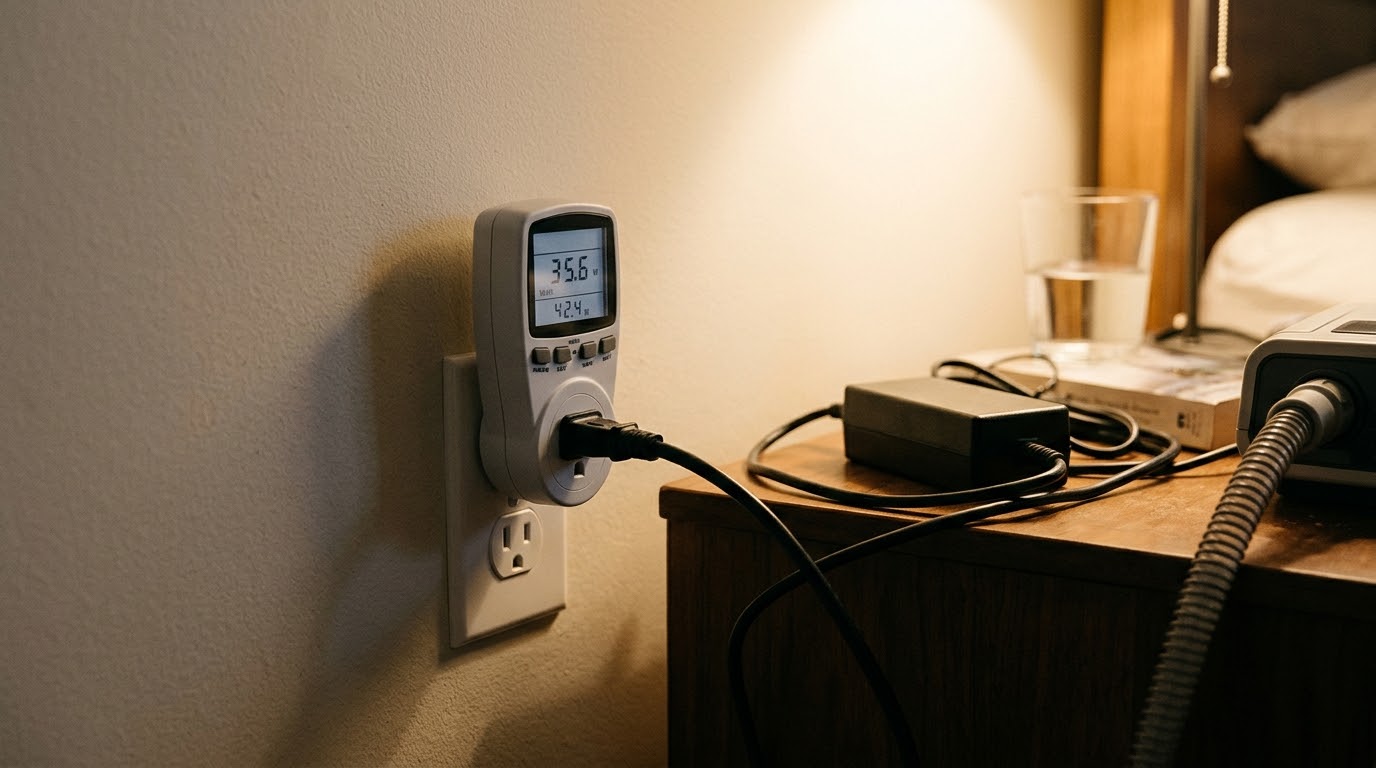
- Know your baseline. Plug a watt meter (about $20) between the power supply and the wall for a normal night. Record the average, not just the peak.
- Use the humidifier less, if your clinician agrees. Turning it off or down is the single biggest saving.
- Skip heated tubing if your room is warm enough and your provider agrees.
- Switch off the inverter's AC output for everything else, and charge phones by USB.
- Recharge in the day. Solar can top up between nights. A 400W array in decent sun can return roughly 1,500Wh/day by our formula in our solar sizing guide, and renters can see our balcony solar guide.
- Consider a bigger unit. If the math says you need two nights of high-draw therapy, buy for that number.
Medical and Safety Cautions.
Power stations fail, lose charge in storage, and trip on overload. If your therapy is life-critical, such as oxygen, ventilation or severe sleep apnea, do not make a single battery your only plan.
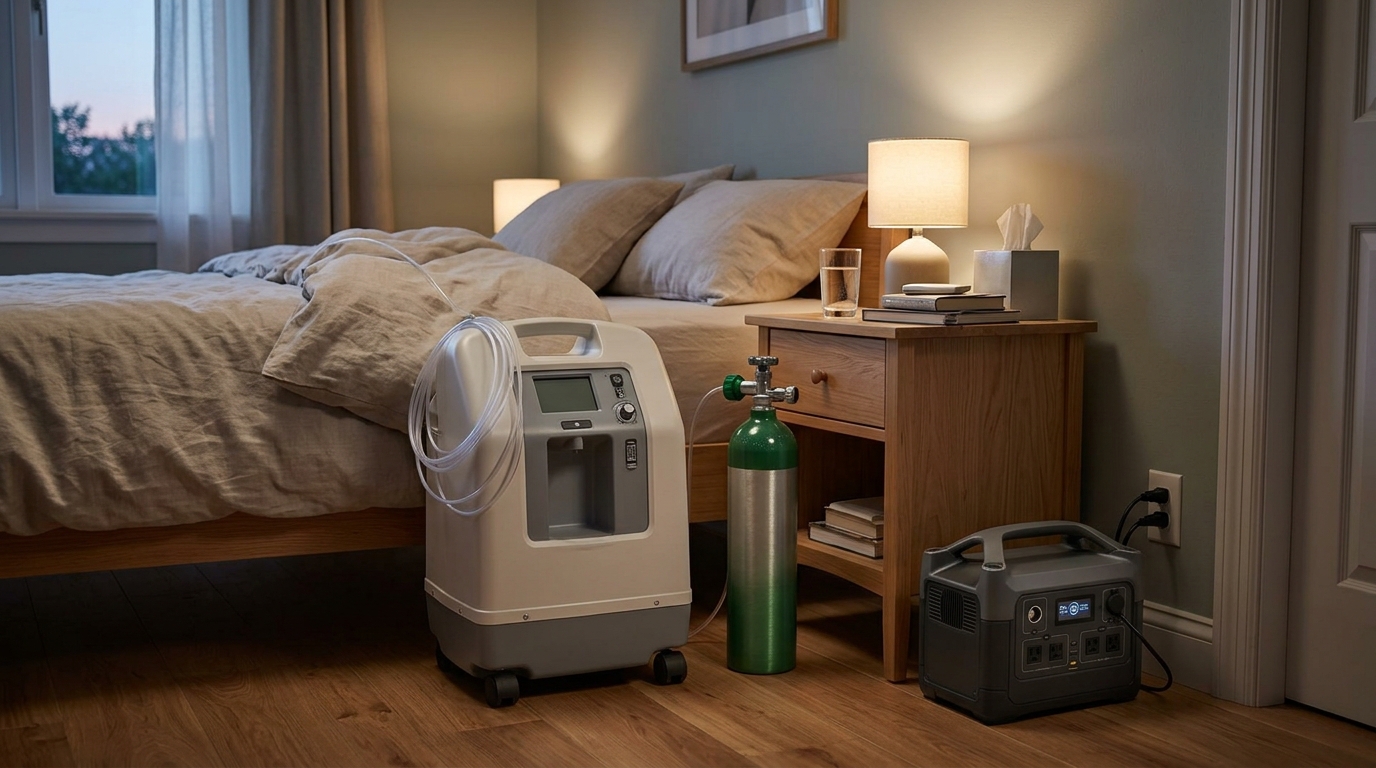
Ask your supplier about manufacturer-approved batteries and about backup arrangements. If you use an oxygen concentrator, which draws far more than a CPAP, read our oxygen concentrator backup guide.
If you use refrigerated medicine, see how to keep medication cold without a generator. For general preparation, Ready.gov's power outage page recommends planning for medical devices that need electricity.
A Pre-Storm Checklist.Charge the station to 100% and keep it indoors.
- Confirm the power supply label wattage and voltage.
- Test one full night on battery, with your real settings.
- Charge your phone and a backup battery for it.
- Keep a printed copy of your settings and your supplier's phone number.
- Store the DC converter (if used) with the CPAP.
- Do not store the station in a hot car or freezing garage.
Which Size Should You Buy?
If you need one night and no humidifier, a 300 to 500Wh unit is enough. For two nights with a humidifier, 1,000 to 1,500Wh is the realistic range.
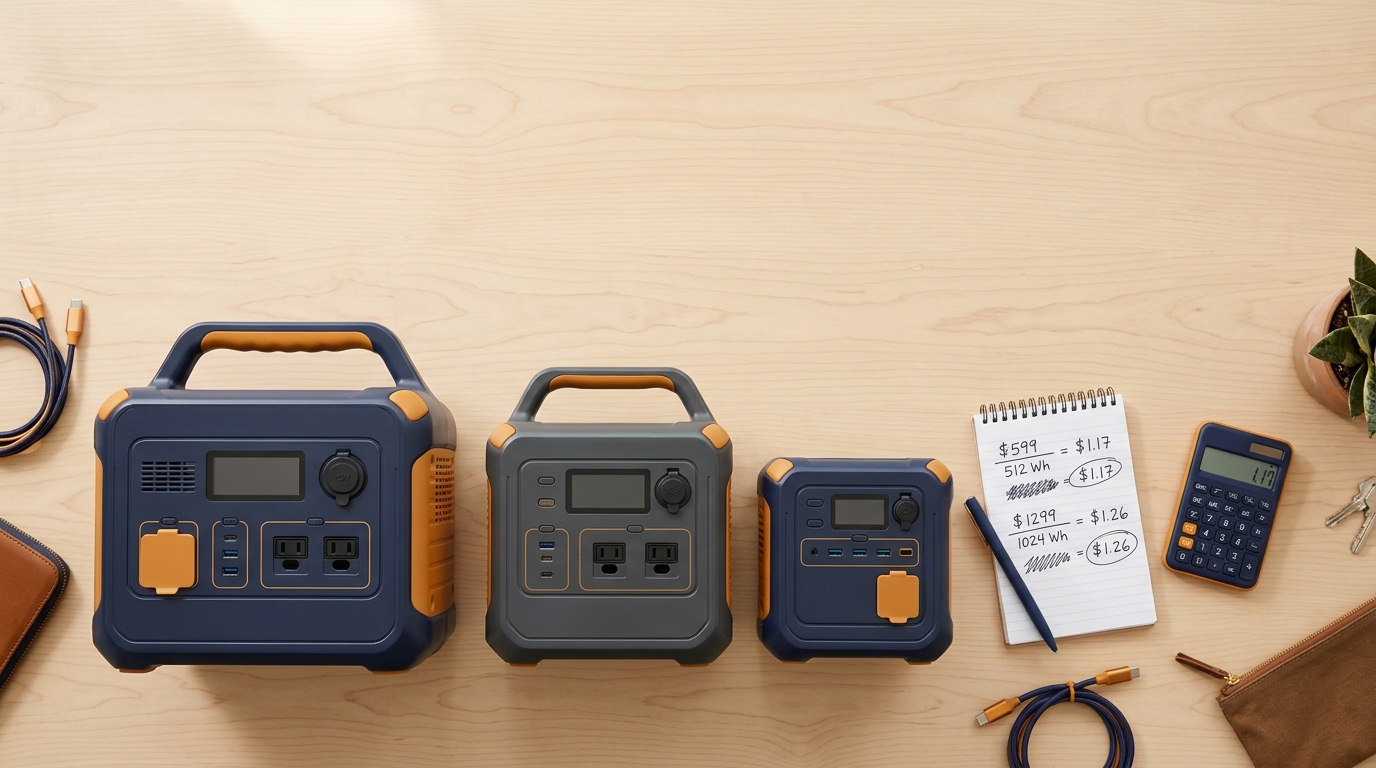
For three or more nights, think 2,000Wh or a plan that includes solar. Compare costs by dividing price by rated Wh, and compare features in our Anker SOLIX C1000X review and budget picks.
If your list also includes a refrigerator, read our fridge runtime breakdown.
FAQ
How long will a 1000Wh power station run a CPAP?
About 14 to 21 hours at 40 to 60W, or about 7 to 9 hours at 90 to 120W.
Does a CPAP humidifier really double the power draw? It can
come close. Published ranges for the AirSense 10 are about 53W without and 90 to 130W with the humidifier.
Can I use a 12V car adapter? Not on machines that need 24V, such as the AirSense 11. Use the converter made for your model.
Can I run a CPAP from a power station overnight in the cold?
Yes, if the station is indoors. Do not charge lithium batteries below freezing.
How many nights can a 300Wh power station run a CPAP?
About 4 to 6 hours at 40 to 60W, so it covers a night only with low-draw settings.
Is a power station safe to sleep next to?
Modern units have no combustion or fumes, unlike generators. Keep it ventilated and dry, follow the manual, and never use a generator indoors. The CPSC warns about carbon monoxide from fuel-burning equipment.
The Bottom Line
A 1000Wh power station will reliably get most CPAP users through one night and often close to two if the humidifier is off or low.
With a heated humidifier at higher pressure, plan on about one night per charge. Before any outage, read the label on your power supply, measure your real draw, and do this math with your number.
This article is for general power planning. For guidance on your therapy settings, talk to your sleep physician or equipment provider. Always check your device's power supply label for its rated wattage and voltage.