Last updated: November 2026. Method note: the tables are our own arithmetic using stated assumptions (a 75% all-in derate in good sun, 90% charging efficiency). Panel output figures come from the cited tests and guides. We have not run our own panel tests, and your location, angle and shade will change the result.
Affiliate disclosure: some links on this page may earn Trendifacts a commission at no extra cost to you. It does not change what we recommend.
A 200W solar panel does not recharge a 1,000Wh power station in 5 hours. In good sun it takes about 1.5 days, in hazy conditions about 2 days, and under clouds in winter four days or more. The shortcut of dividing battery capacity by panel watts ignores three things: the panel rarely delivers its rated watts, you only get a few "peak sun hours" a day, and some energy is lost on the way into the battery. This chart gives the realistic numbers for panels from 100W to 1,600W and batteries from 300Wh to 4,000Wh.
The Short Answer
| Situation | What to expect from a 200W panel on a 1,000Wh station |
|---|---|
| Strong, clear sun, well angled | about 750Wh a day, so about 1.5 days to refill |
| Average sun, some haze or poor angle | about 495Wh a day, so about 2.2 days |
| Overcast, winter or poor angle | about 245Wh a day, so about 4.5 days |
| Same-day recharge of 1,000Wh | about 330W of panels, so two 200W panels |
The Naive Math, and Why It Fails
The tempting formula is battery Wh divided by panel watts: 1,000Wh / 200W = 5 hours. Three things break it.
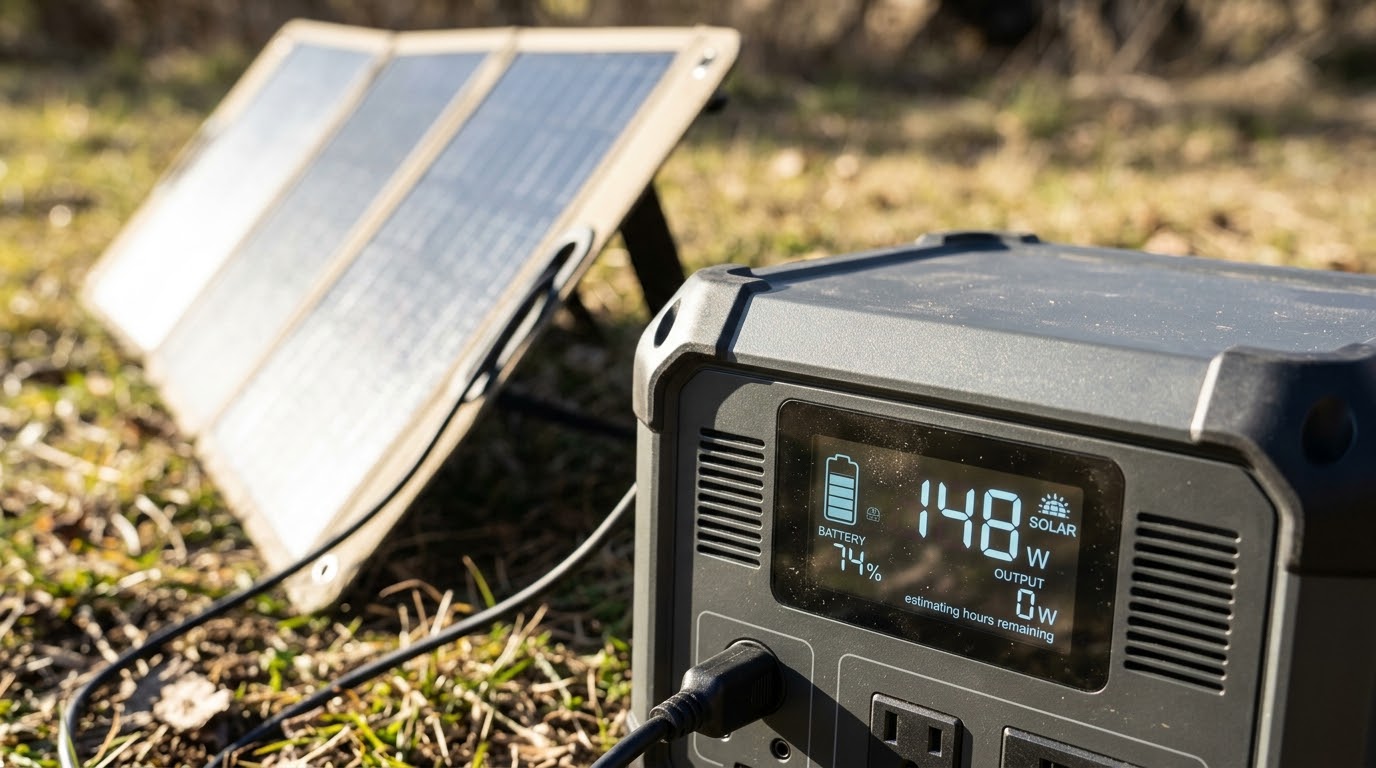
1. Rated watts are a lab number. A panel's rating is measured in direct, perpendicular sun at about 77°F (25°C) with no shade. Real output in good conditions is often 60 to 85% of the rating, and falls to roughly 20 to 40% on cloudy or hazy days, according to calculator sites such as DisasterPrepCalc and PowerStationTips. An independent test backs up the pattern: OutdoorLife measured an Anker SOLIX 400W panel at about 330W in direct sun (83% of rating) and only about 77W in clouds, as we cite in our best solar panels guide.
2. You get peak sun hours, not daylight hours. A peak sun hour is one hour of 1,000 watts per square meter. Most of the U.S. averages about 4 to 6 per day, per Anker's solar charging guide; Arizona can exceed 6, while the Pacific Northwest is closer to 3.5 to 4. A 14-hour summer day might hold only 5 of them. You can look up your location with NREL's PVWatts calculator.
3. Energy is lost on the way in. Cables, the charge controller and the battery's own charging efficiency take a share. We assume about 90% efficiency from panel to stored energy.
What Cuts Real-World Output
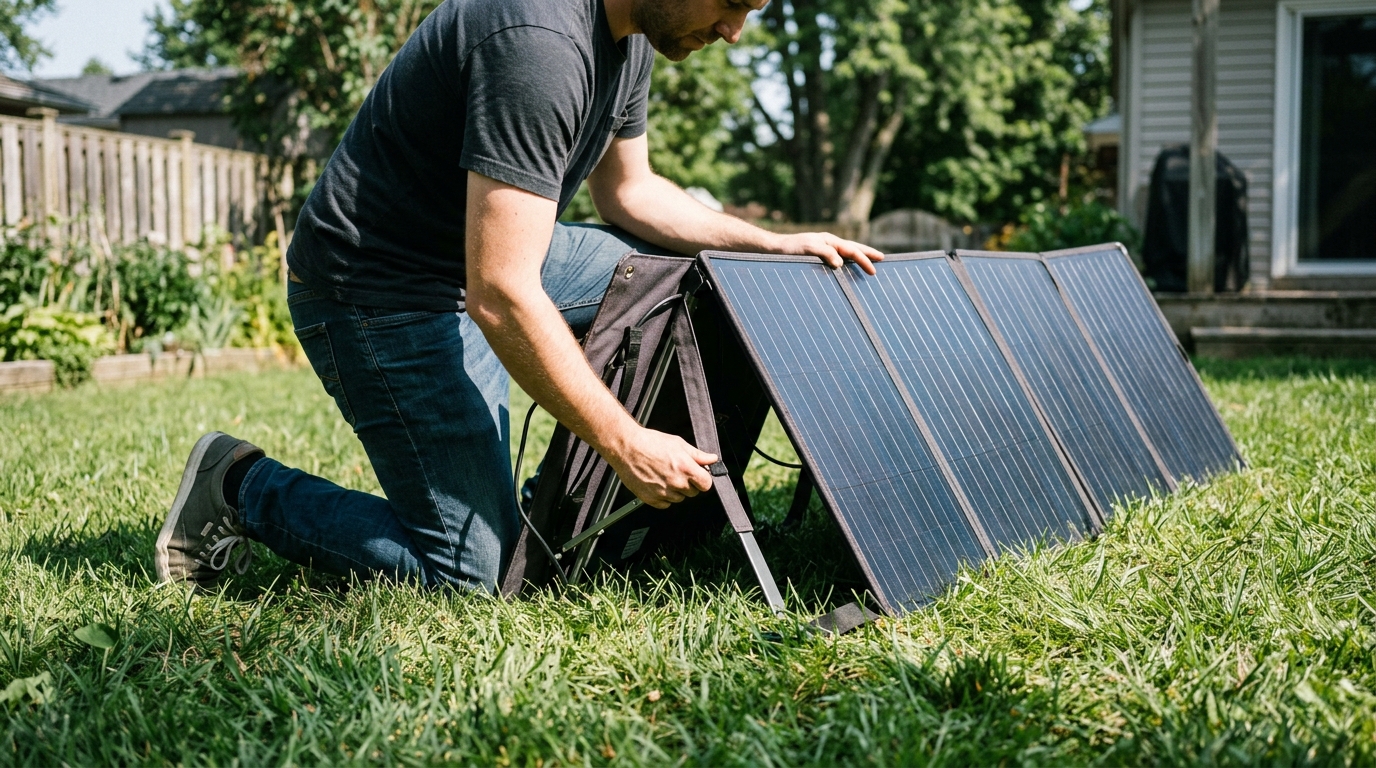
- Sun angle. Aiming the panel at the sun matters. A tilt from flat to roughly 30 to 45 degrees can add 15 to 25% in some conditions, according to calculator guides, and you should reposition through the day if you can.
- Heat. Panels lose efficiency when hot. Datasheets typically list a temperature coefficient of roughly 0.3 to 0.5% of output lost per °C of cell temperature above 25°C, and cell temperature runs well above the air temperature in direct sun. Check your panel's datasheet for its figure. (An earlier version of this article quoted a larger per-degree-Fahrenheit number; the datasheet approach is more reliable.)
- Shade. Cells are wired in series, so shading even a small part of a panel can drag down the whole panel's output.
- Connector and cable losses. Long or thin cables waste energy. Use the cable supplied with the panel.
- Dirt and haze. Dust, pollen and smoke reduce output. Wipe panels clean with water and a soft cloth.
Our Formula
Daily solar energy (Wh) = panel watts x peak sun hours x derate
We use a 0.75 derate for good conditions, 0.55 for average, and 0.35 for poor. These are assumptions that already include heat, angle and cable losses. Then:
Days to refill = (battery Wh / 0.9) / daily solar energy
Recharge Time for a 200W Panel on a 1,000Wh Station
| Conditions | Derate | Sun hours | Energy per day | Days to refill (needs about 1,111Wh) |
|---|---|---|---|---|
| Strong, clear, well angled | 0.75 | 5.0 | about 750Wh | about 1.5 |
| Average, hazy or imperfect angle | 0.55 | 4.5 | about 495Wh | about 2.2 |
| Overcast, winter or poor angle | 0.35 | 3.5 | about 245Wh | about 4.5 |
Note that these figures are slightly longer than an earlier version of this article gave, because we now include the roughly 90% charging efficiency in every row.
The Big Chart: Panel Watts vs. Days to Refill
Values are days to refill from empty, using the good-sun case (0.75 derate) at 5 sun hours. For the more cautious average case, multiply by about 1.4.
| Panel array | 300Wh | 500Wh | 1,000Wh | 2,000Wh | 4,000Wh |
|---|---|---|---|---|---|
| 100W | 0.9 | 1.5 | 3.0 | 5.9 | 11.9 |
| 200W | 0.4 | 0.7 | 1.5 | 3.0 | 5.9 |
| 400W | 0.2 | 0.4 | 0.7 | 1.5 | 3.0 |
| 800W | 0.1 | 0.2 | 0.4 | 0.7 | 1.5 |
| 1,600W | 0.1 | 0.1 | 0.2 | 0.4 | 0.7 |
How to read it: a 400W array refills a 1,000Wh station in about 0.7 days of good sun. Anything under 1.0 means you can refill in a single sunny day. Remember that your station's solar input limit caps how much power it will accept, so a bigger array than the limit does not speed things up. Our large-station solar guide explains voltage and current windows.
How Much Panel Do You Need for a Same-Day Recharge?
Rearrange the formula: panel watts = (battery Wh / 0.9) / (sun hours x 0.75). At 4.5 sun hours, that gives:
| Station size | Panel watts for a same-day refill |
|---|---|
| 300Wh | about 100W |
| 500Wh | about 165W |
| 1,000Wh | about 330W |
| 2,000Wh | about 660W |
| 4,000Wh | about 1,320W |
These land near a commonly cited rule of thumb, which says to multiply battery capacity by 1.2 to 1.5 and divide by peak sun hours. For example, Anker's guide works through a 1,056Wh station and 6 peak sun hours and arrives at roughly 211W. In short, if you expect one 200W panel to fully refill a 1,000Wh station in a day, you will be disappointed; two 200W panels get close.
Is a Same-Day Recharge Necessary?
Not always. During an outage, you are using energy while you recharge. What matters is whether the panel's daily output matches your daily use. Compare solar output with the household profiles in our sizing chart:
- Wifi and phones (about 447Wh a day): a single 200W panel in average sun (495Wh) roughly breaks even.
- Wifi, phones and a CPAP (about 927Wh a day): you need about 400W in good sun.
- Wifi, CPAP, laptop, lights and a fridge (about 2,787Wh a day): you need about 1,000W or more of panels, and a large battery.
For the loads themselves, see our guides on CPAP runtime, router wattage and fridge runtime.
Solar vs. Inverter Losses: Two Different Things.
This is a common confusion. The roughly 85% figure we use for running AC devices is the inverter's conversion loss on the way out of the battery.
The solar losses above are on the way in. Both apply across a full cycle: some energy is lost charging, and some is lost discharging to AC. If you run DC devices directly (a USB phone charger, a 12V router adapter), you avoid the inverter loss, which is one reason DC connections can stretch your runtime.
See our wifi backup guide for how to connect a router by DC.
Tips That Actually Change the Result
- Face the panel at the sun and re-aim every hour or two. In the northern hemisphere, generally face south with a tilt toward the sun.
- Keep it unshaded from about 10 a.m. to 3 p.m. That window carries most of the day's energy.
- Use the supplied cable and keep it short.
- Match connectors. MC4, XT-60 and Anderson connectors are not interchangeable without an adapter, and some panels are not compatible with some stations.
- Check your station's solar input limits (voltage window and current) before buying a larger panel.
- Test on a sunny day. Read the watts going in on the station's display, and write them down.
- Do not charge a lithium battery below freezing. See our cold-weather charging guide.
- Keep the station out of direct sun and heat. See our hot garage guide.
Renters and Small Spaces
If you live in an apartment, a foldable panel on a balcony can still make a difference. See our balcony solar guide for renters and our balcony solar generator picks.
Is Solar Worth It Compared With a Bigger Battery?
For a short outage, extra battery usually wins on cost and convenience. For a long outage, solar wins because it keeps adding energy. A simple way to decide is to compare the cost of the panels that would refill your station in a day with the cost of a second battery. Our expansion battery analysis covers the battery side of that comparison.
FAQ
How long does a 200W solar panel take to charge a 1,000Wh power station? About 1.5 days in strong sun, about 2 days in average conditions, and 4 or more under clouds.
How many solar panels do I need to charge a power station in one day? About 330W of panels for a 1,000Wh station, 660W for 2,000Wh, and about 1,300W for 4,000Wh, at 4.5 sun hours.
Why is my panel producing less than its rating? Heat, angle, shade, haze and cable losses. Output of 60 to 85% of rated watts in good sun is normal.
Can I charge a power station with solar on a cloudy day? Yes, but output can fall to 20 to 40% of rating. In OutdoorLife's test, a 400W panel gave about 77W under clouds.
Does a bigger solar panel charge a power station faster? Only up to the station's maximum solar input. Check the manual.
What are peak sun hours? Equivalent hours of full-strength sun (1,000 W per square meter). Use NREL's PVWatts to find yours.
The Bottom Line
Treat a panel's watt rating like a power station's rated capacity: a lab number, not a promise. Plan on 55 to 75% of rated output on a decent day, 4 to 5 peak sun hours, and a day or more to refill a station sized near your panel's watts. If you want fast, reliable recharging, size the panel at roughly a third of your station's Wh capacity or more, and test it on a sunny day before an outage.
Figures are estimates based on stated assumptions and published sources, and actual results vary. Check your panel's datasheet and your station's solar input limits before connecting.