Last updated: November 2026. Method note: every figure here is our own arithmetic from the wattages in our device guides and a stated 85% usable-capacity assumption. We did not bench-test the stations. Adjust the inputs to your own equipment.
Affiliate disclosure: some links on this page may earn Trendifacts a commission at no extra cost to you. It does not change what we recommend, and much of this page tells you not to overspend.
For a three-day outage, the power station size you need ranges from about 1,600Wh (wifi and phone charging only) to nearly 10,000Wh (wifi, CPAP, laptop, lights and a full-size fridge).
Almost no household covers a full three days of everything on one charge, so the real question is "what do I keep on, and how do I recharge." Pick your profile below, find your daily energy, and match it to a size.
This guide turns the numbers from our device-specific articles into one chart, shows how many days each size lasts for four household profiles, calculates the battery you would need for 1 and 3 days, and explains why a recharge plan usually beats a bigger battery.
The Short Answer
| Your situation | Daily energy | Battery for 1 day (rated) | Battery for 3 days (rated) |
|---|---|---|---|
| A. Wifi and phone charging | about 447Wh | about 530Wh | about 1,580Wh |
| B. Plus a CPAP | about 927Wh | about 1,090Wh | about 3,270Wh |
| C. Plus lights and a laptop | about 1,287Wh | about 1,510Wh | about 4,540Wh |
| D. Plus a full-size fridge | about 2,787Wh | about 3,280Wh | about 9,840Wh |
"Rated" means the Wh number on the box. We divide the daily energy by 0.85 because an inverter wastes some. Anything under about 3,000Wh rated needs a recharge plan to cover three days of Profile B or above.
Step 1: Pick What You Are Protecting
A renter riding out a one-night outage with a phone and wifi has very different needs from a household protecting a CPAP and a fridge for three days. Choose the closest profile.
| Profile | What runs | Daily energy |
|---|---|---|
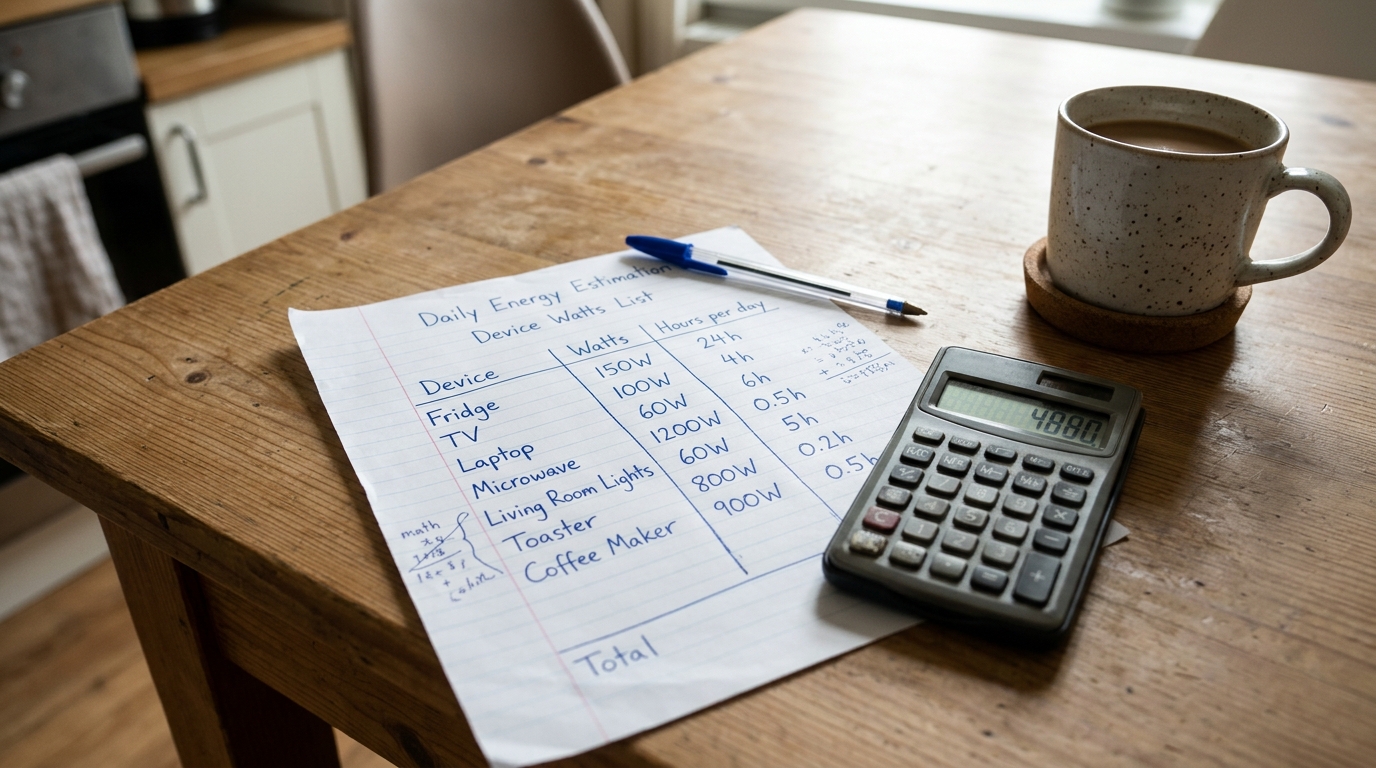
| A. Communication only | Router + modem (18W x 24h = 432Wh), phone charging (about 15Wh) | about 447Wh |
| B. Medical + communication | Adds a CPAP at about 60W for 8 hours (480Wh) | about 927Wh |
| C. Comfort | Adds a laptop at about 40W for 8 hours (320Wh) and LED lights (about 40Wh) | about 1,287Wh |
| D. Full household | Adds a full-size fridge at about 1.5 kWh per day (1,500Wh) | about 2,787Wh |
These use the figures from our guides: router and modem at about 18W, a CPAP at a moderate 60W, and a fridge at 1 to 2 kWh a day.
Your laptop may draw more; our home office guide uses higher figures for a laptop plus monitor. Check the wattage labels on your own devices, or measure them with a $20 plug-in meter.
The U.S. Department of Energy explains how to estimate appliance energy use.
Step 2: How Many Days Does Each Size Last?
Usable capacity is about 85% of the rated Wh. Values are days of coverage with no recharging:
| Station (rated) | Usable | Profile A | Profile B | Profile C | Profile D |
|---|---|---|---|---|---|
| 300Wh | about 255Wh | 0.6 | 0.3 | 0.2 | 0.1 |
| 500Wh | about 425Wh | 1.0 | 0.5 | 0.3 | 0.2 |
| 1,000Wh | about 850Wh | 1.9 | 0.9 | 0.7 | 0.3 |
| 1,500Wh | about 1,275Wh | 2.9 | 1.4 | 1.0 | 0.5 |
| 2,000Wh | about 1,700Wh | 3.8 | 1.8 | 1.3 | 0.6 |
| 3,000Wh | about 2,550Wh | 5.7 | 2.8 | 2.0 | 0.9 |
| 4,000Wh | about 3,400Wh | 7.6 | 3.7 | 2.6 | 1.2 |
What stands out:
- Wifi and phones (Profile A) need very little. A 500Wh unit gets you about a day, and 1,500Wh gets you almost three. Do not overspend.
- A CPAP (Profile B) is the real driver for medical users. A 1,000Wh unit gives under a day of the combined load; 3,000Wh covers nearly three.
- A fridge (Profile D) overwhelms everything. Even a 4,000Wh unit gives only about 1.2 days of the full profile. That is not a product flaw; a compressor running around the clock uses a lot of energy.
Why "3-Day Outage" Means a Recharge Plan, Not Just a Bigger Battery
To cover Profile D for three days on one charge, you would need about 9,840Wh rated, which is several of the largest portable units or a different kind of system.
That is why every sensible plan has three parts: a battery sized for your essentials, a way to recharge, and a plan for what you will not power.
Recharge options:
- Solar. A rough formula is panel watts x peak sun hours x 0.75 equals watt-hours per day. A 400W array at 5 sun hours returns about 1,500Wh a day, which nearly covers Profile B on its own. See our solar recharge-time chart, the more detailed 4,000Wh solar sizing guide, and our measured panel picks. Renters can read our balcony solar guide.
- Rationing. Run the fridge in blocks, not around the clock, while following the food-safety limits in our fridge guide.
- An expansion battery. Some stations accept add-on packs, which can cost less than jumping a size tier. See whether expansion batteries are worth it.
- A second small unit. Two 1,000Wh stations can be cheaper and more portable than one 2,000Wh unit, and give you redundancy.
- A generator, with real safety requirements. Our power station vs. generator guide compares cost, noise and safety.
Step 3: Check Output Power, Not Just Watt-Hours
Watt-hours tell you how long. Watts tell you what the station can run at once. Add up what you will run simultaneously:
- A fridge needs a surge of 2 to 5 times its running watts at startup.
- A microwave or kettle draws 1,000 to 1,800W.
- A window AC averages a few hundred watts but surges higher; see our window AC guide.
- A sump pump surges hard; see our sump pump guide.
A 1,000W-class unit handles most essentials but not heavy appliances together. For bigger loads, our 4,000Wh appliance chart shows what fits.
Step 4: Add a Safety Margin
Real life runs worse than a table. Add 20 to 30% to your daily energy for:
- Battery aging and cold weather. Do not charge lithium batteries below 32°F; see our cold-weather guide.
- Doors opened more than you planned.
- Charging extra devices.
- Inverter idle draw. Larger inverters can draw 15 to 18W by being on, according to a reviewer's measurement of the DELTA Pro 3.
With a 25% margin, Profile B needs about 1,160Wh per day, or about 1,365Wh rated.
Choosing Between Sizes
| Size | Good for | Skip if |
|---|---|---|
| 300-500Wh | Wifi, phones, lights, one night of low-draw CPAP | You need a fridge or multiple nights of CPAP |
| 1,000-1,500Wh | CPAP and wifi for 1-2 nights; fridge for about a day | You need multi-day coverage with no solar |
| 2,000-3,000Wh | Profile B or C for 2-3 days; fridge for part of the time | You want to run heavy appliances |
| 4,000Wh+ | Essentials for 1-2 days, solar-friendly setups | You only need wifi and phones |
For model picks, see our under-$500 list, our C1000X review, and the DELTA Pro 3 and F3800 reviews for the largest class.
A Worked Example: Sizing for a Real Household
Take a two-person apartment with a router and modem, a CPAP for one person, a laptop for four hours a day, a few lights and phones.
That is Profile C, about 1,287Wh a day. Add a 25% margin and the planning number becomes about 1,610Wh a day, or about 1,890Wh rated. For one day, a 2,000Wh station fits.
For three days with no solar, you would need about 5,700Wh rated, which is more than most people want to buy. So the household has three realistic paths: buy a 2,000Wh station and recharge it with a 400W panel returning roughly 1,500Wh a day in decent sun, cut the laptop and lights to reduce the daily figure to about 930Wh, or accept that the third day is a low-power day with only the CPAP and phones.
Running these three options through a calculator takes ten minutes and is worth far more than comparing spec sheets.
What About Medical Needs?
If anyone in the household depends on powered medical equipment, size for that first and add everything else second. A CPAP is modest, but an oxygen concentrator draws several times more, and refrigerated medication has its own temperature limits.
Talk to your equipment supplier and prescriber about backup plans, and do not rely on a single battery you have not tested. Our guides on oxygen concentrator backup and keeping medication cold explain the numbers and the cautions.
Seasonal Adjustments
- Winter storms: battery capacity drops in the cold, heating draws are huge, and solar days are short. Plan for less. See our winter storm prep guide.
- Hurricanes: outages can last days and roads close. See our hurricane season checklist.
- Summer heat: cooling is the heaviest load. Cool one room, not a house, as we explain in our central air guide.
- Apartments: see our renter outage checklist.
For general guidance on preparing, Ready.gov's power outage page is a good starting point.
Common Sizing Mistakes
- Trusting the box number. The usable figure is about 15% lower.
- Sizing for appliances you will not run.
- Ignoring surge.
- Skipping the recharge plan.
- Buying before measuring. A meter costs $20 and replaces guesses with data.
- Putting a medical device on a battery you have never tested overnight.
FAQ
What size power station do I need for a 3-day outage?
About 1,600Wh for wifi and phones, about 3,300Wh with a CPAP, and nearly 10,000Wh with a fridge, unless you recharge with solar or ration.
What size do I need for a CPAP?
About 1,100Wh covers one night plus other basics. See the CPAP runtime guide.
Is 1,000Wh enough?
For wifi, phones and a CPAP for a night or two, yes. For a fridge for multiple days, no.
How do I calculate it myself?
Add each device's watts times hours per day, divide by 0.85, then add a 25% margin.
Should I buy one big station or two small ones?
Two small units add redundancy and are easier to move. One big unit handles larger surges.
The Bottom Line
There is no single right size, only the right size for what you protect and how you recharge. Start with your daily energy, divide by 0.85, add a margin, and then decide how you will recharge. A small battery plus solar often beats a huge battery alone.
Figures are estimates based on typical equipment and an 85% usable-capacity assumption. Verify your devices' wattage and your station's specifications.